Topics

Explore critical topics shaping today’s SAP landscape—from digital transformation and cloud migration to cybersecurity and business intelligence. Each topic is curated to provide in-depth insights, best practices, and the latest trends that help SAP professionals lead with confidence.

Regions

Discover how SAP strategies and implementations vary across global markets. Our regional content brings localized insights, regulations, and case studies to help you navigate the unique demands of your geography.

Industries

Get industry-specific insights into how SAP is transforming sectors like manufacturing, retail, energy, and healthcare. From supply chain optimization to real-time analytics, discover what’s working in your vertical.

Hot Topics

Dive into the most talked-about themes shaping the SAP ecosystem right now. From cross-industry innovations to region-spanning initiatives, explore curated collections that spotlight what’s trending and driving transformation across the SAP community.

Topics

Explore critical topics shaping today’s SAP landscape—from digital transformation and cloud migration to cybersecurity and business intelligence. Each topic is curated to provide in-depth insights, best practices, and the latest trends that help SAP professionals lead with confidence.

Regions

Discover how SAP strategies and implementations vary across global markets. Our regional content brings localized insights, regulations, and case studies to help you navigate the unique demands of your geography.

Hot Topics

Dive into the most talked-about themes shaping the SAP ecosystem right now. From cross-industry innovations to region-spanning initiatives, explore curated collections that spotlight what’s trending and driving transformation across the SAP community.

SAP Supply Chain Planning

SAP Supply Chain Planning: From Operational Tool to Strategic Enabler

SAP Supply Chain Planning (SCP) encompasses the forward-looking processes organizations use to coordinate assets and optimize the delivery of goods, services and information from suppliers to consumers. Delivered primarily through SAP Integrated Business Planning (IBP), SAP SCP connects supply, demand, finance and operations into a unified, cloud-based planning framework. According to SAPinsider benchmark research, supply chain planning has evolved from a tool for running operations into a capability for building business agility and resiliency. Vendor partners include SAP, Reveal and GIB. Explore the latest SAPinsider content on SAP Supply Chain Planning below.

What Is SAP Supply Chain Planning?

SAP Supply Chain Planning is a forward-looking process for coordinating assets to optimize the delivery of goods, services and information from suppliers to consumers. SAP IBP — powered by SAP S/4HANA in-memory technology — provides cloud-based planning capabilities that align supply, demand, finance and operations. Key integration elements include strategy outcomes, cash flow, costs and revenues. Benefits include optimized logistics, improved cross-functional collaboration, planning agility, risk mitigation and improved forecast accuracy. SAP IBP supports what-if scenario modeling and real-time demand commitments, enabling fact-based decisions across the enterprise.

What Use Cases Are Referenced?

Bristlecone Targeting Acquisitions, AI Investments to Scale SAP Supply Chain

Bristlecone, a 27-year SAP supply chain partner owned by Mahindra Group, reported 30% revenue growth in the past year and is tripling its consulting capacity as it pivots toward acquisitions and product-led revenue. Its Trace.ai platform aggregates data from 350 global carriers — overlaying weather, geopolitical risk and port disruption signals — and helped one U.S. beverage company cut $100 million in supply chain costs.

AI Tightens SAP Supply Chain, MRO Integration

SAP’s Q1 2026 Business AI release embeds explainable AI assistants directly into SAP IBP. Planners using the MRO inventory analysis feature cut analysis time for inventory runs by 30%. AI-generated IBP workbook formulas improve individual efficiency by 10%, and security configuration AI delivers a 27% increase in compliance with hardening guidelines.

BSH Uses SAP Business Network Global Track and Trace to Build Real-Time Logistics Visibility

BSH Hausgeräte — a global home appliance manufacturer operating in more than 50 countries — is replacing static ETA models by integrating live shipment data from more than 500 logistics providers into SAP Business Network Global Track and Trace. The initiative creates a digital twin of BSH’s transport network, enabling continuous shipment visibility and dynamic ETAs across sea, road and rail.

Aligning Supply Chain Investments with Measurable Value, Automation

92% of supply chain leaders report technology investments haven’t fully delivered expected results, with integration complexity and data issues as the primary culprits. Poor data quality costs organizations an average of $12.9 million annually, while connected environments resolve exceptions up to 40% faster — underscoring why a strategy-first, data-integrity approach must precede automation investment.

Improving Supply Chain Resilience in 2026 with AI, Sustainability

SAP is positioning agentic AI and sustainability as prerequisites for supply chain resilience in 2026. Customers piloting AI agents are seeing supplier onboarding times cut by up to 50%, unplanned downtime reduced by about 30% through predictive maintenance, and lead times shortened by roughly 25% when AI agents automatically shift critical inventory during disruptions.

What SAPinsider Research Supports This Topic?

Supply Chain Planning in the Cloud Benchmark Research

Surveying 106 SAPinsider community members, this benchmark report found that supply chain planning is becoming a strategic solution — not just an operational tool. Many SAPinsiders report that on-premise planning solutions no longer align with digital-era requirements, and cloud computing is seen as a critical enabler of enhanced planning agility and resiliency.

ERP Migration and Transformation 2026

Based on 296 SAPinsider members surveyed, 82% require integrations between core ERP and line-of-business applications — a threshold directly relevant to SAP SCP’s cross-functional architecture. 43% of supply chain teams are involved in ERP migration decisions, underscoring planning’s role in transformation strategy.

Technology Leaders’ Strategic Agenda for 2026

This SAPinsider report found that 70% of technology leaders cite operational efficiency and cost reduction as their top priority, while 32% plan to enhance supply chain resilience and 35% plan AI for supply chain planning and optimization in 2026 — priorities that align directly with SAP IBP’s cloud planning and AI roadmap.

See Latest Related Content Below

SAP Warehouse Management
Safety Stock Planning – Part 3: SAP Add-on Simulation of Safety Stock, Calculating & Simulating Safety StockSAP offers consulting solutions to enable the first step in demand-driven planning, the strategic inventory positioning. For this you can use the consulting solution MRP Monitor to detect which of your materials should be buffered.
Supply Chain’s Essential Role in Automotive Start-UpsWhen INEOS Automotive was founded in 2017 as a new automotive manufacturer, it faced a unique challenge. It aimed to start production of a new vehicle in just four years, which meant it needed to establish end-to-end supply chain processes, including information and material flows, as efficiently as possible.
SAPinsider Buyers Guide Supply Chain
Workforce Shortages in Supply Chain and Logistics: A Call to Action for SAP UsersA study by Descartes Systems Group reveals a severe workforce shortage in the supply chain and logistics industry, impacting operations, finances, and customer service. A significant 76% of leaders reported workforce shortages, with 37% describing the issue as high to extreme. Particularly, transportation and warehouse functions are the most affected. Additionally, there is a notable difficulty in hiring knowledge workers necessary for today's technology-dependent supply chain operations. For SAP users, addressing these challenges is crucial. They need to leverage SAP's HR and workforce planning modules to enhance recruitment, training, and retention strategies, aligning workforce management with business demands. This approach can help mitigate the adverse effects of workforce shortages by utilizing technology to streamline and optimize workforce capabilities in the supply chain and logistics sectors.
End-to-End Supply Chain
Unifying Data Sources for Accurate Near-Term Demand Forecasting with Google CloudIn the domain of demand planning within SAP systems, there is a growing recognition of the need to incorporate external data sources alongside traditional internal ones. This approach is encouraged by Google Cloud’s "Better Together" partnership with SAP, which promotes integrating external datasets, such as real-time weather updates and marketing trends, with SAP’s internal data. This integration helps organizations capture a fuller picture of the factors influencing demand, such as external events and consumer behavior shifts. The use of Cortex Demand Sensing within this framework provides organizations with tools like impact alerts, which notify of forecast anomalies driven by factors like unexpected weather or promotional activities. Further, integration with Google Cloud tools such as BigQuery, Vertex AI, and Looker enriches data analysis, enabling the identification of key demand drivers and enhancing predictive model accuracy. This holistic data approach aids in optimizing various business aspects, including promotions, inventory control, and demand-supply balance, ultimately leading to better demand forecasting accuracy.
End-to-End Supply Chain
Purpose-built “Powered” Supply Chains with KPMGWhen embarking on supply chain transformation, organizations often look for results while minimizing risk, along with streamlined and compliant technology. From supply chain initiatives focused on customer experience metrics, responding to a supply continuity issue to product movements, organizations often need a guided process with supply chain assets and accelerators to jump start their supply chain transformation. To enable organizations to transform their business functions, KPMG firms have designed a suite of proprietary tools and methodologies known as Powered Enterprise. This methodology encompasses multiple dimensions. Primarily, it functions as an implementation methodology, addressing diverse facets and the complete process taxonomy crucial for standard business operations. While it does not encompass every aspect, it furnishes a diagnostic overview and scrutinizes specific areas such as SAP implementations and supply chain applications.
Supply Chain GRC: Gain Control of Your Supply Chain ProcessesMost companies want to grow their business as fast as possible, but they need stay in control of their supply chain process and avoid unnecessary risks. By implementing a Governance, Risk and Compliance (GRC) system, organizations can monitor processes and ensure they are defined, managed, planned, and executed correctly. Recent SAPinsider benchmark research points to the volatility of supply chain process as a core driver impacting GRC strategy and investment among SAP organizations.
ifm Supply Chain for Planning and Execution TransformationExtending the core ERP capabilities with additional solution functionality can be approached in two ways, namely "add-on" and "add-in" solutions. When it comes to add-on solutions, integration of data, people, and processes is required, which can be a costly and time-consuming process. On the other hand, add-in solutions are natively embedded in the ERP system, eliminating the need for extensive integration efforts. This technology brief will explore ifm Supply Chain, an SAP partner for over 25 years, whose supply chain solutions are natively integrated and deployed into the SAP ecosystem. Originally founded in Germany in 1992, the company's GIB software offers an integrated approach to streamlining demand planning, production scheduling, procurement processes, and inventory control. The company’s solutions deliver superior efficiency by eliminating the need for costly and time-consuming integration efforts.
Creating Value Through End-to-End Supply Chain PlanningIncreasing supply chain complexity, coupled with rapidly evolving customer demand, has given rise to a set of challenges supply chain leaders have not encountered before. What extenuates these challenges for many organizations is the siloed approach to planning and tackling supply chain challenges.
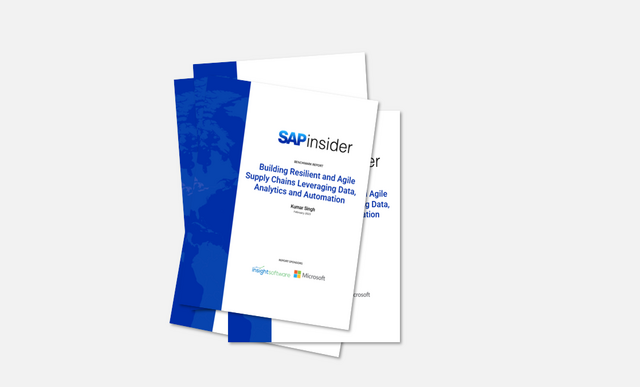
Webinar: Building Resilient and Agile Supply Chains Leveraging Data, Analytics and AutomationSupply chain challenges and associated risks are growing exponentially. These challenges surface in many forms, like unprecedented fluctuations in demand and supply, sudden disruptions impacting sourcing, manufacturing, and distribution, a proliferation of product offerings, and geopolitical and regulatory changes. These challenges have only intensified during the pandemic. As businesses evolve their supply chains to address the Volatile, uncertain, complex, and ambiguous (VUCA) business environments in which they operate today, they add to the complexities that already exist in their supply chains. These challenges have accelerated supply chain digital transformation initiatives across industries. Data, analytics, and automation tools play a crucial role in the digital transformation tool chest. We hypothesized that SAPinsiders are keen to leverage data, analytics, and automation tools to build resilient and agile supply chains to address operating uncertainties. To validate this hypothesis, SAPinsider surveyed businesses and supply chain professionals within the SAPinsider community on inventory management and optimization aspects from November 2022 to February 2023.
Generative AI
Generative AI for Supply Chain Data ManagementThe frenzy around ChatGPT has stabilized for the millions of experimental end-users. However, the game has just begun for the technology giants who will now be competing in this space. The generative AI space will be highly competitive, but the competition will come from something other than product differentiation. Whether it is ChatGPT, BARD, or Einstein GPT in the generative AI model SAP plans to introduce, the value of these tools will lie in the solutions they can help create. While users’ interactions with ChatGPT were fun, it means that these tools will be easy to interact with. From the provider’s perspective, the value comes from monetization. And that monetization comes from leveraging these tools to build business and industry solutions. The pace at which multiple generative AI solutions have been launched in the last few months validates the point that every technology is destined to become a commodity eventually. Uses of generative AI are plenty, and the technology can be leveraged for many business operations. This resonates with the findings of SAPinsider’s recently published research, "Building Resilient and Agile Supply Chains Leveraging Data, Analytics and Automation," which focuses on how tools, data analytics, and automation can help transform supply chain operations. Generative AI can help across all these pillars. This article focuses on the data pillar and provides a high-level view of how generative AI can help organizations transform their supply chain data .

Related Vendors