Sep 1, 2026
•5 minute read
SAP Systems Administration has never been more demanding. Administrators responsible for performance, reliability, and security across SAP environments now manage hybrid landscapes spanning on-premise systems, private cloud, and public cloud deployments simultaneously. They coordinate migrations to SAP S/4HANA, manage change and release cycles, govern security patching, and maintain business continuity plans, all while keeping pace with an accelerating schedule of SAP updates. The rise of AIOps and intelligent automation is reshaping what administrators can accomplish and raising expectations for what operational excellence looks like.
SAP Systems Administration is the practice of ensuring SAP application environments operate at peak performance, availability, and security across complex, multi-tier landscapes. Administrators manage system monitoring, capacity planning, change request management, disaster recovery, and security patch governance. As SAP landscapes expand to include cloud deployments, hybrid architectures, and integrations with non-SAP systems, administrators increasingly rely on automation platforms, AIOps tools, and cross-system observability solutions to maintain end-to-end visibility, prevent incidents before they occur, and support continuous delivery of critical business services at scale.
SAP Systems Administration has never been more demanding. Administrators responsible for performance, reliability, and security across SAP environments now manage hybrid landscapes spanning on-premise systems, private cloud, and public cloud deployments simultaneously. They coordinate migrations to SAP S/4HANA, manage change and release cycles, govern security patching, and maintain business continuity plans, all while keeping pace with an accelerating schedule of SAP updates. The rise of AIOps and intelligent automation is reshaping what administrators can accomplish and raising expectations for what operational excellence looks like.
SAP Systems Administration is the practice of ensuring SAP application environments operate at peak performance, availability, and security across complex, multi-tier landscapes. Administrators manage system monitoring, capacity planning, change request management, disaster recovery, and security patch governance. As SAP landscapes expand to include cloud deployments, hybrid architectures, and integrations with non-SAP systems, administrators increasingly rely on automation platforms, AIOps tools, and cross-system observability solutions to maintain end-to-end visibility, prevent incidents before they occur, and support continuous delivery of critical business services at scale.
Nagarro: 99.995% SAP Availability Across Hundreds of Hybrid Instances
Nagarro implemented Avantra’s intelligent automation platform across hundreds of SAP ECC and SAP S/4HANA systems in hybrid environments. System availability reached 99.995%, system refresh windows dropped from days to overnight, and 1,000-plus custom monitoring checks were deployed. SAPinsider covered the operational transformation.
Gordon Food Service: 330 Hours Saved Monthly Through SAP Operations Automation
Gordon Food Service deployed Avantra’s AIOps platform to automate SAP monitoring, daily checks, and system operations tasks. Results included 330 hours saved monthly, nearly $200,000 in annual savings, and a 25% reduction in operational costs. SAPinsider reported the results.
SoftwareONE and Splunk: Cross-Landscape Visibility During SAP Cloud Migration
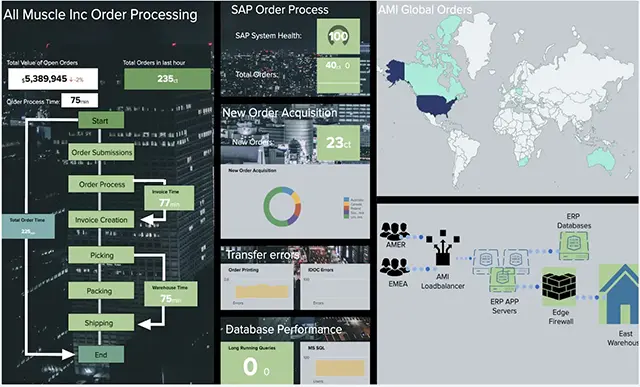
SoftwareONE and Splunk jointly created PowerConnect for SAP, correlating data across load balancers, middleware, firewalls, and cloud metrics to deliver end-to-end business process visibility across SAP and non-SAP systems. The platform helps organizations prevent disruptions during cloud migration and hybrid-landscape operations. SAPinsider covered the solution.
IT-Conductor: Full-Stack SAP Monitoring and Orchestration Across Hybrid Environments
IT-Conductor’s SaaS platform provides full-stack monitoring, event-driven orchestration, and cloud migration support for SAP landscapes. Integrating with Ansible, Terraform, and Azure API, it gives administrators centralized control across distributed environments without requiring monitoring infrastructure beyond a locally installed gateway. SAPinsider covered the platform.
CRIS Benchmarking Reveals Persistent SAP Security Maturity Gaps
CRIS benchmarking data found SAP security maturity remains uneven, with persistent gaps in access controls, data protection, and governance controls. Unpatched systems and credential-based threats top the risk categories for most organizations, underscoring the ongoing role of systems administrators in security posture management. SAPinsider reported the findings.
Technology Leaders: Strategic Agenda for 2026
SAPinsider benchmark research found 70% of technology leaders identify operational efficiency and cost reduction as their top 2026 priority. The report also flags the critical danger of deprioritizing cybersecurity during rapid ERP transformations, a direct systems administration concern as organizations manage parallel SAP landscapes and accelerating migration timelines.
ERP Migration and Transformation 2026
With 55% of organizations having deployed SAP S/4HANA and 34% fully transitioned, complex parallel landscapes are now the norm rather than the exception. SAPinsider research shows larger organizations running multiple ERP instances simultaneously, placing sustained operational and administrative pressure on systems administration teams managing hybrid environments ahead of the 2027 deadline.
Cybersecurity Threats and Challenges to SAP Systems 2025
SAPinsider research found 23% of organizations experienced a credential compromise, malware, or ransomware attack affecting their SAP environment in the past year. Unpatched systems remain the top cybersecurity threat, with keeping up with SAP security notes, patches, and updates cited as the biggest operational challenge in securing SAP landscapes.













Your request has been successfully sent