Jul 22, 2026
•3 minute read
SAP digital twin technology creates virtual models of physical products, processes and services that combine business data, contextual data and sensor data to deliver real-time diagnostics, predictive insights and operational intelligence. As Industry 4.0 technologies — artificial intelligence, the Internet of Things and big data — converge, digital twins are evolving from visualization tools into operational decision engines embedded directly in SAP system landscapes. SAPinsider research shows 70% of technology leaders cite increasing operational efficiency and reducing costs as their top priority in 2026. This page covers the use cases, research and tools SAP practitioners need.
A digital twin is a virtual model of a physical product, process or service in which sensors using Industry 4.0 technologies — artificial intelligence, the Internet of Things and big data — provide real-time conditions, diagnostics and predictions through data analysis. According to Richard Howells, SAP Supply Chain, Digital Economy and IoT thought leader, the virtual representation combines three types of information: business data, contextual data and sensor data. SAP digital twin capabilities include predictive maintenance, cost reduction, improved efficiencies and faster innovation, with SAP IoT on SAP BTP serving as the core platform alongside hyperscaler offerings from Microsoft and AWS.
SAP, Accenture and Vodafone Pilot Humanoid Robotics Integrated With SAP EWM in Warehouse Operations
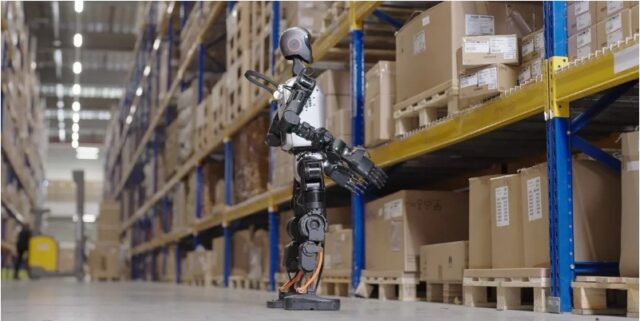
SAP, Accenture and Vodafone Procure & Connect are piloting humanoid robots trained in digital twins and integrated with SAP Extended Warehouse Management to automate inspections, flag safety risks and validate inventory in real time. The pilot, running live in Duisburg, Germany, demonstrates how physical AI closes the gap between supply chain planning and execution by feeding robot insights directly into SAP environments.
SAP Business AI and Uhlmann Drive Manufacturing Resilience
At Hannover Messe 2026, SAP and Uhlmann unveiled PacXplorer, a packaging machine integrating digital twins, condition monitoring and SAP Business AI within the Factory-X data ecosystem. The deployment automates the complete spare parts service workflow and demonstrates how connecting digital twins to live SAP operational data transforms them from visualization tools into resilience-enabling decision engines.
BSH Uses SAP Business Network Global Track and Trace to Build Real-Time Logistics Visibility
BSH Hausgeräte built a digital twin of its transport network using SAP Business Network Global Track and Trace, integrating data from more than 500 logistics providers across more than 50 countries. External ETA signals for ocean, road and rail freight are reconciled in real time with internal planning data and written back into ERP delivery documents, replacing static transit time models.
LESER Deploys SAP BNAC Digital Twins to Boost Safety, Compliance, and Efficiency
LESER GmbH, one of Europe’s largest industrial safety valve manufacturers, deployed SAP Business Network Asset Collaboration digital twin technology to create precise digital models for both new and existing valves. The implementation achieved up to 95% cost savings on initial data recording activities and established a single source of truth for asset data shared with customers and service partners.
Building the Digital Twin Stack
SAPinsider Research Director Kumar Singh explains how a manufacturing execution system serves as the orchestrator in the digital twin architecture, enabling the “create” and “communicate” aspects of a digital twin. The article outlines how SAP technology ecosystems — including SAP IoT on SAP BTP — provide the foundation to build a robust digital twin stack for resilient, agile and optimized manufacturing operations.
Building Intelligent Enterprise With AI, ML and IoT
SAPinsider research with SUSE and Fujitsu found that 55.7 billion connected devices are projected worldwide, with 75% connected to an IoT platform, generating an estimated 73.1 zettabytes of data. A significant portion derives from industrial IoT applications, underscoring the data foundation digital twins require to deliver predictive value in manufacturing and supply chain environments.
Supply Chain Planning in the Cloud Benchmark Research
Based on a survey of 106 SAPinsider community members, this benchmark report found that supply chain planning capabilities have evolved into strategic enablers of business agility and resilience. Digital twin capability was consistently highlighted by SAPinsider members as key to building resilient, agile and optimized manufacturing capability within their SAP technology roadmaps.
Technology Leaders’ Strategic Agenda for 2026
The SAPinsider Technology Leaders’ Strategic Agenda for 2026 report found that 70% of respondents cite increasing operational efficiency and reducing costs as their top priority, while 40% plan to deploy predictive analytics and forecasting and 33% plan AI for supply chain planning and optimization, reinforcing the strategic urgency of digital twin deployments in 2026 SAP roadmaps.












Your request has been successfully sent