Topics

Explore critical topics shaping today’s SAP landscape—from digital transformation and cloud migration to cybersecurity and business intelligence. Each topic is curated to provide in-depth insights, best practices, and the latest trends that help SAP professionals lead with confidence.

Regions

Discover how SAP strategies and implementations vary across global markets. Our regional content brings localized insights, regulations, and case studies to help you navigate the unique demands of your geography.

Industries

Get industry-specific insights into how SAP is transforming sectors like manufacturing, retail, energy, and healthcare. From supply chain optimization to real-time analytics, discover what’s working in your vertical.

Hot Topics

Dive into the most talked-about themes shaping the SAP ecosystem right now. From cross-industry innovations to region-spanning initiatives, explore curated collections that spotlight what’s trending and driving transformation across the SAP community.

Topics

Explore critical topics shaping today’s SAP landscape—from digital transformation and cloud migration to cybersecurity and business intelligence. Each topic is curated to provide in-depth insights, best practices, and the latest trends that help SAP professionals lead with confidence.

Regions

Discover how SAP strategies and implementations vary across global markets. Our regional content brings localized insights, regulations, and case studies to help you navigate the unique demands of your geography.

Hot Topics

Dive into the most talked-about themes shaping the SAP ecosystem right now. From cross-industry innovations to region-spanning initiatives, explore curated collections that spotlight what’s trending and driving transformation across the SAP community.

SAP Global Tax Management

SAP Global Tax Management: An Overview and Key Considerations

SAP Global Tax Management refers to the suite of SAP capabilities that enable organizations to manage indirect tax, direct tax, withholding tax, and digital reporting compliance across multiple jurisdictions from within SAP ERP and SAP S/4HANA. As tax authorities worldwide accelerate digital transformation mandates — including e-invoicing, real-time reporting, and continuous transaction controls — SAP Global Tax Management has become a core operational requirement, not just a compliance function.

Key solutions within the SAP Global Tax Management ecosystem include SAP Document and Reporting Compliance, SAP Business Network (for e-invoicing), and SAP S/4HANA’s native tax determination engine, alongside certified partner integrations for extended tax functionality.

Key capabilities of SAP Global Tax Management include:

  • Indirect tax determination integrated into SAP S/4HANA procure-to-pay and order-to-cash processes
  • SAP Document and Reporting Compliance for statutory and digital tax reporting across 80+ countries
  • E-invoicing compliance via SAP Business Network with localization support for 41+ countries
  • Withholding tax management and direct tax ledger support in parallel ledgers
  • SAP Statutory Reporting for country-specific digital submissions and standard audit files (SAF-T)
  • Integration with external tax engines (Vertex, Sovos, Avalara) to handle complex indirect tax scenarios
  • Real-time and near-real-time reporting capabilities to meet continuous transaction control (CTC) mandates

Key considerations for SAPinsiders:

  • Treat tax as a real-time operational dependency — In 2025, indirect tax shifted from a downstream compliance task to an upstream operational requirement; tax accuracy now affects whether invoices can be issued and payments released within SAP workflows
  • Assess e-invoicing mandate coverage — E-invoicing mandates are expanding globally; verify that SAP Document and Reporting Compliance or SAP Business Network covers all jurisdictions where your organization operates, and plan for mandates coming into effect in 2026 and beyond
  • Evaluate third-party tax engines for complex scenarios — SAP’s native tax determination handles standard cases, but multinational organizations with complex indirect tax requirements should evaluate certified partners like Vertex, Sovos, or Avalara to extend coverage
  • Align with SAP’s clean core architecture — Tax engine integrations should be implemented via SAP BTP to preserve clean core compliance and avoid modification risk during S/4HANA upgrades
  • Plan for IFRS 18 and regulatory changes — New global accounting standards and expanding digital reporting mandates require ongoing SAP tax configuration reviews and solution updates across the tax stack

Frequently Asked Questions: SAP Global Tax Management

What is SAP Global Tax Management?

SAP Global Tax Management is the suite of SAP capabilities that enables organizations to manage indirect tax, direct tax, withholding tax, and digital reporting compliance across multiple jurisdictions from within SAP ERP and SAP S/4HANA.

What are the key components of SAP Global Tax Management?

Key components include SAP Document and Reporting Compliance for statutory and digital tax reporting in 80+ countries, SAP Business Network for e-invoicing compliance with localization support for 41+ countries, withholding tax management, SAP Statutory Reporting, and integration with external tax engines such as Vertex, Sovos, and Avalara.

How does SAP support e-invoicing compliance?

SAP Business Network provides e-invoicing compliance with localization support, enabling organizations to meet continuous transaction control (CTC) mandates and real-time reporting requirements from tax authorities worldwide.

Can SAP Global Tax Management integrate with third-party tax engines?

Yes, SAP’s tax framework supports integration with certified third-party tax engines like Vertex, Sovos, and Avalara, which is particularly useful for multinational organizations with complex indirect tax requirements that go beyond SAP’s native tax determination capabilities.

What should organizations consider when planning their SAP tax strategy?

Organizations should assess e-invoicing mandate coverage across all jurisdictions, evaluate whether third-party tax engines are needed for complex scenarios, align tax engine integrations with SAP’s clean core architecture using SAP BTP, and plan for ongoing regulatory changes including IFRS 18 and expanding digital reporting mandates.
Research Shows Property Tax Compliance Costs Six Figures Annually for Most Large EnterprisesAvalara’s research finds that large enterprises face six-figure annual property tax compliance costs, heavy manual workloads, frequent audits and widespread penalties or missed savings, making ERP-integrated automation an urgent priority to reduce risk and improve strategic decision-making.
From SAP Transactions to Tax Intelligence: How AI Is Redefining Compliance for SAP ShopsSAP runs the transactions that power your business. But who is processing your tax compliance data? Most SAP-run enterprises are sitting on a goldmine of tax and transaction data, yet tax teams are still making manual corrections before every filing, reconciling across disconnected systems, and identifying audit exposure after the fact. As tax requirements become […]
Brazil’s Tax Reform: Building a Resilient SAP-Centered Tax Compliance ArchitectureBrazil's tax reform is already underway—and it is not only redefining compliance, it is reshaping how companies operate at scale. As new mandates, electronic document types, and dual-system tax models take effect, organizations are rethinking the role of technology in managing tax determination, transaction reporting, and operational resilience. In this on-demand session, Sovos experts Antonio Garcia and Helton Arsenio, hosted by SAPinsider's Sean Byers, examined how leading companies operating in Brazil are adapting their architectures to thrive in this new environment. Through three real-world customer cases, they explored how global enterprises are modernizing tax processes, externalizing tax logic from SAP, and building scalable platforms to absorb constant regulatory change. The session detailed how organizations handling millions of transactions per month are preparing their SAP landscapes to support Brazil's new CBS and IBS tax framework—without compromising operational performance. Cases covered included a major Brazilian retailer operating across all 27 states requiring centralized, SAP-certified tax determination; a major airline managing millions of electronic tickets (BPE) with complex cancellation and rebooking workflows; and a global telecom company processing hundreds of documents per second across legacy systems inherited through acquisitions. Each case revealed how companies are turning regulatory pressure into an opportunity to modernize core systems and eliminate reliance on manual, spreadsheet-based processes. Viewers will come away with: - An understanding of Brazil's dual-system transition period (running through 2033), during which companies must manage legacy and new tax regimes simultaneously - Why 2026 is the critical year for alignment and testing—and why 2027 marks the beginning of real government validation and enforcement - How new electronic document formats (NFCom for telecom, BPE for airlines) and dramatically expanded XML invoice data requirements demand tighter master data governance - How the government's move to transaction-by-transaction, item-by-item real-time control—including "assisted calculation"—makes dispute readiness essential - Strategies for connecting SAP to certified tax engines without over-customizing existing systems - How Sovos Intelligence applies AI and business intelligence tools to enable natural language querying of tax data and proactive planning The organizations that will navigate Brazil's reform successfully are those treating tax technology not as a compliance cost, but as a foundation for scale, resilience, and competitive advantage. With 2026 already here and 2027 enforcement approaching, the window to build that foundation is narrow.
Abu Dhabi skyline representing the UAE’s digital tax transformation and upcoming e-invoicing mandate affecting SAP finance systems.
UAE E-Invoicing Mandate: What SAP Finance Teams Need to Know Before 2027The UAE will introduce mandatory e-invoicing beginning in 2027, requiring businesses to exchange structured invoice data through accredited service providers. For organizations running SAP, the mandate changes how invoice data moves through ERP systems and compliance layers.
Professional reviewing digital invoice interface on laptop and calculator, representing SAP mandated e-invoicing compliance and electronic tax reporting.
How SAP Supports Mandated E-Invoicing Compliance Across Global JurisdictionsMandated e-invoicing is reshaping invoice processing, regulatory reporting, and system architecture. This article explains how SAP Business Network and SAP Document and Reporting Compliance support clearance, reporting, and global mandate variation.
KPMG LLP corporate branding image associated with the Tax AI Accelerator Program and Digital Gateway GenAI platform for corporate tax departments.
KPMG Launches Tax AI Accelerator Program to Advance Generative AI in Corporate TaxThe KPMG Tax AI Accelerator combines structured AI training with Digital Gateway GenAI. This analysis explores its sandbox model, governance design, and architectural positioning.
DIY or Done-for-You? Rethinking Tax Compliance Strategy in SAPHow Tax Compliance Is Changing in SAP Tax compliance in SAP is no longer just an IT decision. It’s a strategic risk decision. As governments shift to real-time, transaction-level enforcement, SAP customers are being forced to rethink how tax compliance fits into their S/4HANA, Clean Core, and data governance strategies. Many organizations are evaluating ERP-native approaches, while others are expanding their capabilities to account for authority-led, end-to-end compliance models designed to keep pace with continuous mandates. Each path comes with tradeoffs in cost, risk, scalability, and long-term agility. In this session, Sovos tax and SAP experts explore how SAP customers should think about this decision, not from a product perspective, but from an enterprise architecture, risk, and operating model standpoint. You’ll learn: - Why tax compliance is shifting from an internal ERP function to an externally enforced, authority-led model - What SAP customers should consider when using ERP-native tools for digital reporting and mandates, and what capabilities to enhance and complement those tools - The hidden complexity behind e-invoicing, SAF-T, and continuous transaction controls - How Clean Core principles intersect with tax data, controls, and audit exposure - Key questions IT, Finance, and Tax leaders should be asking before choosing a compliance path - How today’s compliance decisions can impact transformation risk for years to come This session is designed for IT and ERP leaders, Finance and Tax executives, SAP CoE and Clean Core program owners, and enterprise architects responsible for compliance strategy, and is especially relevant for organizations preparing for the 2026–2027 regulatory expansion or actively navigating an S/4HANA
SAPinsider Research Webinar: Tax Technology in SAP EnvironmentsTax and finance leaders running SAP are moving from fragmented, spreadsheet‑driven tax activities to integrated, AI‑enabled tax operations that are tightly aligned with SAP S/4HANA roadmaps and global compliance demands. By standardizing on end‑to‑end tax automation, central data governance, and embedded tax engines, leading organizations are decoupling tax logic from SAP core systems, improving audit readiness, and creating scalable tax platforms that can keep up with rapid regulatory change.​ In this SAPinsider webinar session, learn how benchmark leaders are architecting tax technology across SAP ECC, SAP S/4HANA, SAP BTP, and key third‑party solutions to support direct and indirect tax, e‑invoicing, and global reporting without over‑customizing SAP. The speakers walk through concrete SAP scenarios showing how intelligent mapping, AI‑driven anomaly detection, and cloud‑based tax engines are being used to maintain clean tax data, automate calculations and filings, and provide real‑time visibility to tax, finance, and IT stakeholders.​ Watch this webinar to: - Discover how an end‑to‑end tax automation layer can accelerate SAP S/4HANA projects by isolating tax rules and compliance logic from the SAP core, reducing upgrade risk, technical debt, and manual work.​ - See practical, SAP‑centric use cases where integrated tax workflows, AI, and analytics improve user experience, shorten close cycles, and strengthen compliance across regions facing diverse e‑invoicing, ESG, and indirect tax requirements. - Learn lessons from SAPinsider’s 2025 benchmark on how peers are funding tax technology, managing integration challenges, closing skills gaps, and using the DART model to prioritize next‑step investments in AI, data quality, and third‑party solutions like Avalara, Vertex, and others.​
Driving Tax Determination Excellence: How Hyundai Powers U.S. Sales Tax with Sovos + SAP S/4HANAWatch this webinar to discover how Hyundai: - Eliminated manual tax calculations across high-volume transactions - Handled tax determination in all U.S. jurisdictions with precision and speed - Achieved real-time compliance using Sovos’ certified SAP connectors and automated rule updates - Future-proofed tax operations with scalable architecture and regulatory monitoring This session is ideal for SAP finance, tax, and IT leaders seeking to modernize legacy tax engines, reduce audit risk, and align tax compliance with digital transformation initiatives.
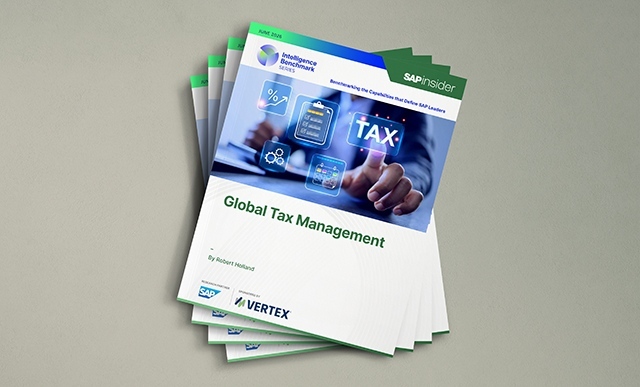
SAPinsider 2025 Benchmark Study: Tax Technology in SAP EnvironmentsThis year’s tax technology report highlights global AI and automation practices, including regional insights. Respondents throughout the year shaped this global view of tax technology and automation in SAP® environments. Tax and finance leaders in SAP environments are continuing digital transformation initiatives globally. Benchmarking against industry-wide global tax automation practices offer an opportunity to measure an organizations’ existing path and celebrate or take course correcting action where needed. Across the globe tax technology adoption (e.g., intelligent mapping, RPA, AI, and Machine Learning) is accelerating. This is good news. AI and automation adoption in tax is paramount to removing blockers that slow business value creation. Value creation today is dependent on high-performing ecosystems, a web in which tax plays a key role in ensuring an organization’s high performance. Fueled by unique challenges, automation and AI adoption priorities differ by region. Europe, Middle East, and Africa (EMEA) lead in adoption to address strategic transformation (63%) and ESG requirements. Asia Pacific, Australia, and New Zealand (APC & ANZ) are advancing integration and compliance capabilities (43%). North America (NA) and Latin America (LATAM) are using AI and automation to drive efficiency, and audit readiness. These differences highlight how important it is for tax automation and AI adoption paths to be regionally specific. Read the full report for details and more findings on AI and Automation in Tax including, approaches to tax process automation, tax technology innovation strategies, use of AI, ML, RPA, and intelligent mapping, and improvements experienced from adopting AI and automation

Related Vendors