Topics

Explore critical topics shaping today’s SAP landscape—from digital transformation and cloud migration to cybersecurity and business intelligence. Each topic is curated to provide in-depth insights, best practices, and the latest trends that help SAP professionals lead with confidence.

Regions

Discover how SAP strategies and implementations vary across global markets. Our regional content brings localized insights, regulations, and case studies to help you navigate the unique demands of your geography.

Industries

Get industry-specific insights into how SAP is transforming sectors like manufacturing, retail, energy, and healthcare. From supply chain optimization to real-time analytics, discover what’s working in your vertical.

Hot Topics

Dive into the most talked-about themes shaping the SAP ecosystem right now. From cross-industry innovations to region-spanning initiatives, explore curated collections that spotlight what’s trending and driving transformation across the SAP community.

Topics

Explore critical topics shaping today’s SAP landscape—from digital transformation and cloud migration to cybersecurity and business intelligence. Each topic is curated to provide in-depth insights, best practices, and the latest trends that help SAP professionals lead with confidence.

Regions

Discover how SAP strategies and implementations vary across global markets. Our regional content brings localized insights, regulations, and case studies to help you navigate the unique demands of your geography.

Hot Topics

Dive into the most talked-about themes shaping the SAP ecosystem right now. From cross-industry innovations to region-spanning initiatives, explore curated collections that spotlight what’s trending and driving transformation across the SAP community.

SAP CyberSecurity

SAP Cybersecurity focuses on protecting SAP applications, data, infrastructure, and integrations from digital threats across cloud, hybrid, and on-premise environments. It spans SAP S/4HANA, SAP HANA, SAP BTP, SAP NetWeaver, SAP Fiori, identity and access controls, threat detection, patching, privacy, and compliance. For SAP customers, cybersecurity connects IT, security, Basis, risk, audit, and business leaders around one goal: keeping mission-critical systems secure, resilient, and trusted.

What is SAP Cybersecurity?

SAP Cybersecurity is the practice of securing SAP systems, applications, users, custom code, data, and connected business processes from internal and external threats. It includes capabilities such as SAP Enterprise Threat Detection, SAP Focused Run, SAP Code Vulnerability Analyzer, data masking, privacy governance, key management, patch management, and access monitoring. Enterprises use SAP cybersecurity to reduce breach risk, protect sensitive business data, support compliance, and maintain operational continuity.

SAP Cybersecurity focuses on protecting SAP applications, data, infrastructure, and integrations from digital threats across cloud, hybrid, and on-premise environments. It spans SAP S/4HANA, SAP HANA, SAP BTP, SAP NetWeaver, SAP Fiori, identity and access controls, threat detection, patching, privacy, and compliance. For SAP customers, cybersecurity connects IT, security, Basis, risk, audit, and business leaders around one goal: keeping mission-critical systems secure, resilient, and trusted.

What is SAP Cybersecurity?

SAP Cybersecurity is the practice of securing SAP systems, applications, users, custom code, data, and connected business processes from internal and external threats. It includes capabilities such as SAP Enterprise Threat Detection, SAP Focused Run, SAP Code Vulnerability Analyzer, data masking, privacy governance, key management, patch management, and access monitoring. Enterprises use SAP cybersecurity to reduce breach risk, protect sensitive business data, support compliance, and maintain operational continuity.

How do enterprises use SAP Cybersecurity?

Protecting Sensitive SAP Data

Enterprises use SAP cybersecurity to protect financial, customer, supplier, employee, and operational data inside SAP systems. Controls such as data masking, access logging, encryption, and privacy governance help limit exposure while supporting audit, compliance, and business-user access needs.

Monitoring Threats Across SAP Landscapes

Security teams use SAP-specific monitoring to detect suspicious activity across SAP applications, databases, users, and integrations. Tools such as SAP Enterprise Threat Detection help connect SAP events with broader SOC, SIEM, and incident response workflows.

Managing Patches and Vulnerabilities

SAP Basis, security, and infrastructure teams use cybersecurity processes to track SAP Security Notes, patch critical vulnerabilities, and validate remediation. This is especially important for SAP NetWeaver, SAP S/4HANA, SAP HANA, and hybrid landscapes where exposure points can expand quickly.

Securing Identity and Access

Enterprises use SAP cybersecurity to enforce least privilege, monitor privileged users, reduce segregation-of-duties risk, and strengthen authentication. This helps protect business transactions while supporting compliance requirements across finance, procurement, supply chain, and HR processes.

Protecting Custom Code and Extensions

SAP teams use code vulnerability analysis and secure development practices to identify risks in ABAP custom code, extensions, integrations, and SAP BTP-based development. This supports clean core strategies while reducing the chance that customizations introduce exploitable weaknesses.

Where does SAP Cybersecurity emerge in SAPinsider research?

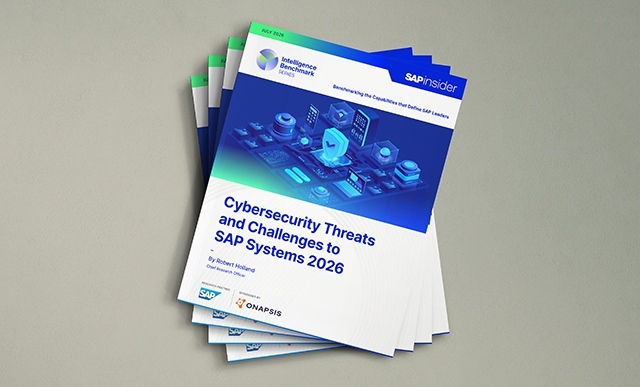
Cybersecurity Threats and Challenges to SAP Systems shows that unpatched systems remain the biggest cybersecurity threat to SAP systems. The report also found that 23% of respondents experienced credential compromise, social engineering, malware, ransomware, or another cybersecurity attack impacting their SAP environment in the past year.

State of the Market GRC in SAP Environments connects cybersecurity priorities with governance, risk, compliance, identity, and control modernization. SAPinsider found that 60% of organizations are automating GRC processes, while 53% are centralizing control workflows to improve visibility and efficiency.


Silhouetted person standing before a digital security display representing zero trust access enforcement.
Saviynt Extends Identity Governance Into Zero Trust Enforcement With ZscalerSaviynt and Zscaler connect identity governance to real-time session enforcement, combining time-bound privileged access with continuous audit evidence.
Skyscrapers rising above clouds illustrate the layered SAP systems affected by July 2026 security patches.
SAP Security Patch Day July 2026: Year’s Largest Critical and High Priority WorkloadSAP Security Patch Day July 2026 delivered the year’s largest combined workload of critical and high-priority entries. Layer Seven, Pathlock, and SecurityBridge explain the attack paths, remediation order, and operational barriers SAP teams must address across hybrid landscapes.
SAP logo sign outside office building in Germany, representing SAP Security Patch Day and enterprise systems.
SAP Security Patch Day: Critical Updates and Vulnerability Analysis Each MonthA structured analysis of SAP Security Patch Day, focusing on the vulnerabilities that shape enterprise risk and how they affect SAP environments each month.
3D illustration of a glowing cloud containing server racks wired to a desktop monitor, representing autonomous monitoring and remediation of cloud-hosted SAP systems.
IT-Conductor Pushes SAP Security Beyond Detection with Autonomous Cyber ResilienceIT-Conductor's recent webinar make the case that SAP security fails at the remediation stage, not detection. Its Maestro agentic AI engine orchestrates a five-stage lifecycle from finding to verified fix.
Bold AI lettering over abstract swirling blue and purple digital forms representing agentic AI deployment in SAP enterprise environments and oXya landscape readiness for S/4HANA transformation
oXya Positions SAP Landscape Readiness as the Prerequisite for AI-Driven Enterprise TransformationoXya makes the case that SAP landscape readiness is a prerequisite for the Autonomous Enterprise, backing it with B4S4 pre-migration methodology, a governance-first AI agent architecture, and expanded SAP cybersecurity capabilities through the axl & trax acquisition.
bowbridge Extends SAP-Specific Antivirus Protection to Uploads Standard Tools Missbowbridge Anti-Virus for SAP Solutions scans SAP uploads and attachments through the NetWeaver Virus Scan Interface, helping security teams catch malware inside SAP workflows before files reach business data.
A glowing blue network of autonomous AI agents radiating from a central neural core above a holographic risk and compliance dashboard in a modern enterprise security operations center, with legacy server racks dissolving into a modern data platform, representing the shift from legacy risk platforms to agentic AI GRC for SAP environments.
Agentic AI Comes for Legacy Risk Platforms. SAP Data Readiness Will Decide What Happens Next.ServiceNow and Accenture are repositioning legacy risk platforms as an agentic AI target. For SAP teams, the real test is whether risk data is governed, integrated, and traceable enough to let agents act safely.
The Truth About SAP Security Architecture: Why Embedded Tools Are a Single Point of FailureThe article argues that SAP security should use an independent external architecture rather than embedded tools because it avoids single points of failure, preserves application performance and HANA licensing compliance, supports objective audits and segregation of duties, delivers rapid threat intelligence and virtual patching against zero-days, and integrates cleanly with the enterprise SOC for continuous, resilient protection.
Compliance and Prevention Are Best Friends: How Custom Code Security Drives Verifiable GovernanceModern enterprise compliance is shifting from reactive audits to automated, shift-left application security that blocks insecure human- and AI-generated custom code before production to meet regulations like NIS2, CRA, EU AI Act, and other industry mandates.
The 2026 SAP Security Assessment ChecklistThe article says modern enterprises must perform regular, comprehensive SAP security assessments to harden platforms, patch vulnerabilities, control access, monitor threats, prove compliance, secure cloud/RISE/BTP environments, test resilience, and train teams to reduce risk and stop attackers before they exploit weaknesses.

Related Vendors