



Mar 16-19, 2026Las Vegas, Nevada, NV
SAP HRIS
Featured Insiders
Upcoming Events
SAPinsider Las Vegas 2026
Related Vendors

What is SAP HRIS?
Human resources information systems (HRIS) are becoming increasingly important as expectations from managers, employees, and others are evolving around what HR data they can access and how quickly they can access it. SAP HRIS tools include the traditional on-premise SAP ERP HCM module, but SAP has shifted much of its development focus to SAP SuccessFactors.
What is SAP HRIS?
Human resources information systems (HRIS) are becoming increasingly important as expectations from managers, employees, and others are evolving around what HR data they can access and how quickly they can access it. SAP HRIS tools include the traditional on-premise SAP ERP HCM module, but SAP has shifted much of its development focus to SAP SuccessFactors.
The core HRIS modules, such as SAP SuccessFactors Employee Central, act as systems of record for employee data that can then be integrated into other areas of the business such as finance and sales. With the advent of cloud software, HRIS have grown in self-service capabilities, providing greater functionality for managers and employees around key HR functions such as recruiting, onboarding, performance management, time and attendance, and more.
There are many SAP partners that provide SAP HRIS implementation and consulting services, such as Deloitte, for example. Other vendors provide HRIS software that integrates with SAP HRIS and goes beyond its capabilities, including Workforce Software for workforce management and DocuSign for eSignatures on important HR documents.
Key Considerations for SAPinsiders
- Don’t compromise on process standardization at the expense of actionable data. This was a key learning for Mitsubishi Heavy Industries as it implemented SAP SuccessFactors across 134 companies, and it will enable your company to realize the benefits of talent management modules, no matter the location or division.
- Automate where you can with HRIS tools for serious results. How manual are your HR processes? In talent acquisition, for example, how many emails do your recruiters send? Automating tasks such as interview scheduling can save significant time and give your recruiters more opportunities to connect with clients rather than spending upwards of 60% of their time making schedules work. This is just one example of how automation through HRIS can help HR practitioners in your organization and create more efficient HR processes.
- Explore solutions that enable self-service in key HR functions. Managing performance and tracking time and attendance are crucial HR processes at many organizations. The better performing companies in our recent HR technology research are more likely to currently use or implement performance management, as well as time and attendance solutions. Typically, these technologies offer self-service for functions such as self-reviews, time logging, paid time-off, and more. Find where self-service fits at your organization, and what tools may help provide HR self-service.
33 results

Implement and Manage Competency Frameworks in SAP SuccessFactorsDec 21, 2021 — Managing talent in today’s volatile climate is both challenging and necessary. Companies need to remain engaged with their top performers while laying the groundwork for succession plans in key roles. To be successful, SAP SuccessFactors Platform provides two different systems to implement and manage Competency Framework. Understanding the differences between both can help with making the right choice.
Competencies are assigned to a Job Role to define what it requires from its incumbent, in terms of his/her abilities to perform the job, writes Faisal Iqbal, SAP Consultant, MSITEK LLC. “It helps companies in different processes, such as Career Development Planning and Succession Management. Anyone who is interested in, or a successor to, another role is first assessed for his/her readiness. “
Read this article and learn:
• How the Competency Framework, which is at the core of Talent Management processes, can be implemented and managed in the system.
• What the differences are between SAP SuccessFactors Platform’s two systems, JDM 1.0 (Job Description Manager) and JDM 2.0 (Job Profile Builder), and how they help companies manage Job Roles and Competencies.
• How to implement and manage your competency framework easily using either JDM 1.0 and JDM 2.0.
• When the Center of Capabilities is enabled and how this framework provides a repository of capabilities, including competencies, work values, etc., defined by an organization.
5 minute read

SAP HXM Product Strategy Roadmap SessionJul 22, 2022 — Time for a new HRIS or payroll solution? This session will provide attendees with an understanding of SAP’s HR Strategy, and a look at SAP SuccessFactors’ Product roadmap. The session will also cover some of the benefits of undertaking digital transformation with SAP SuccessFactors.
1 minute read

Selecting Suitable Delegates for Critical Staff in SAP ERP HCMJul 19, 2016 — Learn how to embed standard SAP ERP HCM master data, such as requirements, restrictions, work centers, tasks, and profile-matchup results, in your SAP ERP HCM Delegation Application. Using an example of safety and trainee workers, learn how to enhance your Delegation Application to determine the most appropriate delegate when personnel who are considered to be […]
13 minute read

Linking Core SAP ERP HCM Data and SAP ECC 6.0 Core SAP EHS FunctionalityMay 1, 2018 —
In this article you'll learn how to configure the employee type SAP business partner, configure the medical provider type SAP business partner, and set up SAP Environment, Health, and Safety (SAP EHS) functionality to use with SAP business partners.
17 minute read

Remote Work Amplifies the Need for Good Employee ExperienceJul 30, 2021 — In a remote environment, employee experiences can differ dramatically as people work on the same projects as their peers but in different locations and under varying circumstances. SAPinsider’s State of Human Experience in the Workplace Benchmark Report, published in June 2021, found that increasing remote work and workplace disruption was a driving force for employee experience strategy for 54% of respondents.
Companies want to achieve recognizable return on their people investment, and investment in experience is often about enabling more productive workers. However, comprehensive employee experience management solutions are still new to the market. SAP only rebranded its human capital management (HCM) solution set to support the concept of human experience management (HXM) two years ago and is only at the beginning of providing a full-fledged experience toolkit.
Many of the requirements around employee experience are measurable through net promoter score such as turnover rates, absenteeism, employee performance, and employer brand. Identifying the connection between happier employees and better metrics will be key to unlocking the biggest roadblocks to investing in employee experience.
Read this article and learn:
- What the challenges are to improving employee experience with the shift to remote work.
- How companies are investing in employee experience in response to this shift.
- The importance of measuring employee experience to improve productivity and satisfaction.
5 minute read
Boost Productivity Gains Through Better Employee ExperienceOct 28, 2021 — What motivates companies to invest in improved employee experience? In SAPinsider recent research on The State of Human Experience in the Workplace, the most significant driver was the rise of remote workforces due to the COVID-19 pandemic.
HR leads employee experience strategy because it is HR that measures the effectiveness of employee experience changes. In essence, while other departments should take an active role in checking the pulse and sentiment of employees and learning about their experiences, they are willing to leave this responsibility to HR instead.
HR leaders will need to make it clear that experience touches every department. When HR leaders get backing from other groups for experience transformation, they help overcome the budget and prioritization roadblocks that can hamper a company’s ability to improve employee experiences through processes and technology.
Read this article and learn:
- What are the main drivers of enterprise investment in employee experience.
- How enterprises can improve return on their employee experience investment
- The importance of HR taking the lead with employee experience strategies.
4 minute read

Human Resources Technology State of the Market Benchmark ReportDec 1, 2021 — In This Report: For many organizations, HR is the last department to receive technology investment. Still, the trend to more remote work and changing employee expectations are putting the spotlight on HR. Cloud offerings have become the dominant force in HR technology. There are more and more options for outsourcing the management of everything in […]
1 minute read

A 2016 Guide to the SAP ERP HCM and SuccessFactors Reporting Landscapes and Solutions (Part 2)Jan 5, 2016 — Review the available SAP ERP HCM and SuccessFactors reporting options, including the pros and cons of each. Key Concept Hybrid reporting refers to any scenario in which you are reporting on data from your SAP ERP HCM system in addition to data from any SuccessFactors module. A real-world example is reporting on Payroll data from […]
3 minute read

Integration Setup for a Core Hybrid SAP ERP HCM SolutionJan 5, 2017 — Learn how to configure the integration between SuccessFactors Employee Central and SAP ERP HCM to set up SAP’s core hybrid HR solution. Key Concept In SAP’s core hybrid solution, SuccessFactors Employee Central on the cloud is set up as the system of records for employee master data and talent management, while the SAP ERP Central […]
13 minute read
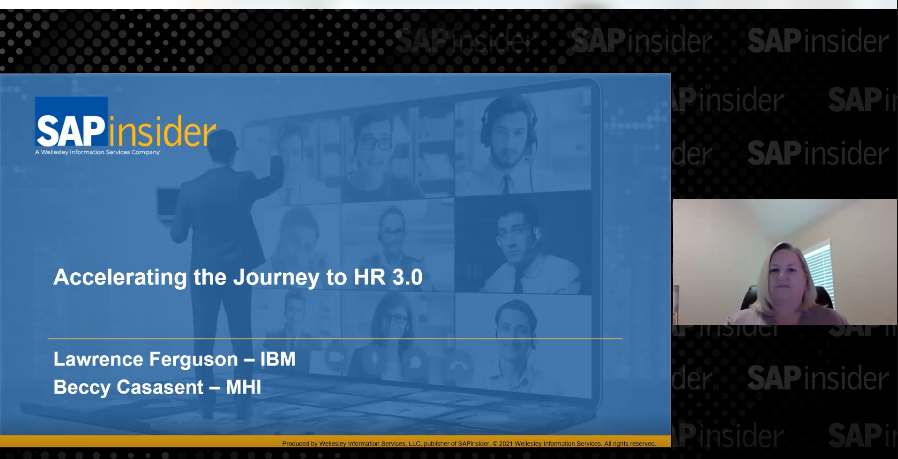
Q&A | Accelerating the journey to HR 3.0May 6, 2021 — In a recent survey, more than two-thirds of executives said that the global HR function is ripe for disruption and employee experience is critical to helping HR drive a company’s overall enterprise transformation. Join this interactive session to discuss the evolution of the HR experience and its importance as we move to a digital age of employee experience, cognitive tools, personalized journeys, and transparency throughout organizations. You will hear from industry experts and leading customers as they discuss how their journey to HR 3.0 with modernized HR technology has improved employee performance, data driven insights, and talent management.
1 minute read