Topics

Explore critical topics shaping today’s SAP landscape—from digital transformation and cloud migration to cybersecurity and business intelligence. Each topic is curated to provide in-depth insights, best practices, and the latest trends that help SAP professionals lead with confidence.

Regions

Discover how SAP strategies and implementations vary across global markets. Our regional content brings localized insights, regulations, and case studies to help you navigate the unique demands of your geography.

Industries

Get industry-specific insights into how SAP is transforming sectors like manufacturing, retail, energy, and healthcare. From supply chain optimization to real-time analytics, discover what’s working in your vertical.

Hot Topics

Dive into the most talked-about themes shaping the SAP ecosystem right now. From cross-industry innovations to region-spanning initiatives, explore curated collections that spotlight what’s trending and driving transformation across the SAP community.

Topics

Explore critical topics shaping today’s SAP landscape—from digital transformation and cloud migration to cybersecurity and business intelligence. Each topic is curated to provide in-depth insights, best practices, and the latest trends that help SAP professionals lead with confidence.

Regions

Discover how SAP strategies and implementations vary across global markets. Our regional content brings localized insights, regulations, and case studies to help you navigate the unique demands of your geography.

Hot Topics

Dive into the most talked-about themes shaping the SAP ecosystem right now. From cross-industry innovations to region-spanning initiatives, explore curated collections that spotlight what’s trending and driving transformation across the SAP community.

SAP CyberSecurity

SAP Cybersecurity focuses on protecting SAP applications, data, infrastructure, and integrations from digital threats across cloud, hybrid, and on-premise environments. It spans SAP S/4HANA, SAP HANA, SAP BTP, SAP NetWeaver, SAP Fiori, identity and access controls, threat detection, patching, privacy, and compliance. For SAP customers, cybersecurity connects IT, security, Basis, risk, audit, and business leaders around one goal: keeping mission-critical systems secure, resilient, and trusted.

What is SAP Cybersecurity?

SAP Cybersecurity is the practice of securing SAP systems, applications, users, custom code, data, and connected business processes from internal and external threats. It includes capabilities such as SAP Enterprise Threat Detection, SAP Focused Run, SAP Code Vulnerability Analyzer, data masking, privacy governance, key management, patch management, and access monitoring. Enterprises use SAP cybersecurity to reduce breach risk, protect sensitive business data, support compliance, and maintain operational continuity.

SAP Cybersecurity focuses on protecting SAP applications, data, infrastructure, and integrations from digital threats across cloud, hybrid, and on-premise environments. It spans SAP S/4HANA, SAP HANA, SAP BTP, SAP NetWeaver, SAP Fiori, identity and access controls, threat detection, patching, privacy, and compliance. For SAP customers, cybersecurity connects IT, security, Basis, risk, audit, and business leaders around one goal: keeping mission-critical systems secure, resilient, and trusted.

What is SAP Cybersecurity?

SAP Cybersecurity is the practice of securing SAP systems, applications, users, custom code, data, and connected business processes from internal and external threats. It includes capabilities such as SAP Enterprise Threat Detection, SAP Focused Run, SAP Code Vulnerability Analyzer, data masking, privacy governance, key management, patch management, and access monitoring. Enterprises use SAP cybersecurity to reduce breach risk, protect sensitive business data, support compliance, and maintain operational continuity.

How do enterprises use SAP Cybersecurity?

Protecting Sensitive SAP Data

Enterprises use SAP cybersecurity to protect financial, customer, supplier, employee, and operational data inside SAP systems. Controls such as data masking, access logging, encryption, and privacy governance help limit exposure while supporting audit, compliance, and business-user access needs.

Monitoring Threats Across SAP Landscapes

Security teams use SAP-specific monitoring to detect suspicious activity across SAP applications, databases, users, and integrations. Tools such as SAP Enterprise Threat Detection help connect SAP events with broader SOC, SIEM, and incident response workflows.

Managing Patches and Vulnerabilities

SAP Basis, security, and infrastructure teams use cybersecurity processes to track SAP Security Notes, patch critical vulnerabilities, and validate remediation. This is especially important for SAP NetWeaver, SAP S/4HANA, SAP HANA, and hybrid landscapes where exposure points can expand quickly.

Securing Identity and Access

Enterprises use SAP cybersecurity to enforce least privilege, monitor privileged users, reduce segregation-of-duties risk, and strengthen authentication. This helps protect business transactions while supporting compliance requirements across finance, procurement, supply chain, and HR processes.

Protecting Custom Code and Extensions

SAP teams use code vulnerability analysis and secure development practices to identify risks in ABAP custom code, extensions, integrations, and SAP BTP-based development. This supports clean core strategies while reducing the chance that customizations introduce exploitable weaknesses.

Where does SAP Cybersecurity emerge in SAPinsider research?

Cybersecurity Threats and Challenges to SAP Systems shows that unpatched systems remain the biggest cybersecurity threat to SAP systems. The report also found that 23% of respondents experienced credential compromise, social engineering, malware, ransomware, or another cybersecurity attack impacting their SAP environment in the past year.

State of the Market GRC in SAP Environments connects cybersecurity priorities with governance, risk, compliance, identity, and control modernization. SAPinsider found that 60% of organizations are automating GRC processes, while 53% are centralizing control workflows to improve visibility and efficiency.


train-on-rail-tracks_Identity security innovation
Saviynt Taps India’s Tech Ecosystem to Accelerate Identity Security Innovation Saviynt is expanding its identity security innovation strategy with a new Bengaluru hub, advancing research in AI-driven identity governance, non-human identity security, and global delivery.
Keyboard_AI-driven identity governance in SAP environments
Saviynt Expands Identity Security Through AWS, CrowdStrike, and Global PartnersSaviynt is embedding AI-driven identity governance into SAP, cloud, and security ecosystems, extending zero trust controls across endpoints, hyperscalers, and machine identities.
Pathlock logo associated with SAP threat detection integration for Microsoft Sentinel Solution for SAP applications.
Pathlock Adds Real-Time SAP Threat Detection to Microsoft Sentinel Solution for SAPPathlock has integrated its SAP Threat Detection capability with Microsoft Sentinel Solution for SAP applications, enabling enriched SAP security events to flow directly into enterprise SIEM workflows. The move brings SAP telemetry into centralized SOC investigation and response processes across hybrid environments.
screen with password_SAP identity governance modernization
How Saviynt Helped LIXIL Modernize Global Identity Governance at ScaleLIXIL replaced fragmented regional controls with a centralized SAP identity governance framework using Saviynt Identity Cloud, aligning access management with global compliance and S/4HANA transformation.
SecurityBridge SAP security platform logo
RISE with SAP Security: Execution Within the Shared Responsibility Model Defines RiskAs RISE with SAP migration accelerates, security accountability remains with the customer. Execution within the shared responsibility model—not documentation alone—defines governance risk in SAP S/4HANA Cloud environments.
Saviynt logo representing identity governance modernization for SAP S/4HANA environments ahead of SAP IDM end-of-life in 2027.
How Saviynt Supports SAP S/4HANA Identity Modernization Ahead of 2027As SAP Identity Management approaches end-of-life in 2027, SAP S/4HANA modernization programs must reassess identity governance, cross-system segregation-of-duties risk, and third-party access control across distributed cloud environments.
AI agents operating inside SAP systems increase the need for unified identity governance and visibility across S/4HANA environments.
AI, SAP, and 2027: Why Identity Architecture Is Now a Program-Level DecisionAI agents are already operating inside SAP systems, yet most organizations lack visibility and effective control over their privileges. As S/4HANA migration and SAP Identity Management retirement approach, identity architecture is no longer an operational afterthought. It is becoming a structural decision that shapes automation risk, segregation-of-duties integrity, and audit resilience.
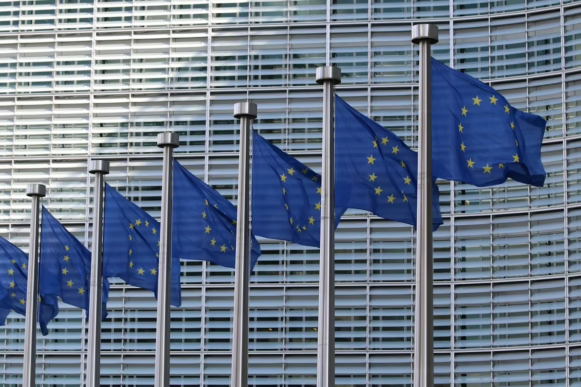
European Union headquarters in Brussels, where DORA digital operational resilience regulations are overseen for financial institutions and ICT providers.
How DORA Is Redefining Accountability for SAP SecurityDORA is redefining how financial institutions manage SAP security. As regulators demand repeatable evidence and operational resilience, accountability now extends deep into live SAP environments and the tools used to monitor them.
Enterprise data center infrastructure representing AI identity and access risk in SAP environments.
As AI Enters SAP Systems, CISOs Confront Visibility and Control GapsNew survey data shows AI agents already operate inside SAP estates with broad privileges, while visibility, governance maturity, and containment capabilities struggle to keep pace.
SAP logo displayed on office building exterior representing enterprise ERP and platform security.
SAP February Patch Day Puts ABAP and Platform Risk in FocusSAP’s February 2026 Patch Day delivered 26 new notes and one update, with critical exposure centered in ABAP and core platform services. Vendors warn impact depends on how trust and integrations operate inside each landscape.

Related Vendors