Retail and eCommerce
Retail industry encompasses small businesses and chain stores of all sizes. These businesses sell consumer products directly to individual consumers. Within retail, there is extensive classification, depending on the specialty or type of retailer. Segmentation may be by product being retailed (ex: apparel, furniture, electronics, grocery etc.) or channel of distribution (ex: supermarkets, convenience stores, specialty stores etc.).
In U.S, retail jobs are the most common occupation, as per Census.gov, with approximately 7% of U.S population employed in retail frontline operation. Conventional brick and mortar format of retail has been disrupted in the 21st century by the rise of electronic commerce, popularly known as ecommerce.
Ecommerce takes buying and selling of products and services online, thereby significantly disrupting the traditional retail model. Due to the increasing adoption of ecommerce in end consumers, which exploded exponentially during the pandemic, traditional retailers are increasingly adopting the ecommerce model and hence creating an omnichannel strategy.
Technology in Retail and Ecommerce
Retail industry encompasses small businesses and chain stores of all sizes. These businesses sell consumer products directly to individual consumers. Within retail, there is extensive classification, depending on the specialty or type of retailer. Segmentation may be by product being retailed (ex: apparel, furniture, electronics, grocery etc.) or channel of distribution (ex: supermarkets, convenience stores, specialty stores etc.).
In U.S, retail jobs are the most common occupation, as per Census.gov, with approximately 7% of U.S population employed in retail frontline operation. Conventional brick and mortar format of retail has been disrupted in the 21st century by the rise of electronic commerce, popularly known as ecommerce.
Ecommerce takes buying and selling of products and services online, thereby significantly disrupting the traditional retail model. Due to the increasing adoption of ecommerce in end consumers, which exploded exponentially during the pandemic, traditional retailers are increasingly adopting the ecommerce model and hence creating an omnichannel strategy.
Technology in Retail and Ecommerce
While ecommerce is entirely a product of technology, retail industry has not been a stranger to technology either. Likes of Walmart leveraged technology decades ago to build business models that destroyed competitors like K-mart. Technology plays a key role in retail value chain, from core supply chain activities ranging from inbound logistics to last mile delivery, to support activities like procurement, marketing, financial planning, people and resource management, merchandizing, assortment planning etc. On the ecommerce side, in addition to the platforms that support ecommerce and the supply chain components, technology adds value in areas like web analytics, assortment planning, personalization, recommendations etc.
SAP has a rich portfolio of solutions that support retail and ecommerce, branded as omnichannel retail. While its SAP S/4HANA product has customized retail industry features, like merchandize management, a plethora of other technologies like SAP intelligent returns management, SAP commerce cloud, SAP Ariba, SAP CX etc. support key omnichannel retail operations like marketing and customer experience, merchandizing, sourcing, and procurement, financial planning, omnichannel retail and store operations. SAP partner ecosystem also has a rich portfolio of partners like DataXstream, which helps retailers and wholesalers develop robust omnichannel capabilities.
Key Considerations for SAPinsiders
This article shares how Walgreens Boots Alliance (WBA) launched a transformation initiative designed to modernize the company’s core business processes to give employees better access to data in real-time at all levels of the organization. The initiative began as a program to replace its custom legacy ERP system with SAP S/4HANA at its 9,000 stores worldwide but soon turned into a full-scale transformation of WBA’s business.
This article discusses how breakthrough beverages expedited the transformation of its distribution operations leveraging ecommerce and SAP technology. Breakthrough was able to move fast and adapt to changing demand patterns because of end-to-end SAP Commerce Cloud and SAP Customer Data Cloud solutions, as well as SAP ERP Central Component (ECC) for ERP, which has helped them tremendously in meeting customer demand.
118 results
-

Navigating M&A Compliance: Key Challenges and Solutions for Mergers, Acquisitions & Divestitures
Mergers, acquisitions, and divestitures demand strategic management of IT systems and data to maintain compliance and operational stability. Companies face challenges such as integrating or separating complex infrastructures, managing data effectively, and retiring outdated systems. By adopting structured solutions, like improving data governance, optimizing business processes, and leveraging modern technologies, organizations can turn these transitions…
-

Introduction to Appian
Appian brings orchestration, automation, and intelligence together in a secure, performant platform for managing your most complex processes. Consolidate your enterprise systems with data fabric, simplify your application architecture with low-code design for building apps and workflows, and unleash your process potential with AI-powered automation for a more adaptable and optimized business. Move your business…
-
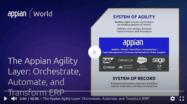
The Appian Agility Layer: Orchestrate, Automate, and Transform ERP
Modernizing ERP systems can take years without the right technology. See how Appian streamlines the process and reduces migration risks—unlocking value faster from SAP S/4HANA and other ERP systems.
-
Defining an ERP Transformation Strategy with Appian
Modernizing ERP doesn’t have to mean disruption. With Appian, you can show value in weeks, keep your core clean, and reduce risk at every step.
-
Bridging the Gap: Migrating from SAP ECC to S/4HANA Cloud
Download the guide to migrating from ECC to S/4HANA Cloud to learn how you can unlock the benefits of SAP modernisation without disrupting operations.
-

Integrating Appian with SAP
Integrating Appian with SAP Organizations across industries and functions—supply chain management, finance, human resources, manufacturing, procurement, product development, and more—use SAP as their Enterprise Resource Planning solution (ERP). SAP addresses many business needs, but organizations often have to customize their SAP solution to conform to the company’s operations. Fortunately, with Appian, you can quickly deliver…
-
Key Success Factors for a Sustainable SAP ERP Cloud Migration
ICYMI: Kevin F. Reilly, ETS Customer Success Officer, highlighted essential factors for successfully migrating to SAP ERP Cloud during his presentation at the SAPinsider Transformation Summit.
-

📌 FREE WEBINAR: PL119-21 Summary Changes to SECURE 2.0 Q4 2025
Event: Wednesday, November 12th, 11:00 AM – 12:00 PM, ET
-

APOS at SAPinsider ERP Transformation Summit!
APOS is looking forward to joining the SAP community in New Orleans at SAPinsider ERP Transformation Summit as a proud sponsor. Join us for a collaboration session on “Generating & Delivering Personalized Financial & Operational Reports on Multiple Platforms” in our booth at 10:05 Oct 22. Finance and operations teams modernizing their SAP Analytics and…
-

A Blueprint for Large-Scale SAP Transformation in Retail
Salling Group successfully modernized its massive SAP ECC system to SAP S/4HANA using SNP’s Bluefield approach, significantly reducing data size and minimizing operational disruption during the transition.
Featured Insiders



Upcoming Events

Related Vendors


Your request has been successfully sent