
Standardizing your IT infrastructure on Red Hat’s integrated software stack can help you optimize your SAP environment and operations while preparing you for the future.

Back to Vendor Directory










Red Hat
Red Hat helps SAP enterprises standardize on a single, open platform and build on a foundation that sets them up for a future of innovation with a rich portfolio of flexible solutions. From standards-based solutions for automation, management, and integration, to app containerization and open hybrid cloud, Red Hat’s SAP portfolio supports any on- premise or cloud environment with freedom from vendor lock-in. Not just an operating system, Red HatⓇ solutions are driving intelligent enterprises through optimized stability, scalability, and security for SAP deployments. Red Hat is a market leader in LinuxⓇ, multicloud container development, and infrastructure automation, with a rich history in the open source community. With more than two decades of strategic collaboration with SAP, the support of IBM, and joint solutions from our global partner ecosystem, Red Hat offers an end-to-end portfolio of open source solutions for organizations looking to build an intelligent enterprise throughout their cloud journey. Red Hat for SAP. Open. For business. www.redhat.com/sap
Featured Solutions
Red Hat Integration is a key component to help you extend SAP systems and adopt the modern application development practices that can provide the agility to go to market faster and encourage innovation.
Featured Content
A single 60-day subscription for Red Hat Enterprise Linux for SAP Solutions and access to Red Hat's award-winning Customer Portal, including documentation, helpful videos, discussions, and more.
In this e-book, discover 10 reasons to choose Red Hat to run, develop, simplify, and extend end-to-end business processes for SAP workloads, from both on-premise and on any cloud.
Multimedia Center
Learn how to simplify your environment complexity by modernizing your application platform, and extend your SAP capabilities as you look to future innovation.
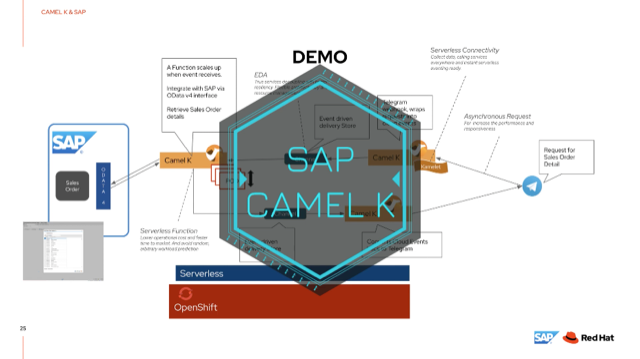
A demo showing how to Integrate SAP with 3rd party services using Camel K with Knative Eventing as well as Kamelet to bind to Telegram.
Articles / Case Studies / Videos


Why SAP Edge Integration Cell is the New Hybrid StandardThe SAP Integration Suite’s Edge Integration Cell (EIC) addresses the dual challenges of data sensitivity and operational resilience in regulated industries by allowing organizations to innovate in the cloud while managing sensitive data on-premise, thus enabling a hybrid architecture that facilitates both agility and control.
Jan 30, 2026
SAPinsider Benchmark Research – RISE with SAP 2025As 2025 ends, the narrative around SAP migration has shifted from “why move?” to “how fast?”
This SAPinsider report, based on a survey of 122 community members conducted in late 2025, highlights a marked acceleration in cloud ERP adoption as the 2027 end-of-maintenance deadline approaches.
Now commercially referred to as SAP Cloud ERP Private, the RISE with SAP package is seeing varied adoption rates; smaller organizations (under $2 billion in revenue) are currently twice as likely to be live on the solution compared to larger enterprises, which are predominantly in the planning or exploration phases.
While SAP’s dedicated transition support and license conversion credits are the primary drivers for migration, cost and unclear business value remain significant barriers for holdouts. The report also identifies a growing influence of Generative AI on ERP strategy. However, it warns of critical gaps in security compliance and an impending shortage of skilled implementation resources.
Download the benchmark report to read the full data analysis and receive recommendations for your own plans.
- Understand why there is a concerning lack of security awareness
- Why we forecast that implementation partners will struggle to staff the volume of concurrent projects required to meet the 2027 and 2030 deadlines.
- How SAP’s direct support and financial incentives are driving adoption rates
Nov 26, 2025
Enterprise Integration for SAP 2025Enterprise integration is essential in the digital business era. Expectations around digital and self-service experiences are driving the need for seamless, enterprise-wide integration across multiple systems, whether they are SAP or non-SAP. Access to the data that moves through critical applications and platforms is key to building data-driven strategies and collaborative workspaces.
To identify the key factors, strategies, expectations, challenges, and technologies driving enterprise integration strategies, SAPinsider conducted a survey of community members across multiple industries, locations, and roles from May to August 2025. Respondents revealed that while many organizations are on the path to integrating their systems in a cohesive and automated manner, only a select few have achieved integration at a level where all systems are fully integrated with real-time data flow.
This research also explored the integration maturity of respondents' organizations, and identified key traits across maturity segments as they journey towards enterprise-wide integration and governance. Download the benchmark report to read the full data analysis and receive recommendations for your own plans.
- Understand the how SAPinsiders are integrating their systems and the strategies they use.
- Explore the factors that are having the biggest impact on enterprise integration.
- Learn about the technologies that are in use to build connections between critical systems.
- Discover how SAP S/4HANA impacts integration strategies
Oct 20, 2025
Orchestrating the Hybrid Cloud – From Shop Floor to Executive SuiteThe Red Hat and SAP framework utilizes a consistent hybrid cloud core to transform operational data into strategic insights, enabling predictive maintenance, AI-driven quality control, end-to-end traceability, and sustainability reporting across multi-cloud environments.
Jan 29, 2026
Closing the Data Gap – The Power of the Digital Thread at the EdgeThe collaboration between Red Hat and SAP addresses the data gap between operational technology and enterprise IT systems in manufacturing by utilizing a three-tier architecture that ensures a reliable digital thread for consistent data flow from machine sensors to executive decision-making.
Jan 20, 2026
Simplified VM Management with Red Hat OpenShift Virtualization EngineAs virtualization remains essential in modern IT, Red Hat has announced the general availability of the Red Hat OpenShift Virtualization Engine to streamline management of virtual machines, enhance scalability and security, and facilitate transitions from other platforms, thereby addressing the evolving needs of organizations aiming to optimize costs and modernize their IT infrastructure.
Jan 20, 2025
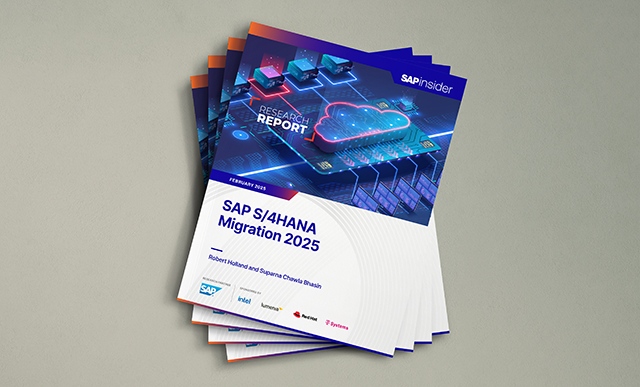
SAP S/4HANA Migration 2025With the 2027 SAP maintenance deadline approaching, SAP customers are under increasing pressure to move to SAP S/4HANA, especially within the context of RISE with SAP. However, recognizing the varying levels of preparedness in the SAP ERP customer base, SAP has introduced a phased maintenance approach beyond 2027. Starting in 2028, organizations can opt for extended maintenance—available until 2030 at a two percent premium—to ensure continued support while organizations complete the transition. Those who forgo this option or reach the end of their extended maintenance period will transition to customer-specific maintenance, which provides essential support but without full enhancements.
This structured approach reinforces SAP’s commitment to facilitating SAP S/4HANA adoption while offering businesses the flexibility to transition at their own pace. However, a critical question remains: What is the true state of SAP S/4HANA migration across industries today?
This year's research also explored whether organizations are planning on switching their existing SAP S/4HANA deployments to RISE with SAP as well as the overall impact of RISE with SAP on organizations that are moving to SAP S/4HANA. Deeper analysis of these topics is available in the executive summary for the report, and data from all the survey questions is available in the detailed findings.
To understand and explore the SAP S/4HANA migration strategies, this SAPinsider report examines the adoption trends for SAP S/4HANA, the version of the solution that organizations are deploying, the challenges that they are encountering with the move, and the benefits that those that have already moved to SAP S/4HANA have received.
The findings indicate a dynamic landscape where organizations are progressing at different paces based on their strategic priorities, business needs, and technical preparedness. Currently, 32% of respondents reported that their organization has already transitioned to SAP S/4HANA, a 10% jump compared to 2024 but more in line with data from 2022 (29%). Meanwhile, 27% of organizations are in the implementation stage, actively working to integrate SAP S/4HANA into their IT landscape, a number that has risen from 20% from last year. However, despite this momentum, 21% of organizations remain in the evaluation phase, a drop of 5% from 2024 and 9% from 2023, still assessing their business case for SAP S/4HANA migration, reflecting the complexities and challenges that come with such a transformational shift.
Download the benchmark report to read the full data analysis from 170 members of the SAPinsider community and receive recommendations for your own plans.
- Understand how organizations are moving to SAP S/4HANA.
- Explore the factors influencing their ERP and SAP S/4HANA planning.
- Learn about the impact of RISE with SAP on that move.
- See where organizations are facing barriers to adopting SAP S/4HANA.
Feb 28, 2025
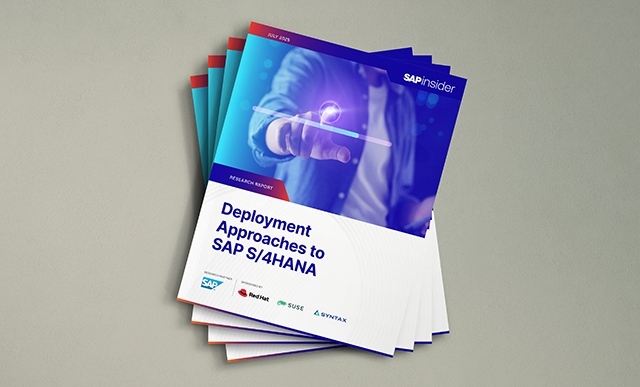
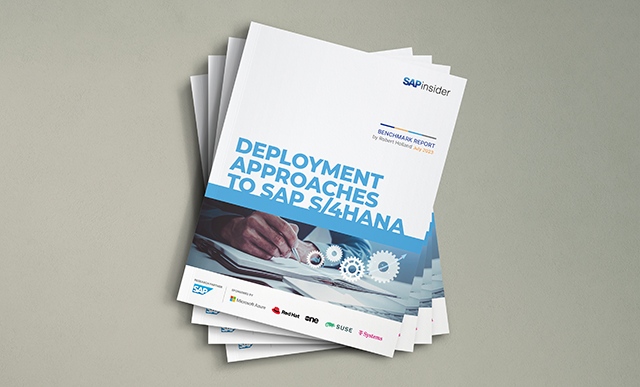
Deployment Approaches to SAP S/4HANA 2025The first productive release of SAP S/4HANA, version 1511, is just a few months shy of being 10 years old. In that time the market has changed significantly, although that change has been accelerating over the last 12-18 months as against changing steadily over time. Despite the launch of RISE with SAP in 2021, and SAP's push towards cloud ERP in general, most SAPinsiders have followed a more traditional approach in terms of both licensing and deployment. This has largely involved perpetual software licenses installed in on-premise infrastructure, although there has been a shift towards more of these deployments being in infrastructure-as-a-service environments in the private or public cloud. Despite not being new, it was originally launched not long after SAP S/4HANA itself, SAP S/4HANA Cloud has seen an increase in adoption over the years particularly due to the connection with RISE with SAP. However, that SAP S/4HANA Cloud adoption only represented a relatively small proportion of the SAP S/4HANA customer base.
This year that has changed. For the first time there is significant movement in the SAP S/4HANA market and the upcoming end of mainstream maintenance is driving that change. A majority of SAPinsiders are now focused on moving to SAP S/4HANA as quickly as possible. More than a third plan on deploying SAP S/4HANA Cloud through either RISE with SAP or GROW with SAP. And nearly a quarter of SAPinsiders now report that they will not complete a transition to SAP S/4HANA until after 2027. The combination of these factors, along with other data from the research, shows a market that has changed rapidly over the last year.
This year's research also explored the deployment model that SAPinsiders plan to use. The emphasis on getting to SAP S/4HANA quickly means that more organizations than in the last few years are considering a system conversion, or brownfield, deployment. However, SAPinsiders must weigh this approach against the work that they will have to do after deployment to achieve a cleaner core.
The findings indicate that the race to deploy SAP S/4HANA before 2027 has become more serious, and that many SAPinsiders have realized that this goal is not readily achievable. However, for those that have been properly preparing, there is still time.
Download the benchmark report to read the full data analysis and receive recommendations for your own plans.
- Understand the how SAPinsiders are deploying SAP S/4HANA and the environments they will use.
- Explore the factors that are having the biggest impact on deployment timeline.
- Learn about the infrastructure that is planned for those SAP S/4HANA deployments.
- See what role SAP Cloud ERP is playing moving forward.
Jul 31, 2025
Accelerate your SAP Journey with Valuable Partnerships While the future is a complete transition to the cloud involving offerings like RISE with SAP, today’s reality for most enterprises continues to involve hybrid environments and landscapes. Navigating this transitional phase and unlocking additional value requires the right solutions and trusted partners.
In this session, we explore how Red Hat’s strategic partnership with SAP, along with collaboration from Avantra and Lemongrass, is helping enterprises simplify operations and deliver business value today. Through real-world examples, we showcase how our solutions come together to increase agility, reduce complexity, and support organizations on their path forward.
Watch this webinar to gain insight into how:
To run, simplify, and expand your SAP landscape
The partner ecosystem delivers measurable outcomes
Customers are realizing tangible value today
May 8, 2025
Maersk’s Vision for an AI-First Finance OrganizationMaersk is reimagining the future of finance with a vision to become an AI-first organization. In this session, explore how the company is leveraging AI to streamline financial operations, enhance forecasting, and support decision-making within its SAP landscape. Learn how Maersk is aligning people, processes, and technology to build a more intelligent and efficient finance function. This session highlights early use cases, key enablers, and practical considerations for integrating AI into SAP-driven finance environments. Ideal for finance and IT professionals looking to understand the real-world impact of AI in enterprise finance.
Watch this webinar to:
- Learn about Maersk’s people-driven approach to deploying AI.
- Explore which AI programs Maersk is emphasizing and how it is educating business teams about AI value.
- Understand how IT and Finance teams are collaborating to provide a platform to support future financial operations
Oct 16, 2025

Accelerating the Adoption of SAP Integration Suite, On-Premise and BeyondSAP customers are transitioning to the SAP Integration Suite, which supports hybrid integration needs through solutions like the Edge Integration Cell, in response to the limitations of existing SAP Process Integration and Orchestration systems.
Feb 5, 2025
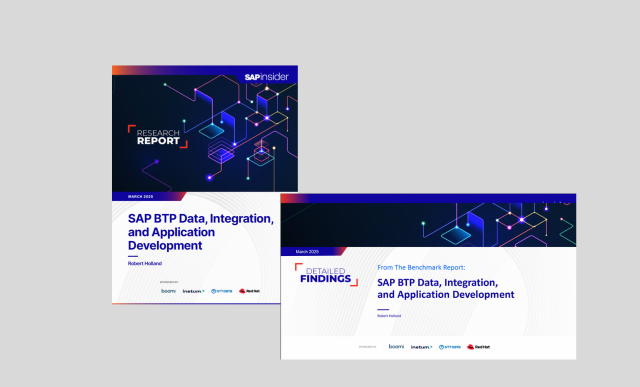
SAP BTP Data, Integration, and Application DevelopmentEnterprise workloads continue to move to the cloud. As this progress continues, enterprise platforms are performing an increasingly important part of that process as they provide an integrated set of solutions and services that streamline the movement and protection of data across landscapes.With enterprise platforms offering additional capabilities such as application development, analytics and data intelligence, database and data management, and artificial intelligence (AI) and automation, choosing the right platform is now a critical component of a comprehensive data and integration strategy.
Implementing enterprise platforms like SAP BTP enable organizations to digitize and automate routine tasks which frees up employees to focus on higher value activities. Workflow automation and intelligent process integration in these platforms helps ensure accurate, real-time data flow between modules — like from procurement to finance for example. This reduces the need for manual intervention, helps minimize errors, and eliminates duplication. This not only accelerates decision-making with up-to-date analytics and embedded insights but increases compliance through capabilities such as standardized processes and audit trails. Given the improved productivity and agility that these capabilities bring, it is no surprise that organizations are prioritizing investments in enterprise platforms to help achieve these goals.
This year's research also explored the increased complexity of organizations today. Few are using predominately SAP solutions with most using a combination of SAP solutions at the core along with some best-of-breed solutions. But a growing number of organizations are taking an entirely agnostic approach to application selection. This makes addressing data and integration challenges more important than ever, something that enterprise platforms can make possible.
To understand and explore the strategies for data, integration, application development and enterprise platforms, this SAPinsider report examines SAP BTP usage, the types of integration scenarios being supported by organizations, the makeup of the landscape, challenges that are being encountered, and the SAP BTP services that are being used.
The findings indicate that integration is one of the most important challenges for organizations today, with eight in ten respondents reporting that that is the primary service they are using in SAP BTP. The mixture of systems from different providers with a combination of cloud and on-premise environments has made integration the primary focus for respondents, although application development and data and analytics services also see significant usage. In addition, while AI is not currently the primary use case in SAP BTP, two thirds (65%) of respondents report that it is important or very important to their organization that application development tools include AI capabilities. This demonstrates the value seen by respondents in the AI assistance that SAP is adding to tools like SAP Build.
Download the benchmark report to read the full data analysis from 151 members of the SAPinsider community and receive recommendations for your own plans.
- Understand how organizations are using SAP BTP.
- Explore the factors influencing the adoption of enterprise platforms.
- Learn about how other SAPinsiders are making plans for integration.
- See what role application development will play in the future.
Mar 31, 2025
SAP Hybrid Integration Powered by Red Hat OpenShiftCompanies are adopting cloud solutions while maintaining on-premise data systems for compliance, and the SAP Edge Integration Cell, running on Red Hat OpenShift, provides a flexible hybrid integration approach that enables secure data management and access to cloud tools.
Dec 6, 2024

Deployment Approaches to SAP S/4HANA 2023For the last three years, SAPinsider tracked how organizations deploy SAP S/4HANA. During that time, adoption of the solution grew steadily, although a significant proportion of respondents either still have no plans for SAP S/4HANA or are only at the point of evaluating the business case. The most likely deployment model for these organizations continues to be a system conversion or brownfield implementation with a new implementation being second. However, over the last two years a greater proportion of respondents indicated that a selective data transition is an option as existing SAP ERP users with complex implementations have started to move to SAP S/4HANA.
The survey asked the respondents to about whether they were running SAP S/4HANA, their time frame for switching, how they planned to deploy, the infrastructure they planned on using, and the factors most impacting their SAP S/4HANA deployment decisions. As has been the case the last three years, the proportion of respondents planning on using a selective data transition continues to grow just as more long-time SAP ERP customers move to the offering. But while a quarter (27%) of organizations have already switched to SAP S/4HANA, more than half the respondents to this survey (53%) indicated that they do not plan to switch before 2025. This has the potential to create a resource bottleneck for partners that are experienced with deploying SAP S/4HANA as the 2027 end of maintenance deadline approaches.
Download the benchmark report to read the full data analysis from 168 members of the SAPinsider community and receive recommendations for your own plans.
- Explore the factors that are most impacting how organizations will deploy SAP S/4HANA
- Learn about the types of deployments being used and what those trends mean
- Understand the time line for when respondents planned to switch to SAP S/4HANA
- See the infrastructure that organizations plan on using for their deployments
Jul 31, 2023
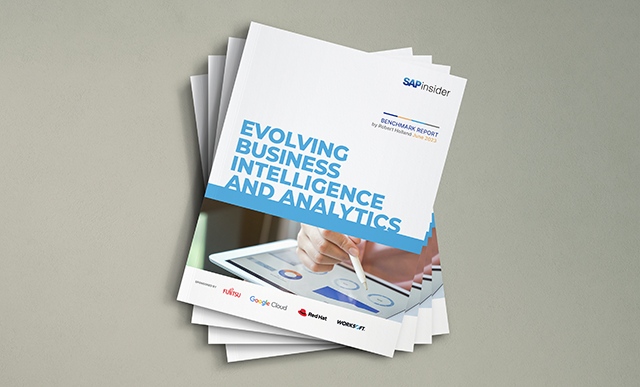
Evolving BI and AnalyticsCreating a cohesive data fabric is integral to organizational business intelligence (BI). However, while many organizations strive to reach this goal, there is often a gap between building cohesive data fabric strategy and its execution. The introduction of SAP Datasphere earlier this year aimed to address this need by harmonizing mission-critical data across the enterprise while maintaining its business context. However, SAPinsider research shows that a need to demonstrate return on investment (ROI) and provide faster time to value may override such broader, strategic goals.
Although four in five respondents reported that their organization was currently considering, planning, or implementing business intelligence solutions, most are still in the early phases of their deployments. The challenges that they face in deploying these initiatives relate to budget, change management issues, and embarking on broader programs rather than trying to provide quick wins. Despite the need for a cohesive data fabric, respondent organizations are constrained with demonstrating ROI, faster time-to-value, and limit expenditure. This may preclude them from meeting their broader business intelligence objectives even though there is a need for more agility and cross-enterprise capabilities in business intelligence. However, as operational business intelligence gets embedded in strategic plans and roadmaps, organizations will be able to better engage with their business intelligence plans.
Download the benchmark report to read the full data analysis from 178 members of the SAPinsider community and receive recommendations for your own plans.
- Explore the factors behind the need for business intelligence and analytics to evolve
- Learn whether business intelligence objectives are part of long-term strategic and enterprise planning
- Understand the challenges that organizations face with deploying business intelligence programs
- See what data consumption tools, technology platforms, and databases/data lakes are being used
Jun 30, 2023
Streamlining Your SAP Cloud Migration by Utilizing PartnershipsSAP users know that cloud migration is a large investment that requires thorough planning, consideration and, of course, time. While there is an array of benefits that companies can enjoy after their digital transformation, it is vital to feel secure and confident throughout the process. Therefore, SAP is constantly on the lookout for new and […]
Mar 28, 2024
Business Automation Challenges and SolutionsBusinesses today are struggling to keep moving in the right direction. Infrastructure and environments are changing more rapidly than ever, and there is an increased need to bring data together across the organization to provide a better understanding of the business. Organizations need more connected applications, more efficient processes, and more specialized skill sets if they are to effectively manage this all. It is also becoming increasingly important to operationalize artificial intelligence in IT environments. This will allow AIOps platforms to learn patterns from monitoring to better comprehend IT asset relationships, define applications, predict events, and automate resolutions.
Oct 19, 2023
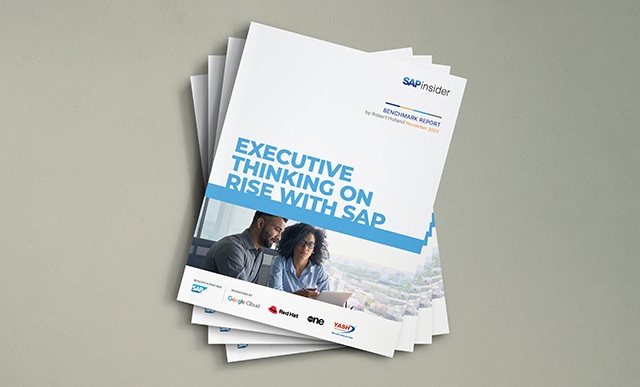
Executive Thinking on RISE with SAPOver the past year, SAP has significantly shifted its strategy for RISE with SAP. However, while RISE with SAP has been the focus of cloud ERP strategy since its release in 2021, SAP has made the transition to SAP S/4HANA more difficult for organizations opting not to use the RISE with SAP framework. The recent announcements stating that some innovations will be exclusive to customers with RISE with SAP contracts, followed by the statement that only RISE with SAP Premium Plus will incorporate new sustainability and generative AI features, has led to confusion among the SAP customer base. This report will focus on what executives are thinking about RISE with SAP and the impact that SAP's most recent statements are having on that thinking.
The survey asked the respondents to about the role of RISE with SAP in plans for ERP modernization and transformation, whether SAP's most recent statements around generative AI capabilities only being available to RISE with SAP customers are having an impact, and where concerns still exist about RISE with SAP. Although responses indicate that while a plurality of respondents (29%) reported planning on evaluating RISE with SAP, it was only slightly more than those who had no plans to evaluate RISE with SAP (25%).
Download the benchmark report to read the full data analysis from 229 members of the SAPinsider community and receive recommendations for your own plans.
- Explore the impact that SAP's most recent statements are having on thinking about RISE with SAP
- Learn about the role that RISE with SAP is playing in plans for ERP modernization and transformation
- Understand whether organizations have concerns about moving to RISE with SAP
- See how organization size has an impact on the approach to RISE with SAP
Nov 30, 2023
Research Report: Enterprise Cloud – Landscape, Transformation, and IntegrationThe survey asked the respondents to about the SAP workloads they are running, the infrastructure used for those workloads, whether they planned on moving on-premise workloads to the cloud, the cloud providers they were using, and the factors most impacting their decisions to move SAP workloads to the cloud.
Oct 2, 2023
Your request has been successfully sent