Topics

Explore critical topics shaping today’s SAP landscape—from digital transformation and cloud migration to cybersecurity and business intelligence. Each topic is curated to provide in-depth insights, best practices, and the latest trends that help SAP professionals lead with confidence.

Regions

Discover how SAP strategies and implementations vary across global markets. Our regional content brings localized insights, regulations, and case studies to help you navigate the unique demands of your geography.

Industries

Get industry-specific insights into how SAP is transforming sectors like manufacturing, retail, energy, and healthcare. From supply chain optimization to real-time analytics, discover what’s working in your vertical.

Hot Topics

Dive into the most talked-about themes shaping the SAP ecosystem right now. From cross-industry innovations to region-spanning initiatives, explore curated collections that spotlight what’s trending and driving transformation across the SAP community.

Topics

Explore critical topics shaping today’s SAP landscape—from digital transformation and cloud migration to cybersecurity and business intelligence. Each topic is curated to provide in-depth insights, best practices, and the latest trends that help SAP professionals lead with confidence.

Regions

Discover how SAP strategies and implementations vary across global markets. Our regional content brings localized insights, regulations, and case studies to help you navigate the unique demands of your geography.

Hot Topics

Dive into the most talked-about themes shaping the SAP ecosystem right now. From cross-industry innovations to region-spanning initiatives, explore curated collections that spotlight what’s trending and driving transformation across the SAP community.

SAP Risk Management

SAP Risk Management focuses on how organizations identify, assess, monitor, and respond to business, financial, operational, security, and compliance risks across SAP environments. It sits within the broader SAP GRC landscape, where risk management connects with process control, access control, financial compliance, threat detection, identity management, and privacy governance.  The topic is especially relevant to teams managing SAP S/4HANA, SAP HANA, cloud, hybrid, and multi-system landscapes where risk visibility must extend across business processes, controls, users, and data. The business value lies in helping compliance, audit, finance, IT, security, and operations teams prioritize risk, automate monitoring, and make decisions.

What is SAP Risk Management?

SAP Risk Management is a capability within the SAP Governance, Risk, and Compliance suite that helps enterprises identify, assess, analyze, monitor, and manage risk in a structured way. It gives organizations a centralized framework for defining risk strategy, documenting risk events, evaluating impact, assigning ownership, and tracking mitigation activities across SAP-enabled processes. SAP customers use risk management alongside GRC capabilities such as process control, access control, compliance monitoring, and audit support to improve visibility, reduce manual effort, and strengthen governance.

SAP Risk Management focuses on how organizations identify, assess, monitor, and respond to business, financial, operational, security, and compliance risks across SAP environments. It sits within the broader SAP GRC landscape, where risk management connects with process control, access control, financial compliance, threat detection, identity management, and privacy governance.  The topic is especially relevant to teams managing SAP S/4HANA, SAP HANA, cloud, hybrid, and multi-system landscapes where risk visibility must extend across business processes, controls, users, and data. The business value lies in helping compliance, audit, finance, IT, security, and operations teams prioritize risk, automate monitoring, and make decisions.

What is SAP Risk Management?

SAP Risk Management is a capability within the SAP Governance, Risk, and Compliance suite that helps enterprises identify, assess, analyze, monitor, and manage risk in a structured way. It gives organizations a centralized framework for defining risk strategy, documenting risk events, evaluating impact, assigning ownership, and tracking mitigation activities across SAP-enabled processes. SAP customers use risk management alongside GRC capabilities such as process control, access control, compliance monitoring, and audit support to improve visibility, reduce manual effort, and strengthen governance.

How do enterprises use SAP Risk Management?

Centralizing enterprise risk visibility

Enterprises use SAP Risk Management to consolidate business, financial, operational, compliance, and security risks into a common view. This helps teams compare risks consistently, prioritize response activities, and understand how risk affects SAP-driven business processes.

Automating risk monitoring and reporting

Organizations use risk management tools to automate repeatable monitoring, alerts, workflows, and reporting. In SAP environments, this can reduce manual GRC work and help teams focus more time on risk strategy, analysis, and remediation.

Connecting risk with controls and compliance

SAP customers use risk management alongside SAP Process Control, SAP Access Control, and related GRC tools to connect risks with controls, access policies, SoD rules, and audit evidence. This supports stronger compliance and clearer accountability.

Supporting S/4HANA and cloud transformation

As organizations modernize SAP landscapes, risk management helps teams evaluate new controls, data exposure, access risks, integration points, and process changes. This is especially important in hybrid environments that combine SAP S/4HANA, cloud applications, and legacy systems.

Where does SAP Risk Management emerge in SAPinsider research?

State of the Market GRC in SAP Environments shows that SAP customers are modernizing GRC as regulatory complexity, digital transformation, and audit fatigue increase. The report found that 60% of respondents are automating GRC processes, while 53% are centralizing control workflows to improve efficiency and visibility.


Red and white windsock extended in strong wind against a blue sky.
Saviynt’s 2026 Outlook Puts Identity at the Core of AI RiskSaviynt’s latest outlook argues that AI agents, MCP connectivity, and inherited privileges are redefining how SAP environments must govern access, risk, and zero-trust enforcement.
NextLabs logo
Why RISE with SAP Security Requires a Data-Centric Zero Trust ModelRISE with SAP and SAP Business Technology Platform are reshaping how SAP environments operate. This article explains why data-centric Zero Trust security is becoming an architectural requirement.
Onapsis logo over modern enterprise office building representing SAP security and cloud transformation.
Why Security Timing Determines Success in RISE with SAP TransformationsSecurity timing often determines whether RISE with SAP transformations stay on track. This analysis examines how late risk discovery undermines migration, execution, and post–go-live outcomes, and why secure-by-design approaches change delivery discipline.
black and white photograph of a chess board and white pawn defeating black; risks management concept
Mitigating Risks by Moving on from Manual Controls MonitoringSAP users are aware of how important it is to develop a thorough risk management policy, especially in the age of constant digital transformation and modernization. As the IT environment grows more complex, workloads and applications move to the cloud and employees work remotely, there is a growing issue of control oversight. With the required […]
Deloitte Provides Security Guidance for Quantum ComputingAs the technological capabilities that organizations have access to expand, so do the potential cybersecurity threats within those new opportunities. One area of particular concern is quantum computing. As its capabilities have advanced, experts now see potential for systemic cybersecurity risk. To help companies stem the tide of new risks, Deloitte has partnered with the […]
Clovity
Thoughts on Event-Driven Business Processes, Risk Mitigation, and Running a Real-Time BusinessEvent-driven business processes are becoming more relevant, and there is a great wave of interest in this topic in the SAP ecosystem. The event-enabled nature of the SAP S/4HANA ERP system, coupled with its sibling Business Technology Platform, enables enterprises to use and develop responsive applications rapidly to seamlessly to take advantage of this new process paradigm.
Parham Eftekhari - third-party risk - image
Third-Party Risk Is Major Concern for OrganizationsData breaches often result from attackers gaining access to poorly secured third parties as a path to breach their primary target. Unfortunately, many companies have little visibility into or control over third parties that connect to their systems. To counter these risks, organizations should implement a third-party risk management program, advises Parham Eftekhari, senior vice president and executive director of the Cybersecurity Collaborative. That program should focus on identifying and reducing risks related to those third parties, which include vendors, suppliers, partners, contractors, and service providers. While requirements for a third-party risk management can vary by industry and organization size, there are best practices that every organization can employ to reduce risk. Watch this video to find out: - How to identify third-party risks - How to conduct an inventory of your third parties - What best practices you should use to reduce the risks from those third parties
A Cyber Risk Framework for the S4 JourneyOrganizations are heading into an unknown territory where both the technology platform they secure and threats to those platforms are getting more complex. Operational, Technology, and Compliance drivers introduce complexity even as customers expect companies to protect their data better. The cyber risk for the SAP solutions is a journey and should follow a maturity model aligned to your corporate risk appetite and enterprise solutions. Unlike SAP’s other tools that can be utilized with your existing organization, Deloitte works with the clients to appropriately leverage existing enterprise solutions to empower a seamless solution. In this session, Kevin Heckel, Managing Director at Deloitte Risk & Financial Advisory, and Tyler Lewis, Principal at Deloitte Risk & Financial Advisory, will discuss Deloitte's perspective of the cyber domains to secure data, applications, and platform, including cyber governance, application security, data privacy and protection, controls and compliance, identity and access management, infrastructure security, operational security, and monitoring and response. Attend this session to: Learn to drive business value by enabling digital transformation -Get a high-level understanding and be able to discuss cyber risk domains impacted by the S4 journey -Understand how to implement cyber capabilities with industry-leading practices, and increase the cost-efficiency of cyber functions without sacrificing outcomes -Know how to detect and respond to breaches and security incidents to enable a safe and secured user experience
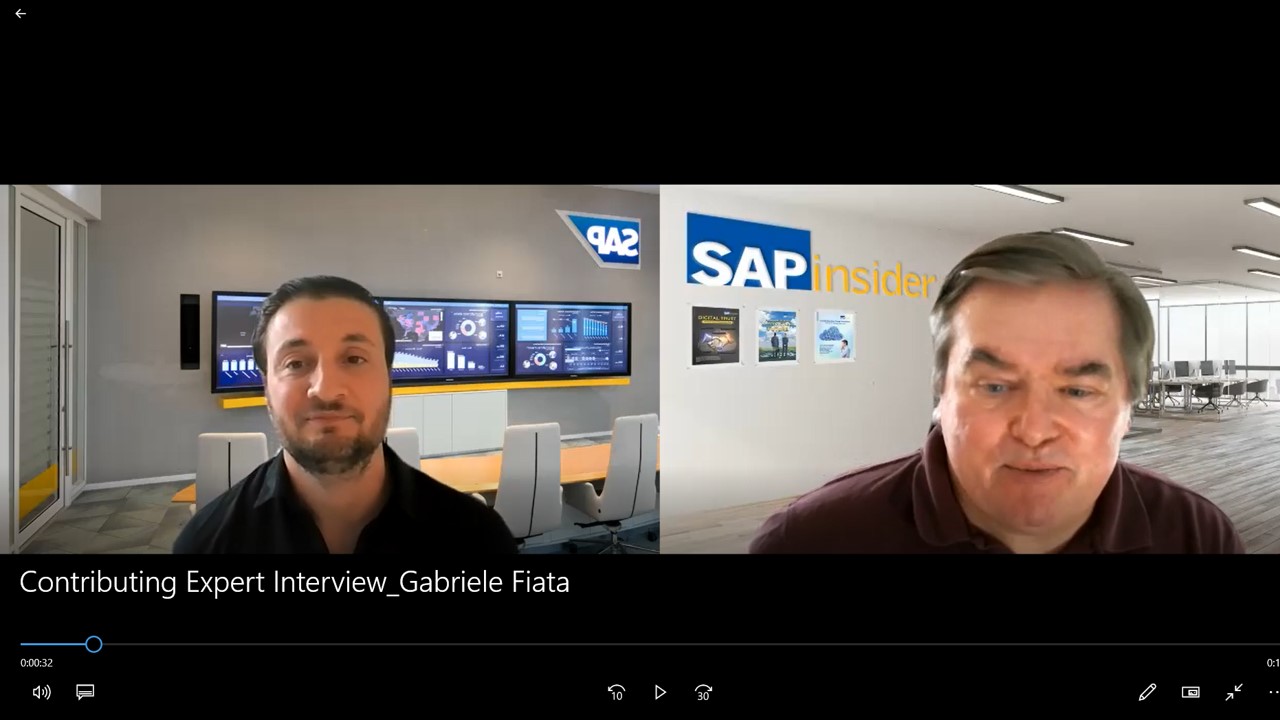
Expert Q&A: The Importance of Integrating Cybersecurity and Enterprise Risk ManagementAs security professionals are all too aware, cyber threats have become dramatically more visible to many organizations in the last couple of years. And risks have proliferated across the enterprise. Gabriele Fiata, head of enterprise risk management and innovation at SAP, recently sat down with SAPinsider to share his thoughts on the common mistakes that enterprises make when managing cybersecurity risk and the need to integrate cybersecurity into an enterprise’s risk management framework. Fiata has worked in the SAP security and GRC space for more than 15 years, the last three with SAP itself. In the following video, Fiata explains some of the common security mistakes that enterprises make, including being overconfident about risk, not having risk owners, and following hyped up security trends. To correct these mistakes, organizations should integrate cybersecurity risks with other risks so that the C-suite and board have a comprehensive view of risk, he advises. Watch the video to learn more.
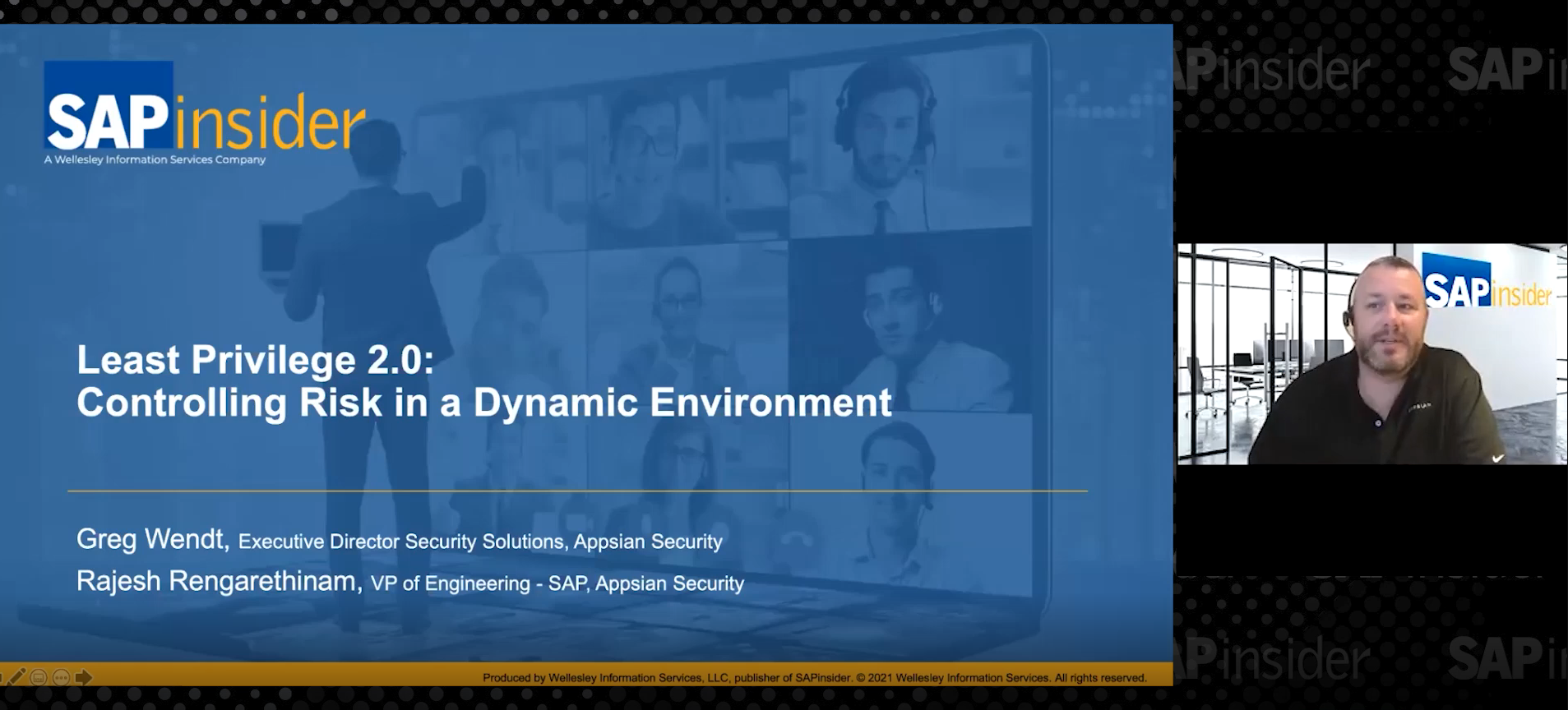
Least Privilege 2.0: Controlling Risk in a Dynamic EnvironmentA growing landscape of laptops and smartphones, widespread internet access, and remote workforces throughout the world have increased the need for risk and identity management and has changed how security models should operate. Continuing to focus on only two dimensions, the “Who” (users and user groups) and the “What” (roles and authorizations), leaves organizations vulnerable to new and emerging security threats. Today, businesses must consider a third dimension to user access risks: the “When.” How can companies better control the assignment of access rights related to tasks, rather than unilaterally granting privileges to users? In this session, join Appsian’s SAP Security experts as they discuss how SAP ERP customers can address and manage Least Privilege in today’s digital world, while explaining why access governance is critical to SAP security and how organizations can take steps to minimize their risk exposure. Attend this session to learn how to: - Strengthen Least Privilege by incorporating context into controls - Minimize risk exposure while enabling flexible, user-friendly access - Protect critical data and transactions in untrusted environments - Adapt to changing security and compliance requirements

Related Vendors