SAP and Snowflake Partner to Provide Better SAP BDC Integration
Meet the Experts

Key Takeaways
-
SAP and Snowflake are integrating to allow customers to govern SAP data within its semantic layer while leveraging Snowflake's AI capabilities and performance, with solutions expected by early 2026.
-
The partnership enables zero-copy data sharing, allowing SAP-managed data to be utilized in Snowflake without duplicating it, thus maintaining governance and business context.
-
To maximize benefits, SAPinsiders should prioritize a BDC strategy, align governance models between SAP and Snowflake, and focus on specific AI use cases that leverage Snowflake's ecosystem.
SAP and Snowflake are integrating SAP Business Data Cloud (BDC) with Snowflake data and AI cloud platform through a new SAP solution extension, and SAP BDC Connect on Snowflake. The goal is to let customers keep SAP data governed within SAP’s business semantic layer while still utilizing Snowflake’s performance, ecosystem, and AI capabilities.
The integration on SAP’s side, called SAP Snowflake, includes an integrated business data fabric that connects SAP and non-SAP data and aims to simplify governance as data is read across the two systems, and is set to be available in Q1 of 2026. SAP Data Cloud for Snowflake, which enables bidirectional, zero-copy data sharing with Snowflake, is expected to be generally available to customers by the end of H1 2026.
Zero-copy data sharing is a central technical pillar of the partnership and integration between SAP Business Data Cloud and Snowflake. Instead of duplicating data into yet another lake, customers can expose SAP-managed, semantically enriched data products to Snowflake while retaining SAP’s business context, lineage, and governance controls.
Explore related questions
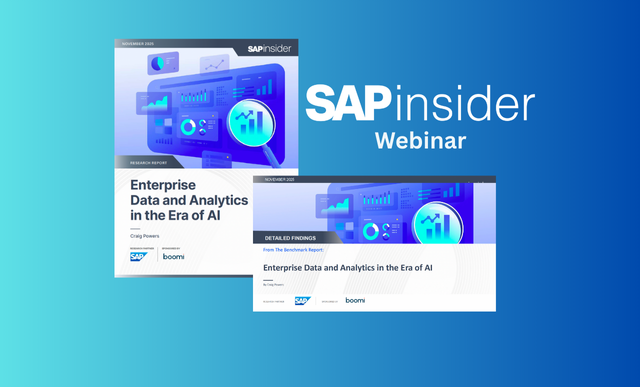
SAP’s expanded collaboration with Snowflake marks an important step in how SAP customers will architect their data and AI foundations over the next several years. For the 26% of respondents to our recent Enterprise Data and Analytics in the Era of AI research who have been building on Snowflake while running core processes on SAP, this move expedites operationalizing a joint data platform strategy.
Making AI on SAP Data More Practical
From an AI perspective, this partnership aims to remove a major barrier for SAPinsiders in getting high-quality SAP data into modern AI platforms without breaking governance or incurring heavy integration costs. With SAP BDC as the semantic foundation and Snowflake providing scalable compute and a large AI ecosystem, customers can design AI use cases such as forecasting and copilots on top of consistent business definitions rather than one-off extracts.
What This Means for SAPinsiders
- Prioritize an SAP BDC strategy that defines which SAP domains (finance, supply chain, HR, CX) will be modeled as governed data products. These will be the primary assets you expose to Snowflake for AI and advanced analytics.
- Align Snowflake and SAP governance models by harmonizing roles, data classification, and lineage policies. This will help ensure zero-copy sharing does not create a parallel “shadow” set of rules outside your SAP controls.
- Start with a focused set of AI and analytics use cases. This can include examples like margin analytics, inventory optimization, or customer lifetime value that clearly benefit from Snowflake’s ecosystem and performance. Design them around SAP’s semantic models rather than custom data marts.