SAPinsider Benchmark Research – RISE with SAP 2025
A Market Divided and a Looming Resource Crunch
Meet the Experts

Key Takeaways
-
The narrative around SAP migration has shifted from 'why move?' to 'how fast?' as organizations prepare for the impending 2027 end-of-maintenance deadline.
-
Smaller organizations are adopting the RISE with SAP package at higher rates than larger enterprises, which are mostly in planning or exploration phases due to cost concerns and unclear business value.
-
There is a growing influence of Generative AI on ERP strategy, but security compliance gaps and a shortage of skilled implementation resources pose significant challenges.
As 2025 ends, the narrative around SAP migration has shifted from “why move?” to “how fast?”
This SAPinsider report, based on a survey of 122 community members conducted in late 2025, highlights a marked acceleration in cloud ERP adoption as the 2027 end-of-maintenance deadline approaches.
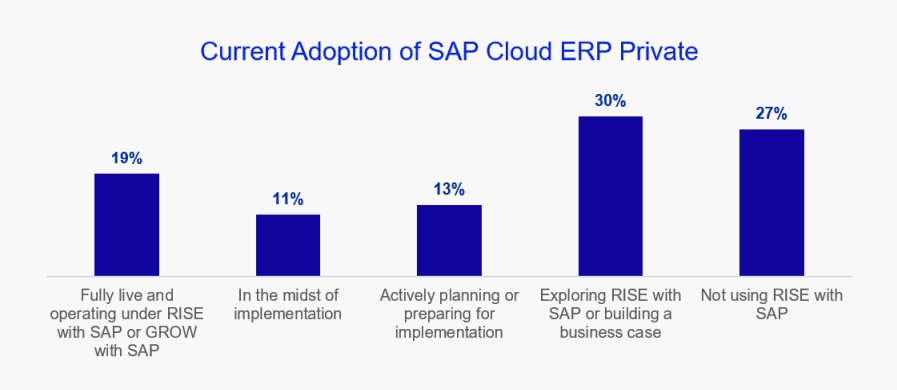
Now commercially referred to as SAP Cloud ERP Private, the RISE with SAP package is seeing varied adoption rates; smaller organizations (under $2 billion in revenue) are currently twice as likely to be live on the solution compared to larger enterprises, which are predominantly in the planning or exploration phases.
While SAP’s dedicated transition support and license conversion credits are the primary drivers for migration, cost and unclear business value remain significant barriers for holdouts. The report also identifies a growing influence of Generative AI on ERP strategy. However, it warns of critical gaps in security compliance and an impending shortage of skilled implementation resources.
Download the benchmark report to read the full data analysis and receive recommendations for your own plans.
– Understand why there is a concerning lack of security awareness
– Why we forecast that implementation partners will struggle to staff the volume of concurrent projects required to meet the 2027 and 2030 deadlines.
– How SAP’s direct support and financial incentives are driving adoption rates



 Premium