1 minute read

Meet the Authors
Key Takeaways
-
Establish a resilient digital thread to close the OT/IT gap by implementing a three-tier framework that connects machine sensors to executive applications, ensuring continuous and reliable data flow.
-
Leverage lightweight Kubernetes at the device edge for local, real-time processing and AI, enabling immediate quality checks without requiring extensive server infrastructure.
-
Ensure 24/7 operational continuity with local edge integration by utilizing Edge Integration Cell on Red Hat OpenShift, which provides store-and-forward resilience to maintain data integrity during network outages.
Industry 4.0 has promised a revolution in manufacturing. Still, for many SAP professionals the data gap between high frequency operational technology (OT) on the factory floor and the enterprise IT systems that drive business decisions, remains a primary hurdle. Closing this gap requires a secure, scalable, and resilient foundation that can handle the unique rigors of the shop floor.
The collaboration between Red Hat and SAP addresses this issue through a three-tier architecture that creates a continuous digital thread. This thread ensures data flows reliably from a single machine sensor all the way to the executive boardroom.
Let us look at the first two tiers and how they set the stage for Tier 3 of the collaboration that helps organizations achieve a consistent hybrid Cloud Core:
Explore related questions
Tier 1: Intelligence at the Device Edge
The journey begins at the Device & Plant Edge. This environment is characterized by minimal resource availability and a requirement for extreme stability. Here, Red Hat Device Edge/MicroShift—an ultra-lightweight, hardened Kubernetes distribution—provides the platform for local, real-time processing for manufacturing plants.
By running basic AI locally, such as immediate defect checking via vision systems, manufacturers can act on data in milliseconds. This foundation communicates using standard industrial protocols like OPC UA and MQTT, ensuring that the digital thread starts with a common language.
Tier 2: The Resilient Plant Control Hub
As data moves to the system, the architecture shifts to Red Hat’s enterprise Kubernetes platform, Red Hat OpenShift. This tier acts as the plant’s secure, containerized control hub that hosts essential software like Manufacturing Execution Systems (MES).
A critical component residing here is the Edge Integration Cell, a hybrid integration runtime offered as part of SAP Integration Suite. By running Edge Integration Cell on OpenShift, the system gains “store-and-forward” resilience. This means that even during a network outage between the plant and the central cloud, data is captured locally and forwarded once the connection is restored, guaranteeing that mission-critical operational data is never lost.
In the second part of this two-part series, we will explore how the third tier transforms raw operational data into strategic business insight.
What This Means for SAPinsiders
Establish a resilient digital thread to close the OT/IT gap. SAPinsiders should move beyond fragmented silos by implementing a secure, three-tier framework that connects the smallest machine sensors directly to executive-level business applications. This digital thread ensures a continuous and reliable flow of data across the entire enterprise.
Leverage lightweight Kubernetes for intelligence at the device edge. By utilizing Red Hat Device Edge/MicroShift at Tier 1, organizations can deploy containers for local, real-time processing and AI—such as immediate quality checks—without the overhead of full-scale server infrastructure. This foundation is purpose-built for minimal resource consumption and maximum stability on the shop floor.
Ensure 24/7 operational continuity with local edge integration: Running Edge Integration Cell on Red Hat OpenShift at the plant hub (Tier 2) level provides essential store-and-forward resilience. This technical configuration guarantees that data is never lost, as it is cached locally during network outages and forwarded once connectivity to the cloud core is restored.
More Resources
See All Related Content

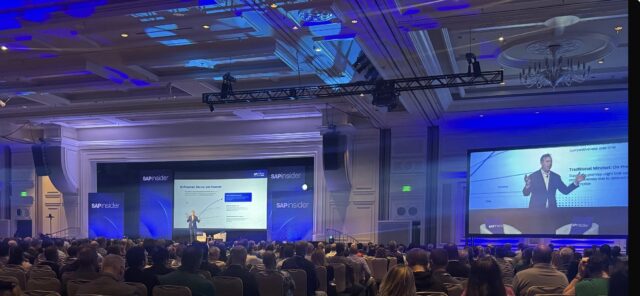
SAPinsider Las Vegas Opening Keynote: David Robinson Says SAP Customers Must Rethink IT Operating Models, Not Just Modernize ERPDavid Robinson, President of SAP North America, highlighted at SAPinsider Las Vegas that business transformation is no longer a linear process, as enterprises face an exponential convergence of AI, cloud, and automation.
4 minute read