Management
Project managers at SAP ERP companies spend an awful lot of time planning the seamless integration of a variety of tools and technologies. However, they often devote far less time when forming their project teams.
Anurag Barua, a senior manager at a major consulting company, says project staffing failures can doom a project long before it even gets going.
“Many project managers don’t plan the composition of their team in advance, and a lot of these projects fail because the project managers didn’t find the right fit. And even if they are eventually able to find the right fit, by that point it’s too late,” says Barua.
Part of the problem, according to Barua, is that many project managers are experts at tackling technical or business issues that can be solved with software or altered processes. Building and maintaining a project team requires a different skill set entirely.
“You can change a system’s behavior, but you cannot easily change a person’s behavior,” he says.
Barua says project managers can eliminate many of these issues by understanding four basic keys to building and maintaining an SAP project team.
Key #1 — Establish Clear Roles
Before searching for qualified team members, project managers should spend considerable time defining the roles needed for a particular project. The precise makeup of the team depends largely on the size, scope, and type of project, but Barua recommends beginning with a loose categorization of the different roles you are likely to need during the project.
Among the roles project managers should consider are functional and configuration analysts, technical analysts, testers, trainers, departmental resources (including end users and power users), and an infrastructure team of SAP Basis or SAP NetWeaver experts. Barua also recommends including business process and subject matter experts from the business side in this initial role planning stage, as shown in Figure 1.

Figure 1
Defining a project team’s basic roles
Once the basic roles have been defined for the project, project managers should compile requirements for each role. For example, functional analysts should have experience with the SAP application being rolled out or a combination of different SAP applications. Infrastructure team members should meet requirements for experience that fits the company’s particular SAP landscape.
Defining these requirements can be difficult when implementing an SAP project for the first time, Barua says. In those situations, it helps if project managers have already built strong relationships with consultants or other information resources who can guide the process.
“You need a few good relationships with vendors. It helps if you’ve been doing that for a few years, or if it’s your second implementation. But if it’s your first one, you have to establish a relationship with the vendors quickly so you can get those resources,” says Barua.
Defining specific requirements for each role doesn’t just help project managers get a clear view of their needs, it also helps focus their recruiting efforts and minimizes the time spent combing through resumes. Advertising for “an experienced Java developer” will typically result in a flood of applicants, whereas as advertising for “a Java developer with experience in SAP R/3 4.6c and specific knowledge of SAP GRC and cross-application development” is more likely to draw only qualified applicants.
The Bad Ad: Avoid Embarrassing Mistakes in Recruiting Materials
Recruiting top SAP talent is difficult, so project managers must be careful to avoid gaffes and errors in job advertisements and recruiting efforts that may turn good candidates away.
Consider the company that placed a job advertisement for “A senior SAP Architect with 5 years of development experience on SAP ERP 6.0.”
Or the company that searched for “An SAP security expert with 5 years GRC experience.”
Since neither SAP ERP 6.0 nor SAP GRC has been around for five years, these ads reflect poorly on the companies that post them.
“I’ve seen companies make foolish mistakes like this that cost them good, serious applicants,” says Barua. “All you’re going to get are the frivolous ones.”
Key #2 — Find the Right Fit for Each Position
Once you know which roles you need, and the requirements for each role, it is time to find the right people for the team. While this practice is “more art than science,” according to Barua, there are ways to introduce scientific rigor to the process.
Barua recommends a number of tips for successfully matching people to positions.
Phone Out the Phonies
Because SAP skills are in such high demand — and project managers are in such a hurry — Barua says many job-seekers have been able to fudge, fabricate, or significantly pad their resumes.
Hiring a candidate based on manipulated qualifications can lead to disaster down the road. If the project manager is lucky, the candidate’s deficiencies will only set the project back a few weeks — and won’t ruin it altogether.
The first step for weeding out unqualified candidates is a simple phone screen, says Barua. A few quick questions to verify the information on the candidate’s resume can save valuable time and money during the project phase.
Show Them Around
However, even a relatively in-depth phone interview is not enough to vet a candidate, according to Barua. Project managers should meet face to face with each candidate — and insist that others meet with them as well.
“Provided a person passes the phone screen, I always insist that the person come in to meet face to face with me, and with some of the key people on the project. This makes your judgment of that person more objective across the board,” says Barua.
For example, while a project manager might think a candidate possesses a high level of leadership abilities, another interviewer might feel otherwise. Barua suggests that key project stakeholders, including senior and executive managers, participate in the hiring process even if those interviewers have limited knowledge of the SAP system or project specifics.
Project managers can expect some pushback from these stakeholders, who are busy with their own work, according to Barua. However, as long as the list of candidates is kept relatively short, project managers should insist on multiple interviews. Key stakeholders should only meet with high-level project team members.
“Eighty percent of the people on a project team are going to be development people — the configuration, Basis, or SAP NetWeaver people. Only 20% would be the team leads or project manager types of positions. It’s a relatively small group,” says Barua.
Create a Requirement Matrix Before Interviewing Candidates
Gut instinct is important when selecting team members, but many project managers rely too heavily on subjective “feelings” about a candidate. This is problematic because it does not account for variables that can affect an interview — such as whether the candidate has a cold or the interviewer is having a bad day.
Barua says creating a candidate requirement matrix can bring some much-needed objectivity to the interview process. A candidate requirement matrix can be as simple as a Microsoft Excel spreadsheet, in which each candidate’s qualifications are compared against the requirements defined for that role. Project managers can then weight the candidates’ raw scores based on the importance of that requirement to the project. An example of a candidate requirement matrix is shown in Figure 2.
Consider Contract-to-Hire Arrangements
To reduce the risk that project team members will be unfit for the position, Barua says companies should consider offering contract-to-hire positions to qualified candidates. That way, if the employee is determined to be ill-suited for the job, the company avoids the costly process of termination.
“It’s a very good risk mitigation strategy. Let’s say you meet a person who everyone likes. I don’t think there is a big danger in bringing him on for two or three months and saying that if he passes the test, you’re going to convert him to full-time. That has worked well at a lot of companies,” says Barua.
These arrangements often benefit candidates as well, since they do not need to wait for lengthy reference checks before they are hired.
Key #3 — Keep Your SAP Talent Pool Motivated
The global shortage of SAP skills is no myth, says Barua. Recently, the head of a large Indian outsourcing firm complained to him that while Indian companies enjoy a surplus of available young talent, they still struggle to find experienced SAP professionals for jobs that require advanced skills.
In this type of global job market, it is critical to keep talented professionals motivated. Barua says project managers should think of team motivation as a type of risk management, as it can reduce the costly process of hiring and training replacements.
The most obvious way to keep good talent around is to lure them with increased pay, but Barua says his experience has shown that good talent isn’t motivated solely by money.
“What I’ve found is that the main reason people leave is that they perceive a lack of appreciation for what they do. It’s not always about the money, because a good SAP resource won’t even join your company if you don’t offer good money,” he says.
Ensuring your project team feels rightly appreciated for its efforts is often a tricky process laden with psychological ramifications.
An easy way to demonstrate your appreciation is to single out high-performing team members in public settings while avoiding accepting too much credit at the project manager level. However, you have to be careful with this approach because it can complicate matters. Sometimes, singling out a few specific team members causes other team members to feel underappreciated. Barua says he’s found the best approach in this situation is to single out the team as a whole in public settings while avoiding mention of specific team members.
Another way to show appreciation for highly-skilled team members is to consult them on projects or plans not directly related to their work. Even if the project manager does not intend to heed the employee’s advice, the act of soliciting the opinion can have a tangible benefit.
“A little appeasement goes a long way to making that person feel good about his or her value,” says Barua.
A Risk-Based Approach
Of all the project risk categories, human resources is the most complicated, the hardest to quantify, and the most difficult to manage, according to Barua.
The reason is that most other risk categories deal with inanimate objects with predictable, controllable behaviors. People, on the other hand, are often unpredictable and present unique management challenges.
For example, many teams saddle high-performing team members with so many responsibilities and tasks that the company risks losing critical knowledge if that employee leaves. Such “risk resources” as Barua calls them, are dangerous to project teams despite their accomplishments.
“Far too often we see so-called superstars — who have only become superstars because no one knows exactly what they’re doing and because they are treated like superstars — have little incentive to share what they are doing and document it. They believe they are indispensable, so they don’t abide by the rules. Anytime you don’t know what someone is doing, and they are not documenting it, you shouldn’t hesitate to penalize such people. In these multimillion-dollar projects, we spend so much time and maintenance trying to figure out what a certain person did, that if they don’t document properly, it’s a huge risk,” says Barua.
To guard against task-hoarding or overloading any team members, project managers should keep an evolving matrix of the responsibilities for each role in the team. Project managers can use this matrix to identify needs and to offload tasks from overburdened team members. A sample resource matrix is shown in Figure 1.
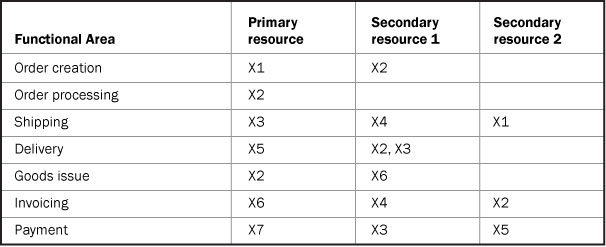
Figure 1
Tracking the project teams skills and responsibilities
Key #4 — Think Globally
As globalization has evolved from a trend to a simple fact of life for SAP project managers, the skill of managing global project teams in increasingly important. SAP project managers need to be sensitive to cultural concerns in order to successfully manage a global team, says Barua.
One of the most important skills for project managers in such environments is the ability to build an understanding of cultural differences among team members. This is easier said than done, according to Barua, as the only way to build that understanding is to spend time studying and interacting with a different culture.
As an example, Barua cites the differences between typical Japanese business presentations and typical Western presentations. Japanese presenters are typically more deferential and consensus-driven than their Western counterparts, a difference that Barua says can be jarring at first. Ignorance of these differences can be embarrassing for an American project manager presenting to his Japanese team, and can cost the project manager credibility.
Another example Barua cites is the custom among Indian men to call their elders “Sir.” Understanding the underpinnings of the custom — Barua says it dates back to British colonialism on the subcontinent — can help visitors navigate the social mores of a meeting with Indian project team members.
“It almost sounds like a person has to be an anthropologist or sociologist, but that’s not really the case. I would say that a certain awareness of a culture goes a long way,” says Barua.
The best way to build knowledge of foreign cultures is to expose yourself to them as much as possible. Barua suggests companies offer incentives for project team members to accept international assignments, and recommends project managers travel to foreign team locations often for face-to-face interaction.
However, cultural sensitivity takes a back seat to project requirements, so a good project manager knows when to force the issue, according to Barua.
“When it comes to client satisfaction and on-time delivery, there can’t be any compromise. Deadlines have to be uniform across the board, and just because there are differences in the way people work doesn’t mean there can be different dates for each group. And in terms of quality, people cannot say, ‘English is not my first language so this deliverable is full of misspellings.’ That’s not going to fly,” says Barua.
Davin Wilfrid
Davin Wilfrid was a writer and editor for SAPinsider and SAP Experts. He contributed case studies and research projects aimed at helping the SAP ecosystem get the most out of their existing technology investments.
If you have comments about this article or publication, or would like to submit an article idea, please contact the editor.