Management
As the stormy economy continues to batter even the sturdiest businesses, even healthcare companies are feeling under the weather. However, while many are cutting back on IT spending, there are positive signs for SAP professionals as the industry continues its march to modernization.
The federal stimulus package focused considerable public attention on technology and the healthcare industry in the United States. The bill allocates billions for modernizing the way healthcare providers and payers create and share information. Experts say SAP projects are in a good position to capitalize on this effort, and SAP executives are optimistic that healthcare companies will increasingly rely on SAP technology to help modernize the industry.
To capitalize on the drive toward IT modernization, SAP professionals in the US healthcare industry should first understand the economic factors driving decisions in the industry, and how those factors may impact their SAP projects.
Driving Factors
The three primary factors driving decisions in the US healthcare industry are the recession, the push to modernize healthcare IT, and the economic stimulus package passed into law in February 2009. Here is a closer look at how each factor affects the healthcare industry.
The Recession
Healthcare is widely considered to be more resilient to economic downturns than other industries because of the persistent high demand for medical care. Experts polled by ERP Expert say healthcare is indeed more capable of weathering economic difficulties than other industries because people will always need doctors and hospitals. However, the conventional wisdom that healthcare is recession-proof is being tested like never before.
“Even though people still get sick, there is a percentage of healthcare that is elective. Across the country, we’re seeing that people who can delay purchases are doing so — and that applies to elective healthcare as well,” says Dr. Robert Carlson, CIO of the Marshfield Clinic in Marshfield, WI.
Tightening credit lines and reduced philanthropy have squeezed healthcare companies further. Many are cutting back on major projects, including those in the IT department, to conserve cash.
A January survey of healthcare providers by the American Hospital Association found that 45% of respondents were putting capital projects on hold. Of that group, 62% cited IT projects as likely to be delayed. The benefits expected from those delayed projects include the automation of clinical processes (cited by 82% of respondents), replacing or updating existing IT infrastructure (74%), and automating administrative processes (50%), as shown in Figure 1.
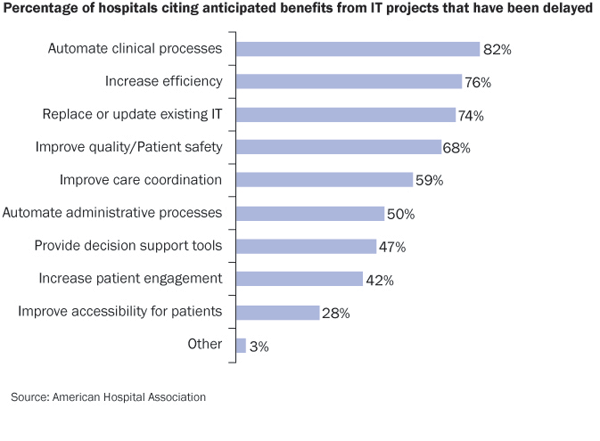
Figure 1
The expected benefits of healthcare IT projects that have been delayed
“Everyone is trying to tighten their belts, and right now they’re not doing anything major,” says an executive at a major medical device manufacturer that runs SAP, who requested anonymity. “People are trying to conserve capital because of the unknowns in the economy. I don’t see healthcare companies any differently.”
However, some experts say business-critical projects and technologies like SAP are unlikely to be abandoned even in bad times. A recent survey by SAP upgrade solution vendor Panaya has found that most companies are moving ahead with their SAP system upgrades despite the downturn in the economy. Three out of four survey respondents said their upgrade projects would continue on schedule, while only 11% said they would be delayed beyond 2009.
“I think the focus of the healthcare industry recently has been the investment in clinical electronic medical record implementation,” says David Laker, senior vice president of healthcare, SAP. “The net new acquisitions of those projects has slowed down, but the continuation of those projects has not been impacted. They’re not being cut because of the impact they have on the overall organization’s performance.”
SAP offers industry focused software solutions to healthcare companies in three basic groups: providers, payers, and life sciences companies. Laker says the SAP healthcare project pipeline has grown despite the recent economic turmoil as companies decide to continue funding core IT projects. He recently visited a healthcare provider that has eliminated five major capital projects from its plans, but will forge ahead with the replacement of its legacy ERP system.
“Eventually they’re going to have to do it anyway, even though they’re making cuts in other areas. Based upon the business case they’ve developed, they felt this was a project that stood on its own and needed to be done sooner rather than later,” he says.
Becky Nies, healthcare industry principal for SAP, says that philosophy applies to upgrades as well, as companies continue to invest in newer technologies.
“We’re not seeing any budgets going away in terms of getting them to the latest applications, whether in finance, supply chain, or HR,” says Nies.
The Push for Modernization
At first glance, the effort to digitize electronic medical information may not seem like an opportunity for SAP professionals, who typically work with core back-end applications. However, experts say SAP can play a big role in managing the data, human capital, and financial planning required of the fully modernized healthcare company.
In fact, electronic medical records may only be the beginning of a much larger effort that will increase demand for large applications that can manage business processes across multiple applications and data sources.
“Even if the entire country had electronic records available, we often describe that as the race to the starting line,” says Carlson. “Simply automating a paper system may improve the availability of the information, but what it really does is set the stage for things like decision support and real-time error checking. I don’t think it’s going to have the long-term impact that a lot of people think until we can take things to the next level.”
The Marshfield Clinic recently decided to implement SAP BusinessObjects to handle the challenges it faces. Laker says the SAP BusinessObjects platform gives companies — even those outside the core SAP customer base — the ability to tie data from disparate systems together.
“Accessing and managing that information across all different business systems, whether clinical, financial, or invoice systems, continues to be a priority. Having our SAP BusinessObjects platform in place makes SAP a great opportunity for providers because a customer may think about updating their infrastructure, but instead may update their BI platform strategy across multiple platforms,” says Laker.
The Stimulus Package
The American Recovery and Reinvestment Act of 2009 — more commonly known as the stimulus package — allots $148 billion for the healthcare industry. About $20 billion of that is aimed at improving IT in healthcare providers. For example, starting in 2011, hospitals that employ “meaningful” health information technology will be eligible for up to $11 million in government incentives.
The actual plan for distributing that money is still in the works. However, the availability of federal money for such projects offers an opportunity for SAP professionals who can effectively position the technology at the center of overarching modernization efforts, according to Nies.
“In order to receive funds you have to be able to provide ‘measurable improvement,’” she says. “To get that, you have to be able to work in multiple systems to be able to demonstrate that return. Some people might think that’s not on the ERP side, but if you think about capacity planning, nurse-to-staff ratio, and all of those things from a resource perspective around the patient, that’s exactly what ERP can assist with. You still have to get all of your resources in play, your staffing models, your utilization rates, your planning and consolidation, etc. Patient information will flow differently with electronic medical records. But the quality of care still has to be monitored through business performance applications.”
Flying Through the Cloud
Carlson likens the current economic situation to flying an airplane through a dark cloud — companies have to rely increasingly on their instrumentation to guide them. Going forward, the healthcare industry will only increase its reliance on IT to survive.
“Healthcare in this country is undergoing a dramatic change. We are entering a perfect storm where the baby boomers and the incidents of chronic disease are increasing at the same time reimbursements are going down,” he says. “We are going to have to do more with less funding. This will require us to get a lot more effective and efficient.”
What You Can Do Now
Positioning the SAP system as central to the company’s ongoing drive for efficiency may help SAP ERP professionals stay ahead, even during difficult times. While much of the public’s attention is fixated on electronic medical records, Nies says, SAP professionals in the healthcare industry should focus on key areas where proper management can boost operating margins right away, such as managing human resources and supplies.
She recommends several initiatives SAP professionals can bring to the CIO or CEO that will reinforce the importance of the SAP system by promising immediate returns, including:
- Retiring and replacing legacy systems that can no longer support the comprehensive needs associated with managing hospital finance and operations
- Integrating and automating budgeting and planning
“For many hospitals today this is disconnected from their financial systems and thus disconnected from financial actual, is executed manually, is time consuming to manage, and nearly impossible to report on,” says Nies.
Automating and integrating this process can reduce budget cycles by 40% and reduce the time required to produce month-end and year-end reports by 50%, she says.
- Implementing a strategic supply chain with an emphasis on spend analytics, strategic sourcing, and contract management to optimize supply spend and leverage contract compliance and volume discounts
- Automating risk and compliance with segregation of duties and compliance monitoring
- Standardizing the reporting processes
- Utilizing solutions from the SAP BusinessObjects portfolio including query and reporting, dashboards and data management
Davin Wilfrid
Davin Wilfrid was a writer and editor for SAPinsider and SAP Experts. He contributed case studies and research projects aimed at helping the SAP ecosystem get the most out of their existing technology investments.
If you have comments about this article or publication, or would like to submit an article idea, please contact the editor.