Management
Like most global businesses with subsidiaries in dozens of countries, SAP’s reporting requirements are daunting. The looming switch to IFRS in the US has complicated things even further, requiring SAP to implement a parallel accounting structure to account for both US GAAP and IFRS reporting rules. See how the company was able to manage this complex project successfully, and how it plans to build on IFRS for the future.
With 180 subsidiaries dispersed throughout the globe, SAP has the same accounting and reporting challenges as any other multinational corporation. With the US Securities and Exchange Commission (SEC) pushing for a transition from US Generally Accepted Accounting Principles (GAAP) to International Financial Reporting Standards (IFRS), SAP began to overhaul its accounting procedures in 2003.
In a recent Webinar, Christiane Ohlgart, IFRS project lead for SAP, offered a behind-the-scenes look at how SAP established a parallel reporting scenario in which the company relies on US GAAP as its primary reporting guideline but is capable of reporting under IFRS to satisfy international guidelines. The project has helped ease the transition to IFRS, which SAP expects to rely on as its primary reporting guideline in 2010. The Webinar was sponsored by SAP EcoHub.
Diverse Reporting Requirements
Like many large companies, SAP reports to several different governments and organizations. With headquarters in Germany, SAP adheres to German requirements for quarterly, half-year, and full-year reporting, plus audits, risk management, and corporate governance requirements. Most German regulations are based on European Union (EU) standards, which include several — but not all — IFRS guidelines. German authorities also require some reports not covered by IFRS or US GAAP.
Additionally, SAP is listed on the New York Stock Exchange (NYSE) and is subject to reporting requirements under the SEC. Each of SAP’s 180 subsidiaries must also adhere to the reporting requirements of their local governments (Figure 1).
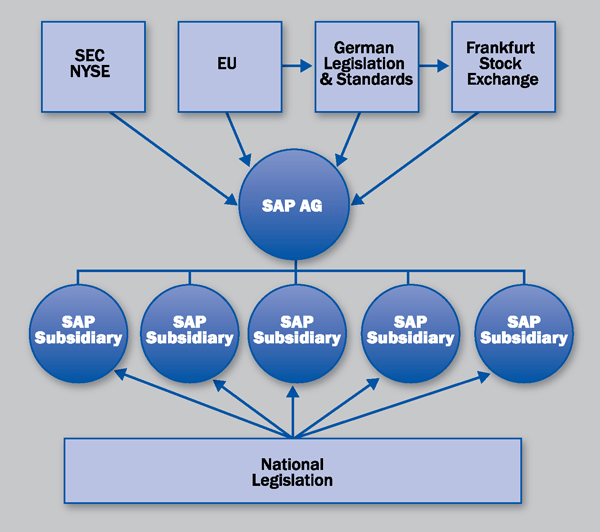
Figure 1
An overview of SAP’s reporting requirements. Source: SAP
To manage the complexity of its financial reporting obligations, SAP’s Corporate Financial Reporting department consolidates and manages all SAP accounting and reporting obligations.
“We have a uniform chart of accounts for all SAP companies that is controlled by our department,” says Ohlgart. “It is very beneficial to us that all SAP companies are on one system and in one client.”
While undergoing the transition to IFRS, SAP still uses US GAAP as the standard accounting language internally and externally. The Corporate Financial Reporting group adheres to IFRS at the same time, but posts those reports as adjustments to US GAAP. All subsidiaries are required to post data under US GAAP first, then produce statutory financial data afterward.
To manage its parallel accounting effort, SAP duplicates all the financial data from its subsidiaries into a consolidation database with real-time updates. All transaction information is included in the database.
“Our consolidation is probably not the textbook aggregation of individual financial statements, but it is very flexible, fast, and we don’t have pre-consolidated figures that don’t provide any insight,” Ohlgart says.
The Corporate Financial Group also runs several automated procedures to accelerate the consolidation process (Figure 2).
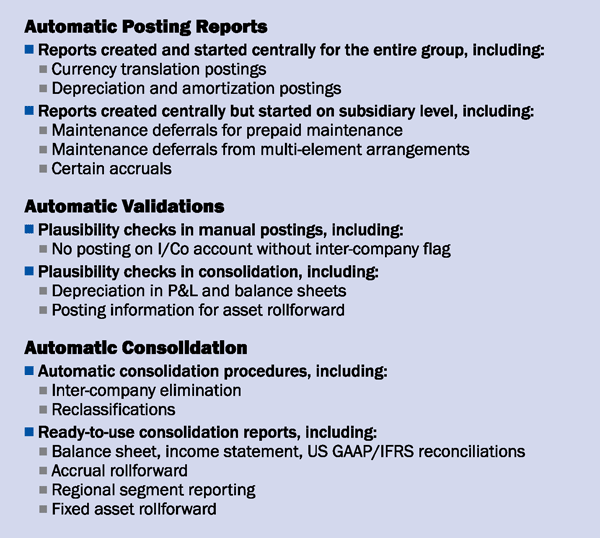
Figure 2
Automated processes for SAP’s financial consolidation. Source: SAP
Keys to the SAP IFRS Project
SAP began its IFRS conversion project in 2003 after the EU announced that all reports from 2007 onward would have to be submitted under IFRS. At that time, SAP already knew that some subsidiaries would be subject to IFRS even earlier — including SAP Australia, which was required to adopt IFRS by 2005.
“That meant SAP Australia would have to go live before SAP as a group with its IFRS financials. That put pressure on us, because we wanted to avoid a situation in which SAP Australia applied accounting policies that would not be consistent with group policies in the end,” says Ohlgart. “We had to work very quickly with SAP Australia to come up with policies in time for Australia to apply group policies for its statutory reporting.”
The SEC began allowing foreign companies to report under IFRS beginning in 2007. However, SAP chose to keep US GAAP as its primary accounting standard because that is the standard that its primary competitors (mostly based in the US) use — and continues to be the preferred standard for financial markets.
The IFRS project was focused on two major objectives. First, SAP needed to analyze the differences between IFRS and GAAP reporting and determine how those differences applied to SAP. The next objective was to ease the transition by making adjustments to SAP’s reporting under US GAAP.
“For example, before 2006 we had an old balance sheet structure governed by German GAAP, but IFRS requires classified balance sheets. So we changed to classified balance sheets in US GAAP so we wouldn’t have any harmonization issues there,” says Ohlgart.
At the time the project steering committee set the goals for the project, IFRS was not well-known or widely adopted in the US. However, the situation has changed significantly in the past six years, according to Ohlgart.
“IFRS is becoming more of a focus in the US, and we believe we’ve shown that the differences between IFRS and US GAAP are so small that we should reconsider our initial assumptions,” she says.
The project team divided project tasks into three groups:
1. Know-how tasks
These tasks included determining the differences between reporting under IFRS and US GAAP, preparing SAP’s accounting policies under IFRS, assessing the need for third-party support, and training of relevant employees.
2. Technical tasks
These tasks included preparing the IFRS chart of accounts and the determination of additional accounting objects.
3. Organizational tasks
These tasks included rolling out the IFRS policies to SAP subsidiaries and establishing a network of IFRS specialists in each region.
Each task included several sub-tasks overseen by the project team. Figure 3 illustrates the project’s timeline, broken down by the different tasks involved.
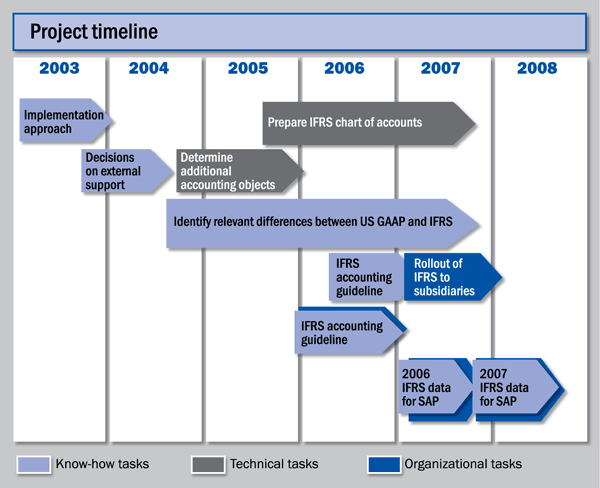
Figure 3
The SAP IFRS project timeline. Source: SAP
The project was governed ultimately by a steering committee that included the CFO of SAP, the head of corporate controlling, and development representatives.
“The steering committee met three or four times during the year and decided on strategic accounting questions, monitored milestones and the timetable, and assigned the budget,” says Ohlgart.
Among the areas identified by the project team as having major accounting differences between IFRS and US GAAP were provisions, pensions and termination liabilities, share-based payments, discontinued operations, and disclosures. These differences are typically caused by different valuation or recognition requirements, different classifications of balance sheet items, or different classifications of income statement items.
The team also identified several processes that would be affected by the IFRS project, and steps SAP would need to take to address the impact, including:
- Additional consolidation processes to quickly consolidate US GAAP and IFRS figures
- Additional accounts and reporting structures to add fixed asset classes, segment reporting, and other IFRS necessities
- Additional CO objects to capture IFRS deviations
- An IFRS accounting guideline and updates to the US GAAP accounting guidelines to support parallel reporting
- New transaction types for provision development
- Automation of certain standard US GAAP and IFRS differences, such as accounting for services revenues
- Expansion of the annual reporting package to include IFRS disclosures
Because SAP planned to report under US GAAP while maintaining parallel IFRS-compliant financials, the company had to establish so-called “I-accounts” in the chart of account and in the consolidation system to capture the differences.
On issue with this approach is that the SEC and EU standards for IFRS reporting are slightly different. The EU must approve each new IFRS standard, which often takes a long time to complete. The result is that SAP must monitor its IFRS reporting closely to ensure that these differences are accounted for.
The Future of IFRS and SAP
At the time SAP began its IFRS project, the US still had not made a major push toward adopting the new guidelines. However, the SEC insists that IFRS will be adopted soon in the US, prompting SAP to alter its approach.
Non-US companies can submit financial data under IFRS without first reconciling with US GAAP.
“We hope that US GAAP will no longer be required for US entities either, for full comparability. Despite the risk that IFRS might not be fully accepted in the US and the debate that the SEC currently has, we have decided that we will fully convert to IFRS in 2010, because our differences have really been minor.”
Davin Wilfrid
Davin Wilfrid was a writer and editor for SAPinsider and SAP Experts. He contributed case studies and research projects aimed at helping the SAP ecosystem get the most out of their existing technology investments.
If you have comments about this article or publication, or would like to submit an article idea, please contact the editor.