Find out some best practices to follow when you want to incorporate new technology and software into your supply chain processes.
Key Concept
In any supply chain optimization project, you must address strategic factors to ensure your business benefits from sustainable improvement. These factors include the project vision, reward systems, and use of tools.
I’ll highlight the roadblocks that supply chain initiatives typically face so you can avoid a bad case of
corporate fainting spells. Table 1 summarizes proposed solutions for each of these mistakes. These
mistakes in supply chain optimization are driven by the need to show quick results at the lowest cost possible.
Let’s look at each of these mistakes in detail.
| 1. Lack of balance between long-term vision and short-term accomplishments |
Use a balanced project scorecard that forces alignment across the enterprise |
Project scorecard must address process, people, strategy, and technology |
| 2. Silo vs. network reward systems — resolving the risk associated with reward conflicts
within the enterprise |
Use a risk management framework that assesses and quantifies risk |
Risk quantification is understood by all managers who own budgets |
| 3. Irrational focus on tool-based solutions |
Use a troubleshooting/business case framework that focuses on the root causes of the problem |
It is tempting to throw money at problems. The true value is achieved with the right tool
for the job. |
|
| Table 1 |
Methods for avoiding three typical optimization mistakes |
Mistake 1
Lack of balance between long-term vision and short-term accomplishments. Supply chain
transformation efforts are typically associated with tight budgets, aggressive targets, and high expected returns on
investment (ROIs). In some cases, companies want the effort to be self-funding via the anticipated savings. As a result,
there is a tendency to strive for short-term quick wins. The sense of urgency is understandable because the initiative can
translate into success for the business. On a personal level, project members may get tangible (financial bonus) and
intangible (good reputation) rewards for successful project delivery.
Short-sighted project planning typically ends up with a project that yields short-term gains offset by long-
term losses. Consider the case of an initiative to lower transportation costs by integrating a transportation management
system with the legacy system. In the short term, the quickest way to deliver the solution is to build and deliver a proof-
of-concept (POC) pilot.
In most cases, the approach involves focusing on the pilot success without consideration for other factors,
such as scalability, IT and business support requirements, integration with the existing landscape, alignment with
strategic objectives and key performance indicator (KPI) targets, and the total cost of ownership (TCO) over the strategic
planning horizon of the enterprise.
It is common for companies to create supply improvement projects on an ad-hoc basis driven by self-directed
teams with limited or no project methodology. What’s more, these projects typically emphasize optimizing the KPIs of
the sponsoring department. The end result is that quick gains are achieved at the expense of other parts of the
organization.
Going back to the example of a transportation management implementation, in the short term a successful POC
shows that the system meets business requirements under a particular set of assumptions. In this case, Joe, the supply
chain initiative manager, calculates the ROI based exclusively on extrapolating the results of the pilot.
Joe is a highly experienced transportation manager. His functional background and experience make him
suited for managing this project. His technical background, however, is relatively weak. His understanding of systems
integration is limited — he sees integration as an IT function he doesn’t have to worry about.
The initiative fails as he rolls out the project to the rest of the company because his short-term
objective was to deliver the POC pilot. He encounters many unforeseen obstacles. The end result is that although he had a
successful pilot, his initiative failed to gain momentum. The project is ultimately shelved.
Solution
Let’s look at what happened by breaking down the analysis to four areas: process, people, strategy,
and technology.
- Process. In the short term, objectives were met. The pilot ran well with data loaded
manually. Although Joe knew the data would come from the legacy system, his assumption was that interfaces would handle
the integration with the legacy system. This assumption, though, proves to be incorrect. The interfaces add additional
functional steps the users did not expect. The users were expected to troubleshoot interface exceptions. This exception
management exceeded the ability and patience of the end users.
- People. In the short term, the pilot had successful buy-in from the user community.
Testing was based on manually loaded data. However, Joe didn’t perform an end-to-end integration with existing
interfaces. This resulted in the end users slowly withdrawing from using the system.
- Strategy. Joe was unaware of the system performance implications of interfacing the
transportation management system with the legacy system. The result is that response time exceeds minimum service levels
due to system landscape constraints. Joe also realizes the maintenance of his new solution is IT resource intensive and
not scalable.
- Technology. Upon getting into the details, it becomes apparent that interface
complexity slows system response time. In addition, as mentioned in the process section, the temporary interfaces are
difficult to troubleshoot and not well documented. Users give up on using the new system and revert to manual workarounds.
Business KPIs show a dip in performance — project momentum is lost and it is shelved.
So what is the solution? Supply chain transformational projects should have a well-defined methodology that
ensures solutions add value at the enterprise level. It should include a balanced supply chain scorecard for every
initiative that analyzes and provides visibility on the expected ROI over the project’s life.
Table 2 shows a sample project ranking scorecard that balances the ROI with the required
alignment. Here Joe has two options — he can implement a non-SAP transportation management system or he can
implement SAP Transportation Management (TM). The non-SAP transportation management solution does not offer integration to
the legacy SAP system, whereas SAP TM does. The scorecard shows that although the SAP TM option has a lower ROI based on
Joe’s pilot results, it ranks higher because it takes into consideration all the required factors for success.
| Non-SAP transportation management system |
ROI is 51%
Score = 50 points |
Process score = 10
People = 5 (training is complicated, users require complex
interface troubleshooting training)
Strategy = 5 (SAP is corporate platform)
Technology = 15 (low integration) |
85 |
| SAP TM |
ROI is 45%
Score = 40 points |
Process score = 10
People = 8 (less complicated training because system is familiar)
Strategy = 10 (aligns with SAP as corporate platform)
Technology = 25 (integrates well with existing SAP systems) |
93 |
|
| Table 2 |
Sample project ranking scorecard |
Mistake 2
Silo vs. network reward systems — resolving the risk associated with reward conflicts within
the enterprise. Many corporations are moving to a decentralized management model to react faster to the
competition. As a result, the reward structure favors silo mentality, which focuses on optimizing the operation at the
enterprise’s expense.
For example, the IT department attempts to show project savings by skipping stress testing for Advanced
Planning and Optimization (APO). The rationale is that the hardware sizing exercise was performed early on during the
visioning/planning phase and there is no need to waste time, resources, and budget over stress testing. The IT department
may even rationalize that if performance is slow, it can address the issue post go-live.
This type of silo mentality translates into potentially long-term damage. The end result is the realistic
potential for unacceptably low system performance, frustrated users, failed planning runs, missed delivery schedules, and
overall poor business performance.
Solution
This is another example in which integrated project methodology is a key to success. The methodology must
align strategy, process, people, and technology. In the case of the stress testing example, the project methodology must
include an approach to quantify risk associated with silo thinking.
Magnitude and probability are two key aspects of risk. A quick way to assess the magnitude is to visualize
the worst-case scenario and assess the impact to KPIs. You quantify this impact in terms business process owners
understand. For example, if daily transaction volume is 8,000 lines per day and the risk assessment quantifies potential
post-live exceptions at 10%, then the manual intervention on 800 lines per day, 16,000 lines per month, at x dollars per
line, will overwhelm the users, have a significant impact on the project budget, and above all, unfavorably affect
customer-facing performance.
Table 3 provides an example of a risk matrix that balances risk magnitude and probability
to prioritize timely corrective action. The matrix quantifies the magnitude of the risk in financial terms. The end result
of the matrix is an increased sense of urgency to prioritize corrective action. You create the matrix in three steps.
1. Integration
and stress testing |
No testing of certain customer Electronic Data Interchange (EDI) message types prior to go-live.
Worst-case scenario is delayed customer shipments for three low-volume customers (10 deliveries/day). |
100% |
R |
Shipment delay penalties and loss of customer |
Adjustment to project:
• Resources
• Scope
• Time line |
| 2. Data integrity |
About 5% of material masters have inconsistent data.
Worst-case scenario is 100 exceptions/errors per day. |
100% |
R |
| 3. End-user training |
End-user training did not include third-shift personnel.
Worst-case scenario is 50 exceptions per day. |
100% |
Y |
|
| Table 3 |
Sample risk matrix. R= Will impact go-live and Y= Requires
attention. |
Step 1. Identify the risk areas. Risk is defined as variability in expected outcome. As a
rule, you should list any risk that could have an impact on the company.
Step 2. Identify the magnitude and the frequency of the risk. How far does the risk reach
and how often could it occur?
Step 3. Quantify the financial impact on the business. Companies can use the matrix to
evaluate their options relative to project resources, scope, and time line.
Mistake 3
Irrational focus on tool-based solutions. You need a balance between low-cost procedural
changes and high-impact tool-based improvements. You may have seen situations in which management invested heavily in a
technology solution only to realize that relatively simple procedural changes would have resolved 80% of the problem.
For example, a business having issues with bad planning runs within SAP ERP Central Component (ECC) 6.0,
could be tempted to invest in APO functionality to resolve the issue. Before the company implements APO, it needs clean
master data. To ensure this, the company must clearly define the business policies and procedures that relate to creating
and maintaining material masters.
Solution
Understand the root cause of the problem before implementing new technology. The solutions cover the
spectrum from simple procedural changes to advanced, highly integrated tools that deliver improved enterprise performance.
Figure 1 shows that your target KPI improvement is 20 points from its historical average.
It also shows that the proper combination of low cost procedural changes and technology should deliver the expected
results.
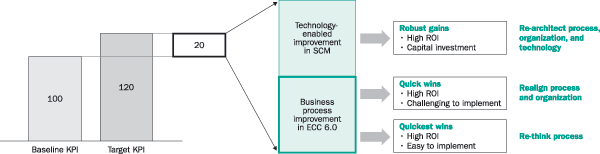
Figure 1
KPI improvement solutions
In the example in Figure 1, a company examines its procedures for creating and maintaining master data. The
procedures specify the trigger for a material it creates. For every trigger (say, a basic view created by the engineering
department), the procedure specifies the appropriate follow-up action. In this case, this is the material master update
required by each functional department (e.g., sales, accounting, planning, and warehousing). Depending on the volume of
master data objects, you can create this update either by performing a simple manual check using standard ECC transactions
(e.g., MM60) or you can create a sophisticated custom workflow.
Going back to the example of planning runs, once you rule out master data as the root cause of the problem,
then procedural changes relating to managing typical business exceptions are appropriate. The typical scenarios include
production line downtime, supplier delivery non-compliance, and unplanned demand.
In most cases, ECC standard functionality supports the processing of these typical exceptions. After you
achieve this level of stability (master data process works and procedures are in place), the complexity and volume of the
business may call for the use of optimizers and advanced technology provided by APO. Note how the systematic, disciplined
approach to troubleshooting and corrective action ensures the enterprise invests in technology that adds true
value.
Serge Ratmiroff
Serge Ratmiroff is an experienced project manager with 12 years of SAP implementation experience. He serves manufacturing and distribution clients with complex global implementations of SAP. He assists his clients with chronic business issues by combining procedural process changes and advanced technology to achieve sustainable supply chain improvement.
You may contact the author at sratmiroff@deloitte.com.
If you have comments about this article or publication, or would like to submit an article idea, please contact the editor.