/HANA
SAP’s recent innovations, including SAP HANA, are likely to cause a skills gap in the SAP community going forward. Experts trained on classical ERP or analytics systems don’t necessarily have the right skills for the future. Get a first-hand look at some of the new skills that you need to successfully embrace the change. Learn how both classic and new competencies can be combined in technology, application, and architecture-related skill profiles, whose timely adoption help you and your company be ready for the future.
Key Concept
SAP HANA is SAP’s in-memory appliance that orchestrates the latest hardware and software technology innovations to help you quickly analyze real-time information on large volumes of non-aggregated data. SAP HANA enables both new innovations and customer enhancements as in-memory solutions, including SAP’s future products, existing products such as SAP NetWeaver Business Warehouse (BW) that can be in-memory enabled, customer-specific development, pre-packaged reporting solutions, and accelerators that speed up SAP applications without changing the application fundamentals.
Due to their effect on both IT and business processes, SAP-related skills and experience have been traditionally perceived as strategic and value adding. With the onset of SAP HANA and mobility innovations, however, a new expert profile is on the rise in the SAP community: an innovation adoption expert.
Adopting innovation requires a new, dynamic skill set that does not necessarily fit in the classic buckets of SAP Basis, ERP, BW, CRM, and so on. A plethora of new competencies has been in high demand as part of the new skill mix, creating a temporary skills gap in the SAP community. The first successful early innovation adopters have already proven this gap can be closed for them: The SAP experts are able to combine their deep knowledge of the SAP fundamentals with a fast understanding of the new concepts, picking up technical, application, and architectural proficiency in the innovative space in a very short period of time.
Let’s introduce a couple of examples of some of the new tasks and challenges for the respective architect, application, and technical expert roles to demonstrate how the classic SAP skills can be successfully combined with new ones to deliver best results:
- Designing system architecture under new, changed circumstances: System landscape architecture discussions are changing with the entry of new innovations. It becomes increasingly important to think about new ways of combining data, reducing data duplication, and increasing data transparency. An enterprise architect can use his or her traditional knowledge around system landscapes and their architecture; however, new insights into real-time replication possibilities, as well as the new modeling paradigms, open up entirely new ways of designing and optimizing system landscapes to support critical business processes.
- Modeling a new breed of business applications: The understanding of the technical fundamentals of in-memory computing is becoming more important for an application expert. Break-through business applications based on innovative, highly efficient data structures can only be implemented with a clear understanding of the new technology, removing any bottlenecks that might potentially occur with the introduction of the new application modeling paradigms. A fundamental database and SQL knowledge enriched with SAP HANA modeling techniques are the key success factors in this area.
- Operations and administration of appliance systems such as SAP HANA: This is a new challenge for IT system administrators and data center operators as the affected technical experts. Having a good knowledge of the appliance concept is essential for these roles, combined with the understanding of the integration possibilities of SAP HANA into customer data centers and operational structures to ensure successful operations for the new technology. Our experience shows that these new insights complement the current knowledge of experienced system administrators.
Before we introduce the new skills and competencies in more detail, let’s summarize the most important current skills that you might use as an optimal starting point when sharpening your skills for SAP HANA:
- Knowledge of SAP Business Suite and Basis technologies
- Knowledge of the SAP NetWeaver platform
- Database knowledge
- Experience in system operations
- Data integration and extract, transform, and load (ETL) skills
- Reporting and analytics
We’ll break up the description of the new skills into three sections as we see the following three expert profiles primarily affected by the introduction of SAP HANA (Figure 1):
- Technical expert: Technology expertise enabling smooth SAP HANA operations
- Application expert: SAP HANA database modeling for optimal application design
- Application architect: Designing and optimizing innovative system architecture
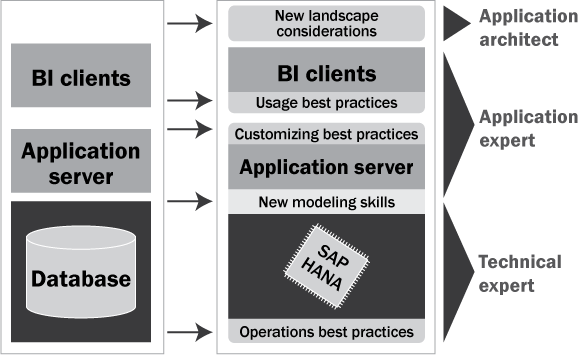
Figure 1
New innovation paradigms requiring new application, architectural, and technical skills
Technical Expert: Technology Expertise Enabling Smooth SAP HANA Operations
For a technical expert, the world is constantly changing in terms of basis knowledge and operational tasks required. The introduction of the appliance delivery models — SAP HANA being one of them — has been one of the recent disruptive changes in this area. The ability to integrate appliances into existing landscapes plays a significant role during system implementations. The tasks are not changing dramatically but the skills needed are different, always depending on the type of the appliance to be implemented. Table 1 highlights the key traditional and new skills for the different tasks related to the operations of SAP HANA.
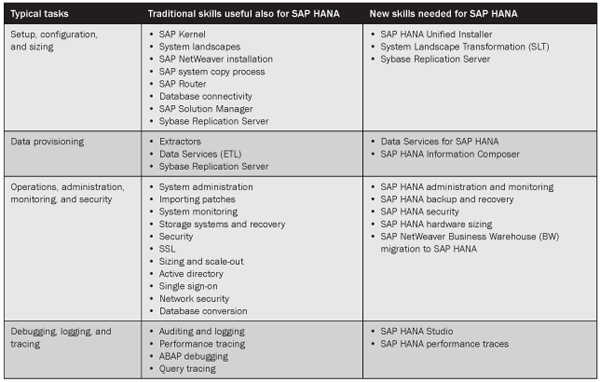
Table 1
Technology expert profile: a combination of traditional and new skills useful for SAP HANA
System Setup
SAP HANA is delivered as an appliance, combining hardware and software that is enabled for factory pre-installation. The hardware partner is able to initially size SAP HANA based on parameters provided by the company and pre-install SAP HANA for hardware, operating system, and SAP software. The hardware vendor may also add specific best practices and SAP HANA software configuration. The partner or a certified expert then finalizes the installation on site in a customer data center, connecting SAP HANA to the network.
While the appliance is convenient in concept, there are definitely new technical skills needed as well. This work typically starts with establishing replication from a data source system and connecting SAP HANA to the SAP BusinessObjects Business Intelligence (BI) clients for reporting. There might be also a need for respective skills to re-install, configure, and further size the appliance.
At the moment, SAP HANA productive installations do not support virtualized scenarios with more than one instance of the SAP HANA database component installed on the same physical server. Thus, the productive SAP HANA instances tend to experience less installation activity by system administrators compared to related development and quality systems, for example. The two latter system types can be treated differently as they enable separate instances, meaning that you have to understand the core SAP HANA installation process to some extent. SAP HANA provides a unified installer to install the following core components:
- SAP Host Agent
- SAP HANA Database
- SAP HANA Client (the server-side version)
- SAP HANA Studio repository
- SAP HANA Software Update Manager (SUM)
- SAP HANA client drivers
Following the core setup, the data provisioning components have to be installed separately. There are three potential options you can choose from, requiring slightly different installation knowledge as there is a separate installer to follow for each component:
- The classical ETL procedure using SAP Data Services
- Trigger-based replication through the System Landscape Transformation (SLT)
- Log-based replication via the Sybase Replication Server
Except for the log-base replication scenario, there is no need to install additional software components on the SAP HANA server. For the log-based replication, the following three components have to be installed on the SAP HANA server following an installation script:
- The Sybase Replication Server component
- Sybase Enterprise Connect Data Access (ECDA)
- SAP Load Controller
All the other related solutions (e.g., the SAP Business Suite, SAP Data Services, and Information Composer) use SAP HANA as a new data source. These solutions are installed on dedicated application servers, leveraging current system admin skills.
Hardware Sizing
SAP HANA is sized based on the uncompressed amount of the source data. This also means that one of the first tasks during the sizing exercise to check what data is supposed to be loaded into SAP HANA. The knowledge of the new paradigms related to data compression, data dependencies, and optimizing in-memory databases help you safely navigate around the possible pitfalls when sizing the SAP HANA hardware together with the hardware partner:
- Source data is already compressed, making it difficult to estimate the amount of data in an uncompressed state that is needed as a parameter for proper SAP HANA sizing. This circumstance can only be circumvented by checking the table contents and structures for every table and applying an algorithm to calculate the theoretical uncompressed size.
- The dependencies of objects and tables used for the desired scenario are typically not clear, making it difficult to produce exact numbers. There is always a risk that some key components in terms of size can slip through the checks, potentially causing an issue when the actual implementation starts.
- Certain database objects that are used in traditional databases are no longer needed in the in-memory world. Good examples are indexes, aggregates, and statistic tables that can influence the required size of SAP HANA dramatically when eliminated.
Data Provisioning
As mentioned above, to fill SAP HANA with data, SAP provides several possibilities (Figure 2), ranging from traditional ETL via SAP Data Services, log-based replication with Sybase Replication Server, and trigger-based replication through the SLT tool.
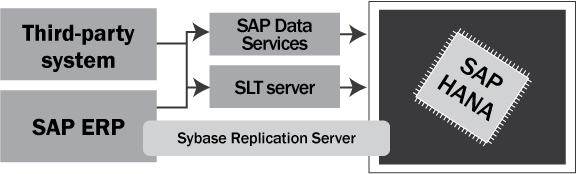
Figure 2
Data provisioning options with SAP HANA
After the initial installation of the components, the knowledge of the technical and connectivity configuration settings becomes essential. All the three data transfer tools require the configuration of a source system and a definition of what data is to be loaded. SAP Data Services as a classic ETL tool provides a customizing view to help you create and change transformations. The Sybase Replication Server is configured to exactly one source system, with the actual data loads managed through the SAP HANA Modeler.
Operations, Administration, Monitoring, and Security
With the introduction of SAP HANA, questions have arisen on what special skills are needed to operate SAP HANA in data center mode, and monitor and safeguard the appliance’s operations. Again, it is a combination of a generic system administration experience with some additional, new knowledge that helps tackle the administration procedures.
You cannot install additional software on the SAP HANA Server. The server is delivered pre-configured with all the necessary components installed. The responsibility for patching the operating system and the individual SAP HANA components is subject to the contract between the hardware partner and company.
The SAP HANA Studio provides baseline system status information, as well as monitoring capabilities and an alert framework. System administrators can monitor memory usage, disk usage, used CPUs, and overall system parameters. Depending on the respective hardware vendor, there could be additional monitoring and administration tools delivered with SAP HANA.
Another important aspect of operating SAP HANA in productive mode is the planning, setup, and execution of backup tasks. Backups can be triggered and planned via the SAP HANA Studio. A backup stores the current data contents from the main memory of SAP HANA on an attached storage solution. This enables data recovery from the storage files in case the dataset in the main memory is potentially corrupted or destroyed for any reason.
A correct authorization concept is the prerequisite for a successful, compliant system setup. The database of SAP HANA provides an authorization system in addition to the already-existing authorization concepts in the related ECC, BW, and BI implementations. For pure database usage, the application server caters to the authorization handling. For reporting purposes, it depends on the BI tool of choice where system administrators need to configure the authorization checks to ensure correct and compliant reporting security. There are also tools available to establish single sign-on (SSO) for SAP HANA to make it easier for the end users to connect to SAP HANA.
Debugging, Logging, and Tracing
Debugging, logging, and tracing tasks and the related skills are necessary to ensure smooth implementations as well as compliant system operations. System administrators need to be able to trace the system behavior for performance reasons and retrieve the respective logs to document systematic and user-driven events in the system. System administrators plan, configure, and monitor most of these tasks in the SAP HANA Studio. They can check the log files and the execution of performance traces to document what happens during query execution and database usage.
Application Expert: SAP HANA Database Modeling for Optimal Application Design
Nowadays, an application expert is confronted with a wide range of new tools and technologies playing an important role in the daily application implementation and configuration tasks. Traditional application knowledge provides a huge asset but has to be complemented with in-memory focused best practices to help application experts leverage the new technology. Table 2 highlights the important skills for an application expert in the SAP HANA space.
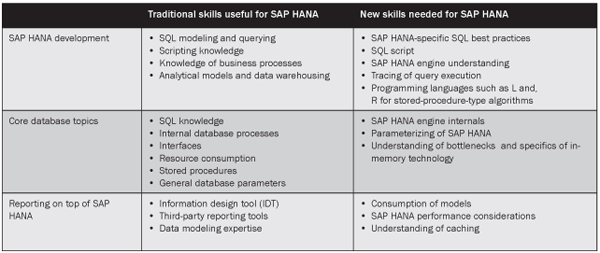
Table 2
Application expert profile: Skills needed for optimal application design and modeling with SAP HANA
Core Database Topics
SAP HANA is a database, and, thus, fundamental database skills have proven vital in projects. Primarily, the skills of leveraging the database parameters and performance tracing capabilities to optimize performance are essential for successful SAP HANA implementations.
The fundamental change in working for many application consultants is the new openness of SAP HANA as an SAP-related database. In the past, a database used to be shielded from both the applications experts and end users, who interacted rather with the application server as the abstraction layer over the technical database component. SAP HANA, on the other hand, enables other SAP products to be installed on top of its database to create real-time scenarios. These hybrid scenarios, however, need to be implemented by someone who has the respective core database skills, as not all the user interaction with the database is controlled by the application server.
SAP HANA Development
SAP HANA Modeler extends SAP HANA beyond the pure database usage. The Modeler tool provides a thin but comprehensive application layer that enables companies to implement their own SAP HANA-based data models with complex logic and scripting without installing a separate application server. Modeling is the essential prerequisite for achieving the subsecond response times of SAP HANA, avoiding any unnecessary data transfer between SAP HANA and an application server that might potentially decrease performance. From a skills perspective, a strong background in data modeling and the way, for example, joins are created in a database is required.
SAP HANA Modeler offers both a graphical maintenance tool for data models and scripting capabilities (Figure 3). An application expert can implement even extensively complex scripts using SQL Script. The creation of the SQL Scripts requires a good understanding of all the SAP HANA database engines. For more stored procedure-like algorithms, languages such as L and R can be used to model the business logic.
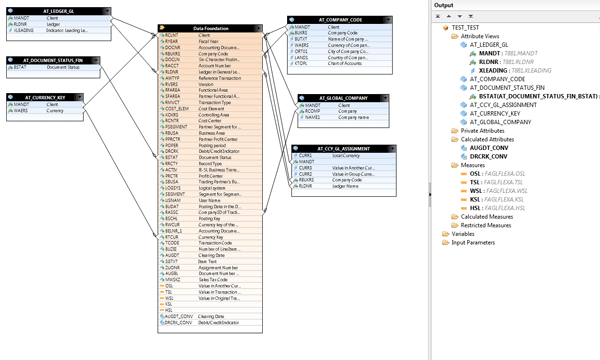
Figure 3
SAP HANA Modeler
Reporting with SAP BusinessObjects BI Front Ends on SAP HANA
Reporting on SAP HANA is optimized and certified only for SAP BusinessObjects BI 4.0 at the moment as these solutions natively use SAP HANA in an optimal way. Due to some of the specifics of an in-memory database, application experts need to configure and use the BI tools in a slightly different way than on a typical database. In conjunction with SAP HANA, the BI 4.0 tools:
- Serve as a common interface for client tools and a common user experience when accessing SAP HANA
- Support an SAP HANA-specific SQL on top of tables and views for detailed and high-performance access
- Provide a native multi-source interface to federate data from SAP HANA with data from other sources
- Make sure complex calculations are passed into the SQL and sent directly to SAP HANA
With the right skills, you can configure BI on top of SAP HANA to help business users read millions of records in under a second and perform virtually instant drill-downs (Figure 4).

Figure 4
SAP HANA data in SAP BusinessObjects Explorer as the reporting front-end
Application Architect: Design and Optimize Innovative System Architecture
The implementations of SAP HANA show that the knowledge of the possible bottlenecks of the underlying in-memory technology is at least as important as knowing the platform’s new, innovative capabilities. The role of a business application architect with the respective skills is crucial for leading and facilitating system architecture related discussions involving SAP HANA. Pioneering new ways of combining data, reducing data duplication, and increasing data transparency with SAP HANA, the architect successfully combines the traditional knowledge around system landscapes architecture with the new insights into real-time replication possibilities and modeling paradigms. Being perceived as a trusted advisor by the business users, the architect also articulates the strategic business value of SAP HANA, fundamentally changing the way the critical business processes of an enterprise are supported. Table 3 shows some of the traditional and new skills necessary for this role.
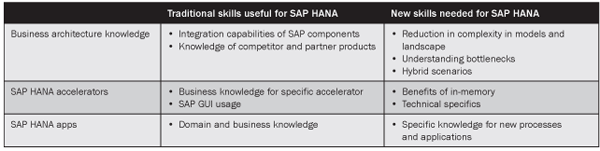
Table 3
Architect profile: a useful architectural skill mix for SAP HANA
Business Architecture Knowledge
Traditionally, the technical capabilities of an IT solution have had the most shaping impact on the implementation projects. SAP NetWeaver BW is a good example of such a solution. The success of a BW-based analytics implementation depended on the ability to reduce the data volumes from a very granular level (representing, for example, the line-item data from ERP) to a highly aggregated view in BW InfoCubes. This architecture was ensuring performance, but on the other hand it did not allow a quick change to the model.
With SAP HANA, this bottleneck has shifted now. Disk read times are now not the bottleneck, as the CPU power is now becoming the ultimate limiting factor for fast calculations. SAP HANA is strong at aggregating large datasets on the fly. This explains why intermediate aggregates and pre-calculations can be avoided compared to the classic analytics model.
With real-time calculations enabled, the focus is now on the respective business need rather than on the limiting technical capabilities. With SAP HANA, you can provide a wide data source to the end users, transferring the responsibility for the final query or report over to the business, instead of having IT designing, configuring, and releasing the respective reports (which typically takes quite long).
All these new considerations enable entirely new business processes but also require rethinking and overcoming some of the traditional architectural paradigms. The different basic usage scenarios including SAP HANA as a technical platform for customer specific data marts, SAP HANA as a technical platform with SAP business content, SAP HANA accelerators, traditional SAP products using SAP HANA as a database, and new applications on top of SAP HANA, can be combined to enable new insights and provide greater flexibility. Let’s have a closer look at two of these scenarios and the skills required.
SAP HANA Accelerators
SAP has introduced an accelerator concept for SAP HANA. This is essentially comparable to the BW Accelerator in the past. The fundamentals of the underlying core SAP component (e.g., ECC) are not changed as the main database is not switched or migrated. Instead, parts of the data are replicated in the in-memory database of SAP HANA, significantly accelerating critical reporting and batch-processing scenarios involved. Prior knowledge of the transactional solutions, their configuration, and reporting is required as the front end is still the user interface of the traditional solution. In addition, detailed knowledge of the underlying business processes is critical to get the most value out of the accelerator implementation.
One of the first accelerators introduced by SAP is the CO-PA Accelerator with SAP HANA. The accelerator focuses on a CO-PA-based profitability analysis scenario, enhancing its reporting and application performance dramatically while remaining within the user interface of SAP ERP. Figure 5 shows the architecture for this accelerator.
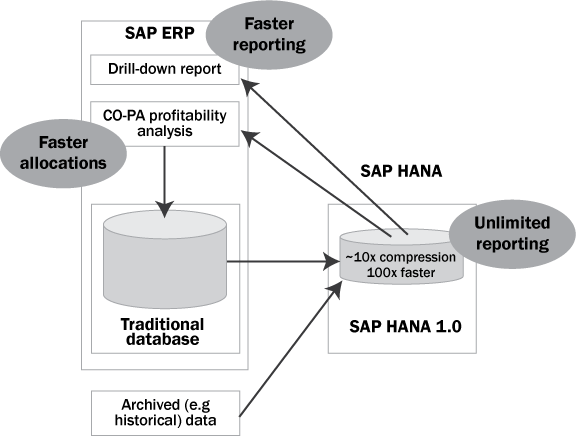
Figure 5
Architecture of the CO-PA Accelerator for SAP HANA
For more information about the CO-PA Accelerator, see the article “Speed Up Your Profitability Analysis Performance with SAP HANA’s CO-PA Accelerator.”
New Applications on Top of SAP HANA
New applications have been released or are being developed or planned on SAP HANA as a database platform, covering key industry and line-of-business scenarios, including SAP Sales and Operations Planning, and SAP Smart Meters Analytics. For a business architect, it is essential to acquire the respective knowledge as the new applications are released, getting familiar with the business domain involved and the usage of the respective application. Based on their architecture, some applications might expose the modeling capabilities of SAP HANA opening up configuration possibilities, while the others rather using SAP HANA solely as a database, resulting in different architectural paradigms.
In addition, business architects and application experts might leverage their skills in predictive analysis, simulation, and high-volume calculations to boost the SAP HANA applications. As an example, SAP Smart Meter Analytics is focusing on heavy number crunching that would have killed performance on many current systems, thus enabling significant batch calculation performance improvements.
Dr. Karol Bliznak
Dr. Karol Bliznak is vice president of the Rapid Innovation Group (RIG) within the mobility division at SAP. He focuses on converging SAP’s strategic innovation categories, such as mobile solutions, SAP HANA, business analytics, and the cloud. He works at the SAP AG headquarters in Walldorf, Germany. He has more than 14 years of SAP experience in business intelligence, mobility and in-memory technologies, enterprise performance management, financial accounting, controlling, governance, risk, and compliance.
You may contact the author at karol.bliznak@sap.com.
If you have comments about this article or publication, or would like to submit an article idea, please contact the editor.
Dennis Schwerer
Dennis Schwerer is vice president of the Customer Solution Adoption (CSA) organization at SAP, driving SAP HANA customer adoption via strategic internal and external engagements. Dennis is working at the SAP AG headquarters in Walldorf, Germany. He has 12 years of SAP experience in a wide range of solutions and functions. In the past years, he focused on financial consolidation, enterprise reporting, system architecture and databases.
If you have comments about this article or publication, or would like to submit an article idea, please contact the editor.