Review these seven key steps to ensure that your SAP NetWeaver BI 7.0 implementation or upgrade project goes as smoothly as possible. For new implementations, find out what you need to consider as you migrate to SAP NetWeaver BI. For upgrades from SAP BW 3.5 or earlier, understand how you can apply lessons learned from your current implementation to your SAP NetWeaver BI upgrade.
Key Concept
With a new implementation of SAP NetWeaver BI 7.0, or an upgrade from an earlier release of SAP BW, you should take into account data warehouse competency, project goals, and system performance. You can do this by mapping your project outside of the system before beginning work in the system to ensure that all interested parties agree on the project design and goals.
1. Develop Data Warehouse Competency
New projects
- Legacy data warehouse knowledge owners
- Experienced SAP NetWeaver BI implementation resources
- Business process and end-user information requirement knowledge owners
Upgrade projects
Early-release projects most likely relied heavily on external consulting expertise. As your BI team has used the SAP BW system, however, your organization has gained great knowledge of how SAP BW works and where the gaps lie. You probably have many lessons learned, all of which you can use to enhance the quality of future SAP NetWeaver BI deliverables.
To convert past lessons to current competency, you need to complete a thorough review of pros and cons, gaps, and lessons learned in the current environment. This ensures that the upgraded environment fills prior gaps, improves on prior design, and achieves greater project efficiency and quality. Conduct explicit, comprehensive interview sessions and quality reviews, and review existing documentation to facilitate the conversion process. Take advantage your users’ competencies because experience is one of the most valuable assets at your disposal in the upgrade.
2. Define Your SAP NetWeaver BI Vision
All successful SAP NetWeaver BI projects must have a vision statement that applies for near-term project results and for five- and 10-year plans in SAP NetWeaver BI. Ideally, you should establish this vision in a top-down fashion, making it part of the organizational mindset. Following the vision, you must establish clear objectives for short- and medium-term activities to achieve the vision.
New projects
The BI project must start with a solid vision statement that is specific to every organization document. Although every vision statement is different, a schema of a sample vision statement is shown in Figure 1. This statement highlights the strengths, weaknesses, opportunities, and threats (SWOT) that you must address in the project plan. We recommend that you first define the final state, then the current state, and finally the high-level phases and start-up time frame. The final state of the reporting environment involves all reporting, including multiple different technologies in the landscape, not just that hosted by SAP NetWeaver BI. Here, you can determine the different levels of reporting, which typically correspond to organizational levels: executive, operations management, and day-to-day activities support. Make sure to distinguish between transactional (operational) and analytical reporting.
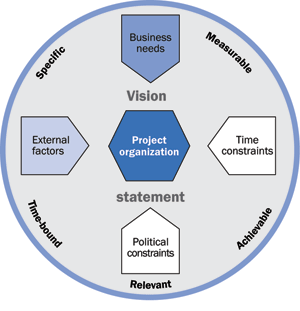
Figure 1
Example of a vision statement schema
It is also important to note that some reporting requirements have decision support significance whereas others are required for different purposes such as legal, government, or environmental. Decision support reporting may serve discrete business process information needs and also go across business processes. Two other major parameters for all the classes of reporting are frequency of use and the required frequency of data refresh.
The current state of the reporting environment defines the starting point for the roadmap, including an analysis of the reporting systems currently in use. You should include a high-level view of the information systems landscape to show the reporting systems and the source (transactional) systems. Explain the gaps in the current state compared to the outlined end state.
Also, define the high-level phases and a start-up time frame with estimates for projected rollout timing for the new reporting sources to emerge and when/how the legacy systems will retire. Optimally, the organization can place all these phases on a diagram (Figure 2).

Figure 2
Diagram of the vision establishment and project phases for new SAP NetWeaver BI projects
Upgrade projects
In the case of SAP NetWeaver BI upgrade projects, a project vision and set of policies, procedures, and KPI requirements exist from prior projects. However, as an organization changes, its vision and supporting elements may change, too. As such, the upgrade project management team must evaluate the lessons learned from prior projects, review the current BI solution quality and performance, and then determine if the vision and its supporting elements need adjustment (Figure 3).

Figure 3
Diagram of the vision review for SAP BI upgrade projects
3. Define Your Immediate Business Goals
Strategic vision can ensure consistent, sustained SAP NetWeaver BI development. Immediate goals are necessary to prepare the organization to use, understand, and accept SAP NetWeaver BI. For example, short-term goals might include:
- Implement key supply chain metrics reports and introduce these metrics into the supply chain business process
- Implement inventory management reporting to allow for slow-moving, aged, and expiring inventory. For example, you could track expiring and aged inventory to get a better look at opportunities for overall inventory reduction across the organization.
New projects
You should design goals with the understanding that the introduction of this technology into the organization is a gradual process. It takes time to integrate the technological changes into the culture.
One possible achievement of your SAP NetWeaver BI implementation is better transparency. However, your implementation goals must be more specific than that. You need to design every element of the usage process based not only on current requirements, but also on future requirements. Simply delivering analytical query capabilities based on current requirements often results in data redundancy, competing solutions, and other architectural and performance problems.
The goals of an SAP NetWeaver BI project must relate to the long-term vision of organizational BI. Some examples of such tactical, long-term goals would be to:
- Support the mobile workforce delivering Web, portal, pre-calculated, and scheduled reporting solutions
- Collect, define, and design component-reporting solutions for centrally defined performance metrics
- Execute the necessary environmental planning and master data design to integrate data from all source systems
- Deliver cross-organizational transparent reporting solutions
Upgrade projects
Business goals are always finite in scope and duration. You should always review them when creating SAP NetWeaver BI project plans. Similar to the prior step, the upgrade project management team should review the prior BI project goals, compare them to the business goals in the current organizational environment, and then make any adjustments as necessary. This effort must be thorough and should require sign-off from organizational upper-level management to align project scope and goals with business goals.
4. Establsh a Performance Policy
When implementing an SAP NetWeaver BI system, you must consider the following:
- Level of granularity: What level of detail can you extract, store, and analyze?
- Data retention: How long will the data be available for analysis and in archived form?
- Reporting methods used: Will you use the Web, portal, or BEx?
- Data warehouse architecture and design: What is the hardware and software landscape? What are the data warehouse data layers (e.g., persistent storage, enterprise warehouse, data marts, and archiving objects)? What are the guiding policies for creating objects?
You measure SAP NetWeaver BI performance in two ways: data load and query execution. SAP NetWeaver BI comes with a set of monitoring tools in the Technical Content area. Use them to monitor the data loads and query executions. We also recommend introducing benchmark metrics to measure data load and query execution.
Most importantly, the data load and query performance must become part of the design specifications. Do not allow non- performing InfoCubes and queries in the production environment because these can cause cascading effects on all other solutions.
Periodic monitoring of performance has to be imbedded into the SAP NetWeaver BI support organization. Along with data quality, it is one of the vital signs of your BI environment.
New projects
Establishing a performance policy for the first SAP NetWeaver BI implementation is always a bit challenging, as there is no prior experience to fall back on. You can obtain input for performance guidelines through industry forums. Furthermore, you can benchmark user expectation levels from existing system performance metrics.
Upgrade projects
The upgrade management team should evaluate:
- Current SAP BW system performance
- Actual performance against planned performance (as set forth in the prior project goals)
- Actual performance against the new business goals (a reflection of changes in competitive and technological environments)
5. Establish a Global Data Warehouse Data Quality Policy
New projects
Although the project teams are in the best technical position to perform data quality testing, end users are the judge for data quality. They must be involved early in the process of data validation to catch problems before they move into production and permanently give the impression of data quality (or lack thereof) for your BI system. End users should have input on how you test data quality during the implementation phase and how you sustain data quality in the new data warehouse.
There are two parts to data quality: one related to master data (e.g., cleansing), and one related to data validity (e.g., transactional data availability and correctness). To ensure transactional data and reporting quality, we recommend the following steps:
- Include the data validation approach as part of the design specification of every area. A section of every design specification should define a step-by-step guide for validating the data against the source system.
- Enforce that the support team executes this data validation periodically
- Introduce automated procedures to ensure data quality, if possible
Upgrade projects
The upgrade management team should evaluate:
- Current SAP BW system and data quality
- Actual system and data quality against planned quality thresholds (as set forth in the prior project goals)
- Actual quality against the new business goals (a reflection of changes in competitive and technological environments)
6. Create a Centralized Corporate Master Data Map
Hierarchies and supporting master data in SAP NetWeaver BI provide the basis for multidimensional analysis (Figure 4). Understanding the relationships between these hierarchies and their master data as early as possible is critical.

Figure 4
Hierarchies in SAP NetWeaver BI
When implementing SAP NetWeaver BI, it is important to depict the master definitions into a usable master data platform to support these different reporting uses. However, quite often companies exert little effort to understand the definitions and relationships of their own master data in sufficient detail.
New projects
We recommend that you use a diagram to describe the master data relationships before you start to design your SAP NetWeaver BI system.
These documents may already exist with the transactional master data team. If so, make sure that they are available to the BI developers. The developers may also want to consult data unification sources such as Dun and Bradstreet and United Nations Standard Products and Services Code (UNSPSC), which are related to industry standardized codes assigned to customer organizations and products/materials. Dun and Bradstreet’s global commercial database contains more than 115 million business records (www.dnb.com). UNSPSC provides a standard for accurate classification of products and services (www.unspsc.org).
Upgrade projects
The starting point of technical design and modeling an SAP NetWeaver BI upgrade should be a thorough investigation and understanding of the master data models and how they support the various analytical and operational designs in the data warehouse. Without performing this process prior to starting the upgrade effort, you risk creating redundant master data (which clouds overall BI clarity across the environment) and incongruous reporting architectures. The steps include reviewing all master data documentation and speaking with key business and technical process owners to hear their view of the nature and role of their vital master data objects (to ensure this still matches the prior project documentation).
7. Create a Centralized Set of KPI Definitions
KPIs are business-driven and usually understood best by the business representatives, but often KPIs are a mystery to the IT organization. Top management typically defines and measures KPIs, while day-to-day users work with key figures. Here are some examples of KPIs that are commonly built in a data warehouse:
- Inventory days of supply
- Delivery performance to customer request date
- Cost of goods sold
- Days sales outstanding
New projects
We recommend that you create a thorough technical and business description of every KPI before starting your SAP NetWeaver BI implementation. You must align these definitions with the corresponding business process. You also need to understand source data on both business and technical levels. It is also important to have global trends in mind in the effort to standardize these definitions. One such KPI standardization effort is the Supply-Chain Operations Reference-model (SCOR), as defined by the Supply-Chain Council (www.supply-chain.org). You can find other metrics for standardizing the KPI definitions in SAP Strategy Management (formerly PilotWorks).
Upgrade projects
As in the case of vision and business goals, KPIs are usually measurements tied to the achievement of overall business goals of the organization. In an SAP NetWeaver BI upgrade effort, the project management team should review existing KPI documentation, conduct interviews with key organizational process owners, and compare the prior BI KPIs to the current organizational performance measurement needs. If you skip this process, your project may result in a correct BI architecture but fail to fulfill the current organizational needs.
Note
For more information about this topic, consider attending SAP Education course DBW70M (BI - Upgrading to SAP NetWeaver 7.0) or BW001 (SAP NetWeaver Business Intelligence).
Michael Loveless
Michael Loveless is an SAP NetWeaver BI strategic architect for Sapiex, Inc., a consulting group that focuses on strategic architecture planning and integration for SAP applications. Previously, he worked for SAP America (1998-2004) as a platinum SAP NetWeaver BI consultant. Michael has worked on many SAP NetWeaver BI projects in roles ranging from an SAP NetWeaver BI application configuration consultant to a global strategic SAP NetWeaver BI SME. Currently, he is working as an SAP NetWeaver BI 7.0 project manager and architect for a global forecasting solution project in the pharmaceutical industry, and as a global BI strategic planner for federal government projects.
You may contact the author at michael.loveless@sapiex.net.
If you have comments about this article or publication, or would like to submit an article idea, please contact the editor.
Gueorgui Patchov
Gueorgui Patchov is an SAP BW data architect with Sapiex, Inc., a consulting group that focuses on strategic architecture planning and integration for SAP applications. Previously, he worked for the Rohm and Haas Company in Philadelphia, PA, and has provided BI consulting services in the chemical, pharmaceutical, and consumer products industries. Currently, he is consulting for a large SAP NetWeaver BI 7.0 implementation project in the pharmaceutical industry.
You may contact the author at goshopachov@yahoo.com.
If you have comments about this article or publication, or would like to submit an article idea, please contact the editor.