Oct 13, 2026
•9 minute read
SAP Extended Warehouse Management (SAP EWM) is an advanced warehouse management platform within SAP’s supply chain suite that delivers real-time visibility, inventory control and automated fulfillment across inbound, outbound and cross-docking operations. As omni-channel demands, labor shortages and supply chain disruptions accelerate, organizations are turning to SAP EWM to optimize inventory tracking, streamline distribution and reduce total cost of ownership. SAPinsider research shows 55% of organizations have deployed SAP S/4HANA or SAP S/4HANA Cloud, the platform that powers embedded SAP EWM. This page covers the use cases, research and tools SAP practitioners need.
SAP Extended Warehouse Management (SAP EWM) is a software platform within SAP’s suite of supply chain solutions. Integrated with inventory management and delivery processing, SAP EWM controls inbound and outbound processes and goods movement in real time, lowering total cost of ownership across complex warehouse networks. Key capabilities include SAP Global Batch Traceability for end-to-end inventory tracing, mixed and layered pallet building, labor structure management, flexible returns management and voice picking optimization. Organizations can deploy basic warehouse management focused on inventory and goods movement, or advanced functionality covering material flow control, yard management, labor management and cross-docking.
SAP, Accenture and Vodafone Pilot Humanoid Robotics Integrated With SAP EWM in Warehouse Operations
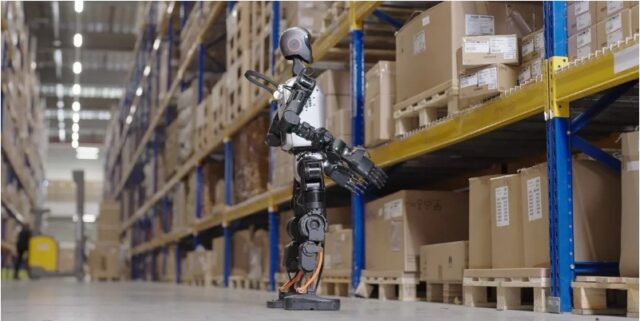
SAP, Accenture and Vodafone Procure & Connect are piloting humanoid robots integrated with SAP EWM and SAP Joule in a live warehouse in Duisburg, Germany. Robots conduct visual inspections, validate inventory in real time and flag safety risks, feeding insights directly into SAP systems to reduce worker injuries, lower overtime costs and minimize dependence on temporary labor.
How KAMAX Leverages SAP S/4HANA and SAP EWM to Optimize Logistics and Boost Performance
KAMAX, a German automotive supplier of high-strength fasteners, deployed SAP EWM and SAP TM with RFID tracking, automated guided vehicles and laser-based container counting across multiple plants and warehouses. The implementation cut labor hours, reduced CO2 emissions by optimizing truck utilization and improved shipping precision — all in support of a carbon neutrality goal by 2037.
How Intelligent Warehouse Management Delivers Supply Chain Resilience
A major Canadian telecom company deployed SAP EWM using delaware’s FAST EWM TM preconfigured template across more than 150 warehouses operated by subcontractors in 18 months. The template — pre-integrated with SAP TM and SAP Business Network for Logistics — accelerated the design phase, reduced deployment risk and enabled mobile Fiori apps for a Gen Z warehouse workforce.
Part 2: How RFgen Supercharges SAP EWM Mobility
Integrating RFgen’s mobile platform with SAP EWM enables customers to deploy five to seven fully functional EWM applications in under four months and achieve ROI within six months — compared to a year or more for SAP’s native RF stack. Hybrid online/offline mode keeps warehouse workers scanning, moving and labeling uninterrupted during planned SAP maintenance windows.
How a Global Manufacturer Improved SAP Inventory Accuracy
Graphic Packaging International deployed RFgen mobile barcoding integrated with SAP across 25 North American manufacturing sites, achieving a 25% efficiency boost, 30% productivity gains and an 80% reduction in training time. Separately, Schwing America reached 99.9% inventory accuracy and cut transaction times by 75%, demonstrating the measurable ROI mobile-first tools deliver in SAP warehouse environments.
ERP Migration and Transformation 2026
Based on a survey of 296 SAPinsider community members, the ERP Migration and Transformation 2026 report found that 55% of organizations have deployed SAP S/4HANA or SAP S/4HANA Cloud, while 24% cite supply chain disruptions as a top external factor shaping migration plans — directly driving demand for embedded SAP EWM capabilities.
Surveying 170 SAPinsider community members, the SAP S/4HANA Migration 2025 report found that 32% of organizations have already transitioned to SAP S/4HANA and 27% are in active implementation, accelerating the shift to the digital core on which SAP EWM’s advanced warehouse management and real-time inventory capabilities depend.
Technology Leaders’ Strategic Agenda for 2026
The SAPinsider Technology Leaders’ Strategic Agenda for 2026 report found that 70% of respondents cite increasing operational efficiency and reducing costs as their top priority, while 32% are targeting supply chain resilience as a strategic focus, reinforcing why SAP EWM deployments have moved to the top of warehouse modernization roadmaps in 2026.








Your request has been successfully sent