Topics

Explore critical topics shaping today’s SAP landscape—from digital transformation and cloud migration to cybersecurity and business intelligence. Each topic is curated to provide in-depth insights, best practices, and the latest trends that help SAP professionals lead with confidence.

Regions

Discover how SAP strategies and implementations vary across global markets. Our regional content brings localized insights, regulations, and case studies to help you navigate the unique demands of your geography.

Industries

Get industry-specific insights into how SAP is transforming sectors like manufacturing, retail, energy, and healthcare. From supply chain optimization to real-time analytics, discover what’s working in your vertical.

Hot Topics

Dive into the most talked-about themes shaping the SAP ecosystem right now. From cross-industry innovations to region-spanning initiatives, explore curated collections that spotlight what’s trending and driving transformation across the SAP community.


Topics

Explore critical topics shaping today’s SAP landscape—from digital transformation and cloud migration to cybersecurity and business intelligence. Each topic is curated to provide in-depth insights, best practices, and the latest trends that help SAP professionals lead with confidence.

Regions

Discover how SAP strategies and implementations vary across global markets. Our regional content brings localized insights, regulations, and case studies to help you navigate the unique demands of your geography.

Hot Topics

Dive into the most talked-about themes shaping the SAP ecosystem right now. From cross-industry innovations to region-spanning initiatives, explore curated collections that spotlight what’s trending and driving transformation across the SAP community.

Application Development

SAP API Management Isn’t an API Strategy: Here’s What One Actually Looks LikeThe article emphasizes that while SAP API management provides essential infrastructure for APIs, a comprehensive governance strategy is necessary to avoid duplication, establish ownership, and manage the API lifecycle effectively in organizations.
When Building AI In-House Makes Business SenseAgentic coding tools make building cheaper, but the case for building AI in-house still rests on proprietary process knowledge and the capacity to run what gets built.
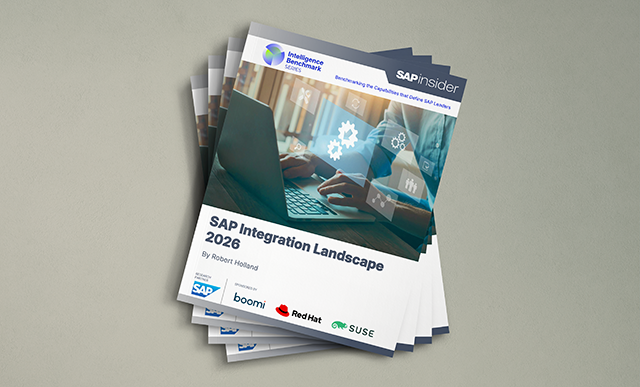
Enterprise Integration for SAP 2026 SAPinsider Benchmark Research ReportEnterprise integration is becoming a strategic platform capability for SAP organizations. As application landscapes expand across SAP and non-SAP systems, businesses increasingly depend on integration to support cloud transformation, operational visibility, analytics, partner connectivity, and artificial intelligence. The question is no longer whether organizations need an integration strategy. It is whether they can translate that strategy into a modern, governed, and scalable architecture. SAP integration has become strategic, but it is not yet uniformly modern. Organizations are defining enterprise strategies and increasing investment as real-time visibility, cloud growth, SAP transformation, and AI create new connectivity demands. At the same time, legacy middleware, point-to-point integrations, skills shortages, and technical debt continue to limit execution. This year’s integration research reveals substantial progress at the strategic level. Half of respondents describe their integration strategy as either enterprise-wide or platform-driven and AI-enabled, while only 4% have no formal strategy. Integration is also closely connected to transformation: 46% say it is strategically aligned with, or fully embedded in, broader cloud and digital transformation programs. Download this benchmark research report to read a deeper analysis and receive insight on your own plans. - Understand the integration strategies and architectures that organizations are using. - Explore how organizations are transitioning to real-time and AI-ready integration. - Learn about the integration challenges that are being created by AI. - See what SAPinsiders are doing to implement the capacity to execute on integration.
Which Software Projects AI Makes Cheaper to BuildCoding agents are lowering the cost of writing software, but review, testing, and requirement definition now carry a larger share of build effort. The largest savings go to SAP projects with clear requirements, testable outputs, and documented interfaces.
Build AI-Native Business Apps that Extend SAP While Keeping the Core CleanEvery SAP organization, no matter which ERP version it runs, has requirements that reach beyond standard transactions: multi-level approval workflows, customer and partner portals, shop-floor tools, and easy-to-use mobile apps for field sales teams. These requirements sit closest to how the business functions and they need to be addressed quickly for smooth operations. Building all […]
Abstract representation of digital pathways and AI neural networks interacting with SAP modules on a sleek interface.
Building Business Applications and AI Agents for SAP, Wherever You Are on Your SAP JourneyIn a September 17, 2026 SAPinsider webinar, Neptune Software's Stefan Captijn and Dan Wiseman argued that the execution gap between SAP systems and daily work, not SAP itself, is what stalls AI in the enterprise. A Yazaki Brazil stock-planning case shows how SAP-native AI applications close that gap in weeks.
AI Is Repricing the Enterprise Build-vs-Buy DecisionAI is lowering development costs while expanding the sourcing choices enterprises must manage.
LTM Repositions IT Operations and Transformation Around Agentic AILTM has repositioned its iRun managed operations model and iTransform transformation suite around autonomous agents, outcome-based commitments, and its shared BlueVerse AI layer. The approach changes how SAP teams may evaluate service agreements, delivery models, and governance controls.
Knoa Connects User-Level Task Mining With SAP Signavio Process IntelligenceA new integration connects SAP UEM by Knoa's user-level data with SAP Signavio Process Intelligence, giving process teams a combined view of how transactions move through SAP systems and how users interact with them.
ABAP Code Remediation vs Application Modernization: What to Do First on the Road to S/4HANAMoving from SAP ECC to SAP S/4HANA requires organizations to initially remediate legacy ABAP code for compatibility and business continuity, and subsequently modernize their customizations to align with clean core principles, balancing short-term needs with long-term agility.