Topics

Explore critical topics shaping today’s SAP landscape—from digital transformation and cloud migration to cybersecurity and business intelligence. Each topic is curated to provide in-depth insights, best practices, and the latest trends that help SAP professionals lead with confidence.

Regions

Discover how SAP strategies and implementations vary across global markets. Our regional content brings localized insights, regulations, and case studies to help you navigate the unique demands of your geography.

Industries

Get industry-specific insights into how SAP is transforming sectors like manufacturing, retail, energy, and healthcare. From supply chain optimization to real-time analytics, discover what’s working in your vertical.

Hot Topics

Dive into the most talked-about themes shaping the SAP ecosystem right now. From cross-industry innovations to region-spanning initiatives, explore curated collections that spotlight what’s trending and driving transformation across the SAP community.

Topics

Explore critical topics shaping today’s SAP landscape—from digital transformation and cloud migration to cybersecurity and business intelligence. Each topic is curated to provide in-depth insights, best practices, and the latest trends that help SAP professionals lead with confidence.

Regions

Discover how SAP strategies and implementations vary across global markets. Our regional content brings localized insights, regulations, and case studies to help you navigate the unique demands of your geography.

Hot Topics

Dive into the most talked-about themes shaping the SAP ecosystem right now. From cross-industry innovations to region-spanning initiatives, explore curated collections that spotlight what’s trending and driving transformation across the SAP community.

SAP Data Science

SAP Data Science focuses on how organizations use SAP data, analytics, AI, and machine learning to predict outcomes, automate decisions, and improve business performance. This topic covers SAP Analytics Cloud, SAP Business Data Cloud, SAP Datasphere, SAP BTP, SAP S/4HANA, and related AI-enabled capabilities such as Smart Predict, Joule, and embedded analytics.

It is relevant for data scientists, analytics leaders, CIOs, enterprise architects, finance teams, supply chain leaders, and business users. In SAP environments, data science helps convert operational and transactional data into forecasts, recommendations, anomaly detection, and real-time decision support.

What is SAP Data Science?

SAP Data Science is the practical use of statistical models, machine learning, predictive analytics, and AI on SAP and non-SAP data to support better decisions and business outcomes. In SAP environments, data science is often applied through platforms such as SAP Analytics Cloud, SAP Business Data Cloud, SAP Datasphere, SAP BTP, and SAP Databricks integrations.

SAP Data Science focuses on how organizations use SAP data, analytics, AI, and machine learning to predict outcomes, automate decisions, and improve business performance. This topic covers SAP Analytics Cloud, SAP Business Data Cloud, SAP Datasphere, SAP BTP, SAP S/4HANA, and related AI-enabled capabilities such as Smart Predict, Joule, and embedded analytics.

It is relevant for data scientists, analytics leaders, CIOs, enterprise architects, finance teams, supply chain leaders, and business users. In SAP environments, data science helps convert operational and transactional data into forecasts, recommendations, anomaly detection, and real-time decision support.

What is SAP Data Science?

SAP Data Science is the practical use of statistical models, machine learning, predictive analytics, and AI on SAP and non-SAP data to support better decisions and business outcomes. In SAP environments, data science is often applied through platforms such as SAP Analytics Cloud, SAP Business Data Cloud, SAP Datasphere, SAP BTP, and SAP Databricks integrations.

These tools help teams prepare governed data, build predictive models, automate analysis, and embed intelligence into finance, supply chain, operations, customer experience, and ERP workflows. The goal is not just analysis, but faster, more trusted action.

What are some SAP Data Science use cases?

Predictive Planning and Forecasting

Finance and planning teams can use SAP Analytics Cloud and SAP S/4HANA data to forecast revenue, demand, cash flow, or working capital. Predictive models help planners compare scenarios, identify risks earlier, and adjust plans based on real-time business signals.

Supply Chain Optimization

SAP data science can help supply chain teams predict demand shifts, detect inventory risks, optimize replenishment, and improve service levels. By combining SAP S/4HANA, SAP IBP, and external data, organizations can move from static reporting to proactive supply chain decision-making.

Finance Anomaly Detection

Finance teams can apply machine learning to detect unusual transactions, payment patterns, journal entries, or reconciliation issues. In SAP environments, these models can support faster close processes, stronger controls, and more targeted investigation of financial exceptions.

Self-Service Predictive Analytics

Business users can use SAP Analytics Cloud Smart Predict to create predictive models without deep data science expertise. This supports use cases such as churn prediction, sales forecasting, and operational risk analysis while reducing dependence on centralized analytics teams.

AI-Ready Data Products

Organizations can use SAP Business Data Cloud and SAP Datasphere to create governed data products for analytics, machine learning, and AI agents. These reusable data assets help preserve business context and reduce duplicated data preparation across teams.

What does SAPinsider research say about SAP Data Science?

Data science depends on governed data foundations. The SAPinsider Benchmark Report, SAP Business Data Cloud Use Cases and Adoption, shows that only 3% of organizations report a unified governed data layer, while 38% remain siloed. The report also finds analytics modernization is a top SAP BDC driver.

Technology Leader’s Strategic Agenda for 2026 shows SAP leaders are funding the foundations needed for data science. SAP BTP services lead planned investments beyond core ERP at 48%, followed by SAP analytics initiatives at 43%.

The webinar, Evolving BI and Analytics, highlights the shift from reporting toward agile, AI-enabled analytics. Four in five respondents were considering, planning, or implementing BI solutions, and the benchmark drew on input from 178 SAPinsider community members.

Enterprise Data and Analytics in the Era of AI frames data and analytics maturity as a prerequisite for AI-enabled business outcomes. The research examines how Data Leaders modernize data foundations and align business and IT to become more data-driven.
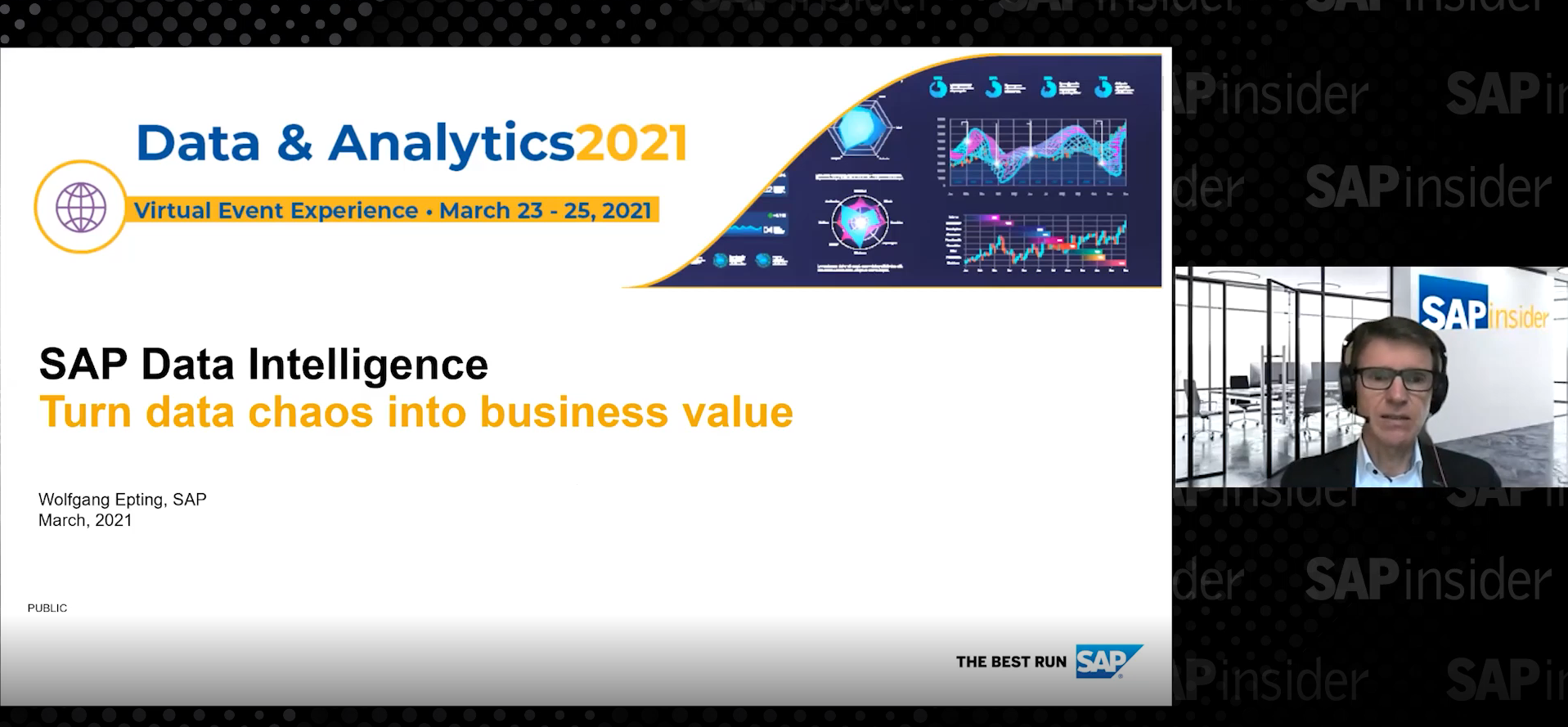
Turning data chaos into data value with SAP Data IntelligenceIn the age of big data and business intelligence, data catalogs are becoming the essence of metadata management, helping and guiding data users better understand their data and its importance. A data catalog focuses on data assets and connects the data sets within the assets with its related metadata to help the users of the data understand it better. Data Catalogs are rapidly and widely being integrated into the systems across industries to manage the extensive data at hand. Integrating and implementing data catalogs is the first step in data governance. A Data Catalog can be defined as a collection of metadata, typically used for data management with query access to help analysts and other data users find the data that they need. It serves as an inventory of available data within the organization and provides access to evaluate the fitness of data for its intended use. With all its benefits, the effectiveness of the Data Catalog depends on the central capacity to provide a collection of metadata.
Operations Research
Combining Operations Research (OR) and Machine Learning (ML)If you are an active resident of analytics land, you know that Artificial Intelligence (AI) and Machine Learning (ML) tools are the new bosses in town. Every tool, technology, and technology solution around you tries to incorporate them in their solution in some form. And all this limelight on AI and ML has pushed the classic analytics professionals like statisticians (who stood their ground and decided to stay with that title rather than getting "rebranded" as data scientists) and good old Operations Research (OR) professionals into a separate categories. Whether talking to executives, reading books, or doing secondary research, a consistent theme is that we have classified the community of advanced analytics professionals in the supply chain world into two primary categories: OR and ML professionals. But do they need to always be in two distinct buckets in the supply chain? This article discusses how OR and ML algorithms can be leveraged in tandem to address critical challenges in the supply chain world.
analytics
Helping “Data-Rich, Insight-Blind” Organizations Make Sense of Their Complex SAP SystemsBas Kamphuis, General Manager of Magnitude Software shares how he is leading the Magnitude Productivity business, capitalizing on the digital revolution by defining and executing the company’s global strategy in the SAP ecosystem, driving product definition and the product roadmap, and growing revenue and market share via a customer-oriented culture and strategic partnerships. In this Q&A, learn how Magnitude is helping customers unlock the value of enterprise data, as Kamphuis fields questions such as: - What are the big questions on the minds of SAP customers today? -Are there any trends specifically in the areas of data management? - Do you have any recommendations for companies considering a move to SAP S/4HANA?
How Can Data Science Help Businesses Thrive?In today’s climate of economic uncertainty, many firms are looking to reposition and adapt through automation. Investing in robotic process automation (RPA) can help SAP customers reduce bottlenecks and improve workplace efficiency. Bots can automatically perform manual and repetitive tasks, reducing the need for human intervention. However, firms need data scientists to oversee these systems and analyze data. In fact, the demand for data science skills is predicted to increase by up to 27.9% by 2026. More and more employers are acknowledging the value of technology to drive growth and expansion, and the increasing number of specialists studying data science at degree level online is feeding this demand. The rise in data science graduates led to Glassdoor naming it the best job in America in 2018, with the average job growth for research analysts alone at 27%. By hiring from this wide pool of expert data scientists, businesses can obtain fresh and actionable insights that will help them succeed in the future.
How Data Science Will Change IT Operations

With IT working in silos, visibility into operations can be greatly limited. New technology such as machine learning can allow for cross-silo information transfer, enabling IT Operations Analytics (ITOA) to gain a broader view of data.


Related Vendors