Topics

Explore critical topics shaping today’s SAP landscape—from digital transformation and cloud migration to cybersecurity and business intelligence. Each topic is curated to provide in-depth insights, best practices, and the latest trends that help SAP professionals lead with confidence.

Regions

Discover how SAP strategies and implementations vary across global markets. Our regional content brings localized insights, regulations, and case studies to help you navigate the unique demands of your geography.

Industries

Get industry-specific insights into how SAP is transforming sectors like manufacturing, retail, energy, and healthcare. From supply chain optimization to real-time analytics, discover what’s working in your vertical.

Hot Topics

Dive into the most talked-about themes shaping the SAP ecosystem right now. From cross-industry innovations to region-spanning initiatives, explore curated collections that spotlight what’s trending and driving transformation across the SAP community.

Topics

Explore critical topics shaping today’s SAP landscape—from digital transformation and cloud migration to cybersecurity and business intelligence. Each topic is curated to provide in-depth insights, best practices, and the latest trends that help SAP professionals lead with confidence.

Regions

Discover how SAP strategies and implementations vary across global markets. Our regional content brings localized insights, regulations, and case studies to help you navigate the unique demands of your geography.

Hot Topics

Dive into the most talked-about themes shaping the SAP ecosystem right now. From cross-industry innovations to region-spanning initiatives, explore curated collections that spotlight what’s trending and driving transformation across the SAP community.

SAP Business Intelligence

SAP Business Intelligence focuses on how SAP customers turn enterprise data into trusted reporting, dashboards, visualizations, and decision-ready insights. The topic spans SAP BusinessObjects, SAP Analytics Cloud, SAP BW/SAP BW/4HANA, SAP Business Technology Platform, SAP Datasphere, and SAP Business Data Cloud.

It is relevant to CIOs, analytics leaders, finance teams, line-of-business managers, data architects, and SAP administrators who need governed access to operational and historical data. In the SAP context, BI supports faster decisions, better performance management, improved transparency, and a stronger foundation for AI-enabled analytics.

What is SAP Business Intelligence?

SAP Business Intelligence is the use of SAP data, analytics tools, and reporting processes to analyze business performance and convert enterprise information into actionable insight. In practice, SAP BI helps organizations report on finance, supply chain, HR, sales, procurement, and operations using platforms such as SAP BusinessObjects, SAP Analytics Cloud, SAP BW/4HANA, SAP Datasphere, and SAP Business Data Cloud.

SAP Business Intelligence focuses on how SAP customers turn enterprise data into trusted reporting, dashboards, visualizations, and decision-ready insights. The topic spans SAP BusinessObjects, SAP Analytics Cloud, SAP BW/SAP BW/4HANA, SAP Business Technology Platform, SAP Datasphere, and SAP Business Data Cloud.

It is relevant to CIOs, analytics leaders, finance teams, line-of-business managers, data architects, and SAP administrators who need governed access to operational and historical data. In the SAP context, BI supports faster decisions, better performance management, improved transparency, and a stronger foundation for AI-enabled analytics.

What is SAP Business Intelligence?

SAP Business Intelligence is the use of SAP data, analytics tools, and reporting processes to analyze business performance and convert enterprise information into actionable insight. In practice, SAP BI helps organizations report on finance, supply chain, HR, sales, procurement, and operations using platforms such as SAP BusinessObjects, SAP Analytics Cloud, SAP BW/4HANA, SAP Datasphere, and SAP Business Data Cloud.

It connects data from SAP and non-SAP systems, applies governance and business logic, and delivers dashboards, reports, visualizations, and self-service analytics so business users can make informed decisions.

What are some SAP Business Intelligence use cases?

Executive performance dashboards

Leadership teams use SAP BI to track revenue, margin, working capital, supply chain performance, and operational KPIs across SAP S/4HANA and other enterprise systems.

Finance reporting and planning

Finance teams use SAP Analytics Cloud and SAP data models to support management reporting, forecasting, variance analysis, consolidation, and board-level performance reviews.

Supply chain visibility

Operations teams use BI dashboards to monitor inventory, demand, logistics performance, supplier risk, and fulfillment trends across SAP ERP and supply chain applications.

Self-service analytics for business users

Line-of-business teams use governed BI tools to create reports, explore data, and answer operational questions without relying on IT for every data request.

Migration and modernization reporting

SAP teams use BI to compare legacy ERP data with SAP S/4HANA outputs, validate transformation progress, and identify process or data quality gaps.

AI-ready data foundations

Data and analytics teams use SAP Datasphere or SAP Business Data Cloud to prepare governed datasets that support predictive analytics, Joule-enabled workflows, and AI use cases.

What does SAPinsider research say about SAP Business Intelligence?

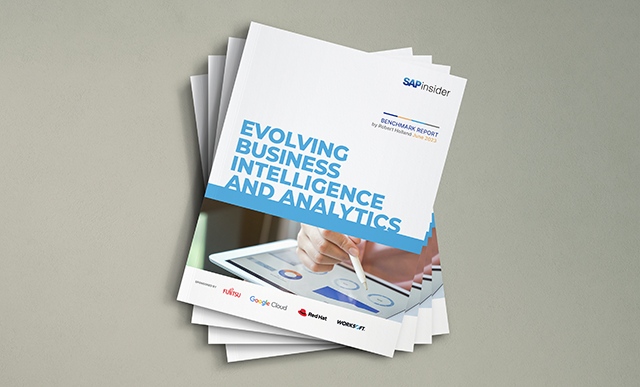
The Evolving Business Intelligence and Analytics surveyed 144 business and IT leaders overseeing BI and data analytics. The report found that 45% cited agility in response to global change as a key driver of BI strategy, while 35% pointed to improving ROI from technology investments.

The SAP Business Data Cloud Use Cases and Adoption report shows why BI modernization depends on data foundations. Only 3% of organizations have a unified governed data layer, while 38% remain siloed.

The Enterprise Data and Analytics in the Era of AI report connects BI maturity to AI readiness. SAPinsider found that organizations modernizing data and analytics strategies are focused on improved forecasting accuracy, faster decision-making, enhanced user experiences, and stronger AI foundations.

Evolving BI
Evolving BI and AnalyticsCreating a cohesive data fabric is integral to organizational business intelligence (BI). However, while many organizations strive to reach this goal, there is often a gap between building cohesive data fabric strategy and its execution. The introduction of SAP Datasphere earlier this year aimed to address this need by harmonizing mission-critical data across the enterprise while maintaining its business context. However, SAPinsider research shows that a need to demonstrate return on investment (ROI) and provide faster time to value may override such broader, strategic goals. Although four in five respondents reported that their organization was currently considering, planning, or implementing business intelligence solutions, most are still in the early phases of their deployments. The challenges that they face in deploying these initiatives relate to budget, change management issues, and embarking on broader programs rather than trying to provide quick wins. Despite the need for a cohesive data fabric, respondent organizations are constrained with demonstrating ROI, faster time-to-value, and limit expenditure. This may preclude them from meeting their broader business intelligence objectives even though there is a need for more agility and cross-enterprise capabilities in business intelligence. However, as operational business intelligence gets embedded in strategic plans and roadmaps, organizations will be able to better engage with their business intelligence plans. Download the benchmark report to read the full data analysis from 178 members of the SAPinsider community and receive recommendations for your own plans. - Explore the factors behind the need for business intelligence and analytics to evolve - Learn whether business intelligence objectives are part of long-term strategic and enterprise planning - Understand the challenges that organizations face with deploying business intelligence programs - See what data consumption tools, technology platforms, and databases/data lakes are being used
Ariston Group’s Path to Optimizing SAP Implementation on AWSIn an effort to reduce operational IT costs, many large organizations are beginning to rely on third-party suppliers to deliver high system availability and an optimal cost structure.  This approach consolidates resources into Availability Zones where a Single Pane of Glass Management is the key benefit. Learn how Artison Group, a world leader in energy-efficient, renewable heating and hot water solutions, leveraged AWS and Syntax to succeed in moving to a cloud-based SAP model.
business intelligence
The Future of Business Intelligence Benchmark WebinarIn This Webinar: We have entered the age of Artificial Intelligence (AI) and Machine Learning (ML). Technology has taken a massive leap in the last decade and is expected to take another exponential leap in this coming decade, leading to rapid advances in the discipline of data science. Data science practices introduced the world of […]
Addressing Data Management Challenges for Data Intense Processes in SAP EcosystemBy Kumar Singh, Research Director, Automation & Analytics, SAPinsider Integrated challenge of process and data management A key challenge that organizations operating in complex technology ecosystems like SAP face is managing their business processes seamlessly and efficiently. From  a systems perspective, business processes within an ERP system span across several modules and hundreds of tables. […]
Ferrar's cloud strategy image
Best-of-Breed Business Intelligence for Improved AgilityWhenever two or more companies merge, an extensive list of technical difficulties soon follows. The challenges include integrating systems, databases, and applications and enabling synchronization of information between organizations. For Ferrara – an emerging North American powerhouse in sweet snacking that recently acquired Nestle’s U.S. Confection and Kellogg’s Cookie, Cones, and Crust business, including Keebler brands – bringing in new information from acquired companies used to take about two years. But in defining a new business intelligence (BI) playbook, they significantly reduced that time down to about a week. The company is realizing the benefits of its investments faster by using a best-of-breed approach for bringing in acquisitions data. With real-time information about new acquisitions available at its fingertips, the company can support leadership decision-making and optimize market opportunities. Additional benefits of its best-of-breed BI approach include less latency when moving information back and forth and increased performance and integration. Ferrara achieves unparalleled agility for reporting and streamlines the analytical process across its business thanks to the combination of Amazon Web Services (AWS), SAP HANA, and SAP Analytics Hub. For example, SAP HANA empowers the company’s BI team to pull data from the company’s SAP ERP system and acquired companies faster and make changes without reloading data. With AWS and SAP HANA at the center of its evolving journey to the cloud, Ferrara delivers enhanced value to the business and its partners and customers. Read this customer story and learn: - How running SAP on the AWS Cloud enables Ferrara to be 50% more efficient overall in its development efforts while reducing development costs by 70%. - Why real-time data helps BI teams understand business partners’ goals and roadmaps and empowers them to deliver innovation across the organization. - The benefits of the cloud to optimize opportunities, including quicker access to data and immediate decision making about acquired companies, high-value collaboration across the business, and the ability to simplify complexity. - The importance of a cloud strategy that supports best-of-breed business intelligence for improved agility, impacting employee, customer, and consumer experiences.
Executive Q&A: The intelligent finance imperativeThe recent economic disruption has accelerated the evolution of finance. Business demands that finance and accounting teams provide tighter integration, increased automation, better visibility into operations as well as more sophisticated planning and reporting capabilities. This interactive panel examines: - How finance and accounting teams are adapting critical priorities when it comes to planning, visibility, and providing real-time insights for the business - How companies are integrating intelligence into their finance processes that extend far beyond simple automation - What ROI and business benefits early adopters are seeing and how they are measuring success - What skills and steps organizations are taking to incorporate intelligent capabilities within their core end-to-end finance and accounting processes
Traditional and Modern BI Tools Have Their PlaceThe world of data and analytics is quickly evolving. The role of traditional BI tools like SAP BusinessObjects is shifting as today’s software-as-a-service subscription-based platforms incorporate advanced analytic capabilities. Ken Coleman, Business Intelligence Manager for the American Red Cross, describes several trends impacting the data and analytics space. Modern BI tools like SAP Analytics Cloud (SAC) are becoming more widely adopted for their interactive dashboards and feature sets. However, this does not mean there is not a place for traditional BI solutions. Learn how ERP and other source systems are shifting the data landscape in operational reporting. What are the architectural differences between SAP BusinessObjects and SAC and their ideal applications? And why does data need to be architected properly for it to be analyzed?
Understanding the difference between Business Intelligence (BI) and Artificial Intelligence (AI)In the world of technology, it will be an impossible task these days to find someone who is not aware of the term data science. With the emergence of data science, Artificial Intelligence (AI) and Machine Learning (ML) tools appreared on the horizon. The world was introduced to the significant impact AI and ML tools could make to the way businesses plan and operate. Among all this hype, BI, which was the poster child of the world of analytics till then, started to lose its glamour. However, the fact is, descriptive analytics is one of the foundational capabilities and is in no way inferior to other type of tools and algorithms. The fact is, an organization strategically needs to define what type of analytics it will be leveraging across its functions and processes. Eventually, you will be leveraging a portfolio of tools. And for some aspects, descriptive analytics is all that you need and anything more than that may be an overkill.
Enterprise Business Intelligence: Best practices, tips, and tricksIn today’s data driven world, organizations are investing heavily in Business Intelligence tools and capabilities like SAP BusinessObjects. The sessions in this track will provide you with tips and tricks to get the most out of the current analytic solutions that you already have such as the business object solutions and native SAP reporting solutions.
Accelerating the Intelligent Enterprise with InsightViews from ProtivitiThis fun, non-technical mini workshop will give you the game-changing tools and techniques you need to start crafting compelling data stories with your data! Our BI Data storytelling Mastery framework removes the guesswork from crafting data stories that pop! Learn how to craft a compelling data story using only a whiteboard and post-its. After taking this workshop you will be able to: - Craft a four-part data story that emotionally connects to your users  - Cut requirement gathering time in half - Transform otherwise daunting user sessions into fun gamified workshops - Unlock the key to user buy-in, trust, and ownership - Leave with a wealth of tips, techniques, and templates to take your data skills to the next level. All data professionals welcome!

Related Vendors