Topics

Explore critical topics shaping today’s SAP landscape—from digital transformation and cloud migration to cybersecurity and business intelligence. Each topic is curated to provide in-depth insights, best practices, and the latest trends that help SAP professionals lead with confidence.

Regions

Discover how SAP strategies and implementations vary across global markets. Our regional content brings localized insights, regulations, and case studies to help you navigate the unique demands of your geography.

Industries

Get industry-specific insights into how SAP is transforming sectors like manufacturing, retail, energy, and healthcare. From supply chain optimization to real-time analytics, discover what’s working in your vertical.

Hot Topics

Dive into the most talked-about themes shaping the SAP ecosystem right now. From cross-industry innovations to region-spanning initiatives, explore curated collections that spotlight what’s trending and driving transformation across the SAP community.

Topics

Explore critical topics shaping today’s SAP landscape—from digital transformation and cloud migration to cybersecurity and business intelligence. Each topic is curated to provide in-depth insights, best practices, and the latest trends that help SAP professionals lead with confidence.

Regions

Discover how SAP strategies and implementations vary across global markets. Our regional content brings localized insights, regulations, and case studies to help you navigate the unique demands of your geography.

Hot Topics

Dive into the most talked-about themes shaping the SAP ecosystem right now. From cross-industry innovations to region-spanning initiatives, explore curated collections that spotlight what’s trending and driving transformation across the SAP community.

SAP Business Intelligence

SAP Business Intelligence focuses on how SAP customers turn enterprise data into trusted reporting, dashboards, visualizations, and decision-ready insights. The topic spans SAP BusinessObjects, SAP Analytics Cloud, SAP BW/SAP BW/4HANA, SAP Business Technology Platform, SAP Datasphere, and SAP Business Data Cloud.

It is relevant to CIOs, analytics leaders, finance teams, line-of-business managers, data architects, and SAP administrators who need governed access to operational and historical data. In the SAP context, BI supports faster decisions, better performance management, improved transparency, and a stronger foundation for AI-enabled analytics.

What is SAP Business Intelligence?

SAP Business Intelligence is the use of SAP data, analytics tools, and reporting processes to analyze business performance and convert enterprise information into actionable insight. In practice, SAP BI helps organizations report on finance, supply chain, HR, sales, procurement, and operations using platforms such as SAP BusinessObjects, SAP Analytics Cloud, SAP BW/4HANA, SAP Datasphere, and SAP Business Data Cloud.

SAP Business Intelligence focuses on how SAP customers turn enterprise data into trusted reporting, dashboards, visualizations, and decision-ready insights. The topic spans SAP BusinessObjects, SAP Analytics Cloud, SAP BW/SAP BW/4HANA, SAP Business Technology Platform, SAP Datasphere, and SAP Business Data Cloud.

It is relevant to CIOs, analytics leaders, finance teams, line-of-business managers, data architects, and SAP administrators who need governed access to operational and historical data. In the SAP context, BI supports faster decisions, better performance management, improved transparency, and a stronger foundation for AI-enabled analytics.

What is SAP Business Intelligence?

SAP Business Intelligence is the use of SAP data, analytics tools, and reporting processes to analyze business performance and convert enterprise information into actionable insight. In practice, SAP BI helps organizations report on finance, supply chain, HR, sales, procurement, and operations using platforms such as SAP BusinessObjects, SAP Analytics Cloud, SAP BW/4HANA, SAP Datasphere, and SAP Business Data Cloud.

It connects data from SAP and non-SAP systems, applies governance and business logic, and delivers dashboards, reports, visualizations, and self-service analytics so business users can make informed decisions.

What are some SAP Business Intelligence use cases?

Executive performance dashboards

Leadership teams use SAP BI to track revenue, margin, working capital, supply chain performance, and operational KPIs across SAP S/4HANA and other enterprise systems.

Finance reporting and planning

Finance teams use SAP Analytics Cloud and SAP data models to support management reporting, forecasting, variance analysis, consolidation, and board-level performance reviews.

Supply chain visibility

Operations teams use BI dashboards to monitor inventory, demand, logistics performance, supplier risk, and fulfillment trends across SAP ERP and supply chain applications.

Self-service analytics for business users

Line-of-business teams use governed BI tools to create reports, explore data, and answer operational questions without relying on IT for every data request.

Migration and modernization reporting

SAP teams use BI to compare legacy ERP data with SAP S/4HANA outputs, validate transformation progress, and identify process or data quality gaps.

AI-ready data foundations

Data and analytics teams use SAP Datasphere or SAP Business Data Cloud to prepare governed datasets that support predictive analytics, Joule-enabled workflows, and AI use cases.

What does SAPinsider research say about SAP Business Intelligence?

The Evolving Business Intelligence and Analytics surveyed 144 business and IT leaders overseeing BI and data analytics. The report found that 45% cited agility in response to global change as a key driver of BI strategy, while 35% pointed to improving ROI from technology investments.

The SAP Business Data Cloud Use Cases and Adoption report shows why BI modernization depends on data foundations. Only 3% of organizations have a unified governed data layer, while 38% remain siloed.

The Enterprise Data and Analytics in the Era of AI report connects BI maturity to AI readiness. SAPinsider found that organizations modernizing data and analytics strategies are focused on improved forecasting accuracy, faster decision-making, enhanced user experiences, and stronger AI foundations.

Discover What’s New – SAP BusinessObjects BI4.3Join this session and learn about the upcoming release of the SAP BusinessObjects Business Intelligence (BI) Platform. During this session, you will see a demo-rich showcase of the latest and greatest capabilities, such as a redesigned launchpad and workspace, a new SAP BusinessObjects Web Intelligence software designer, new visualizations, updated data sources, and deployment support. This session will help you discover the enhancements and key improvements for administrators and content consumers.
Case Study: Tips and Tricks to Build High-Powered Semantic Layers with SAP BusinessObjectsGain practical advice from the American Red Cross on how to build semantic layers to support complex reports, dashboards, and structured Big Data. Based on real-world lessons using the information design tool (IDT) to create universes for its deployment of self-service BI to a portion of its 6,000 users nationwide, attendees will: - Learn how and why to create fact tables from dimension tables, and to build derived dimension tables within the IDT tool when there is no equivalent table that exists in the data source - Gain insight into when and how to use the IDT tool as the semantic layer for SAP HANA data sources - Discover techniques for creating “smart measures” and coding useful custom conditions in the IDT business layer - Be presented with a methodology that uses the concepts of “shared and private dimensions” and “area of analysis” to simplify the business layer for self-service BI users - Obtain use cases for using the IDT projection function feature Plus, take home a step-by-step document of use cases and the various techniques demonstrated in the session
Twelve Traits That a Business Intelligence Program and Building With LEGO Bricks Have in CommonA strong and reliable business intelligence (BI) program can quickly reveal areas for improvement and help organizations make proactive decisions by identifying business patterns and trends and providing a comprehensive view of a company’s data. Establishing such a program, however, requires many pieces to fit together, similar to—according to SAPinsider Expert Jeff Stout—building with LEGO bricks. Stout lists a dozen shared traits between creating your next BI program and building with plastic blocks. After reading this article you will be able to: - Understand when to incorporate creativity and visionary qualities into your BI program; - Explain strategies for collaboration, community, and sharing feedback during your program creation; and - List the different parts of and apply a simple framework for a BI program.
Planning in a Crisis – Business Lessons from The Eye of the StormFeatures 8 critical lessons Finance should learn from the Covid-19 pandemic as well as why it’s critical to evolve your finance function today — and how to do it.   Find other insightful content from Wolters Kluwer | CCH Tagetik on their Vendor Showcase
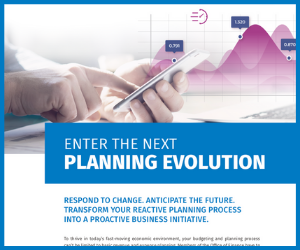
White Paper: Enter the Next Planning EvolutionIn the report, learn how software innovations are transforming the planning process into a strategic, future-focused activity that you can use to drive your business forward.   Find other insightful content from Wolters Kluwer | CCH Tagetik on their Vendor Showcase
Using Artificial Intelligence with SAP for Dynamic Financial EnvironmentsTraditional programming approaches—such as using ABAP development to create customized applications within SAP—are often too slow to respond to today's fast-changing environments. With the rise of artificial intelligence (AI), data scientists are able to create more sophisticated, customized calculations in SAP to better support marketing and operations. In this article, the author explains how to build an AI model using SAP tools that can manage sales volumes with dynamic commissions based on inventory levels. After reading this article you will be able to: - Define AI's current role in SAP and two types of AI; - List examples of SAP tools that can be used to create applications using AI; and - Recall the steps required to build an intelligent system.
How AI and SAP Technology Optimize OperationsBy Georgina Watkins Artificial intelligence (AI) and SAP ERP technologies have been highly instrumental in optimizing and streamlining the operations of many modern companies. Despite the value of these technologies to both scaling startups and large corporations, not all are fully aware of just how AI and SAP are beneficial to their organizations. If you’re […]
Access Your Intelligent Technologies Content BundleAccess to all of the resources in this Intelligent Technologies Content Bundle. Register below to gain the latest insights with SAP Intelligent Technologies tutorials, tips and training content from SAP Experts.
How Poggenpohl’s Adoption Of A Software-Defined Approach To Archiving SAP BI/Data Management Reduced Up To 90% Of Its Operating CostsHow Poggenpohl’s Adoption of a Software-Defined Approach to Archiving SAP BI/Data Management Reduced Up to 90% of Its Operating Costs.
Access Your BI/Analytic/Predictive Content BundleAccess to all of the resources in this BI/Analytics/Predictive Content Bundle. Register below to gain the latest insights with SAP BI/Analytics/Predictive tutorials, tips and training content from SAP Experts.

Related Vendors