Topics

Explore critical topics shaping today’s SAP landscape—from digital transformation and cloud migration to cybersecurity and business intelligence. Each topic is curated to provide in-depth insights, best practices, and the latest trends that help SAP professionals lead with confidence.

Regions

Discover how SAP strategies and implementations vary across global markets. Our regional content brings localized insights, regulations, and case studies to help you navigate the unique demands of your geography.

Industries

Get industry-specific insights into how SAP is transforming sectors like manufacturing, retail, energy, and healthcare. From supply chain optimization to real-time analytics, discover what’s working in your vertical.

Hot Topics

Dive into the most talked-about themes shaping the SAP ecosystem right now. From cross-industry innovations to region-spanning initiatives, explore curated collections that spotlight what’s trending and driving transformation across the SAP community.

Topics

Explore critical topics shaping today’s SAP landscape—from digital transformation and cloud migration to cybersecurity and business intelligence. Each topic is curated to provide in-depth insights, best practices, and the latest trends that help SAP professionals lead with confidence.

Regions

Discover how SAP strategies and implementations vary across global markets. Our regional content brings localized insights, regulations, and case studies to help you navigate the unique demands of your geography.

Hot Topics

Dive into the most talked-about themes shaping the SAP ecosystem right now. From cross-industry innovations to region-spanning initiatives, explore curated collections that spotlight what’s trending and driving transformation across the SAP community.

SAP Regulatory Compliance

SAP Regulatory Compliance focuses on how organizations use SAP systems to meet defined legal, tax, data, security, and reporting obligations across business processes. The topic includes SAP GRC, SAP Access Control, SAP Process Control, SAP Document and Reporting Compliance, SAP S/4HANA, SAP Cloud ERP Private, and related tax, identity, privacy, and controls platforms. For SAP customers, the business value is practical: reduce compliance risk, support audits, manage national tax and e-invoicing mandates, maintain digital sovereignty requirements, and keep regulated processes aligned with changing rules.

What is SAP Regulatory Compliance?

SAP Regulatory Compliance is the use of SAP processes, controls, data, and reporting capabilities to satisfy specific regulatory obligations. In practice, it helps finance, tax, security, privacy, IT, and audit teams prove that SAP-enabled transactions, access, invoices, tax records, cloud configurations, and business controls meet applicable requirements. It is used to manage obligations such as SOX, GDPR, VAT/GST reporting, e-invoicing, statutory reporting, segregation of duties, access governance, and cloud security responsibilities within SAP environments.

SAP Regulatory Compliance focuses on how organizations use SAP systems to meet defined legal, tax, data, security, and reporting obligations across business processes. The topic includes SAP GRC, SAP Access Control, SAP Process Control, SAP Document and Reporting Compliance, SAP S/4HANA, SAP Cloud ERP Private, and related tax, identity, privacy, and controls platforms. For SAP customers, the business value is practical: reduce compliance risk, support audits, manage national tax and e-invoicing mandates, maintain digital sovereignty requirements, and keep regulated processes aligned with changing rules.

What is SAP Regulatory Compliance?

SAP Regulatory Compliance is the use of SAP processes, controls, data, and reporting capabilities to satisfy specific regulatory obligations. In practice, it helps finance, tax, security, privacy, IT, and audit teams prove that SAP-enabled transactions, access, invoices, tax records, cloud configurations, and business controls meet applicable requirements. It is used to manage obligations such as SOX, GDPR, VAT/GST reporting, e-invoicing, statutory reporting, segregation of duties, access governance, and cloud security responsibilities within SAP environments.

How do enterprises use SAP Regulatory Compliance?

Tax Reporting and Tax Legislation

Finance and tax teams use SAP regulatory compliance capabilities to manage country-specific tax rules, VAT/GST requirements, statutory reporting, and local mandates. SAP tax engines, localization tools, and SAP S/4HANA integrations help organizations adapt reporting and transaction processes as legislation changes.

E-Invoicing and Tax Payments

Enterprises use SAP Document and Reporting Compliance and SAP Business Network to support mandated e-invoicing, invoice validation, tax reporting, and government submission requirements. These capabilities help align procure-to-pay and order-to-cash processes with country-specific invoice schemas, clearance models, and audit trail expectations.

Digital Sovereignty and Data Residency

Organizations use SAP compliance practices to address where data is stored, who operates systems, what legal frameworks apply, and how regulated workloads are controlled. This is important for SAP cloud environments where data sovereignty, operational transparency, and contractual safeguards shape compliance.

Access Governance and Segregation of Duties

GRC teams use SAP Access Control and identity tools to monitor sensitive access, detect segregation-of-duties conflicts, and document approvals. This supports audit readiness and reduces the risk of unauthorized transactions across SAP ERP, SAP S/4HANA, and hybrid application landscapes.

Continuous Controls Monitoring

Enterprises use SAP Process Control and third-party GRC platforms to automate control testing, monitor exceptions, and centralize evidence. Continuous monitoring helps teams move from periodic compliance checks to earlier detection of policy violations, configuration drift, and audit issues.

Where does SAP Regulatory Compliance emerge in SAPinsider research?

The Tax Technology in SAP Environments benchmark study shows why tax compliance belongs in this topic: 65% of respondents prioritize integrating tax across the enterprise, while 41% are automating to ensure compliance in direct and indirect tax. The report also highlights e-filing and e-document management at 41%, reinforcing the role of SAP systems in national tax, reporting, and payment-related compliance.

State of the Market GRC in SAP Environments shows that SAP customers are modernizing compliance operations through automation and centralized controls. The report finds that 60% of organizations are automating GRC processes and 53% are centralizing control workflows, reflecting a shift from manual compliance activity toward integrated control management.

Bridge infrastructure representing ERP-connected tax automation and integrated compliance processes.
The Business Case for Tax Automation in ERPAvalara’s economic impact study models a 153% three-year ROI for a representative business using its tax automation products, with value driven by lower outside tax costs, audit-related savings, and less manual compliance work.
Glass building facade illustrating connected SAP security controls and NIS2 compliance visibility
What SAP Security Teams Need for NIS2 ComplianceNIS2 is bringing SAP security into wider enterprise cyber risk management. SecurityBridge is connecting SAP-layer controls, threat detection, incident response, and audit evidence to the processes organizations use to manage and demonstrate NIS2 compliance.
Beyond the Checkbox: Compliance as StrategyThis research report argues that invoice and tax compliance should be treated as a strategic driver of business resilience, operational efficiency, and competitive advantage rather than merely a regulatory requirement. Based on a global survey conducted by Basware and FT Longitude, the findings show that organizations with centralized, automated compliance practices are more likely to reduce risk, improve audit readiness, exceed profit targets, and support long-term growth.
European building beneath cloud-filled sky illustrating sovereign cloud and digital sovereignty.
Beyond Data Residency: What Sovereign Cloud Means for SAP ERPSAP’s four-part digital sovereignty framework moves the cloud ERP discussion beyond data location. Here is how data, operational, technical, and legal sovereignty affect SAP workloads, AI, architecture, and the level of control customers may need.
Dassian Extends SAP With Compliance Suite Built for Federal ContractorsDassian 2.0: Enhanced Regulatory Compliance Suite integrates with SAP to offer federal contractors automated billing, DFARS compliance, and audit readiness. This solution extends existing SAP investments for contract, program, and cost management, providing real-time data and intelligent workflows.
Case Study: HARMAN Meets India’s Financial Data Compliance Requirements with EPI-USE LabsTo meet India’s evolving financial data residency and record-keeping regulations, HARMAN implemented EPI-USE Labs’ Data Sync Manager Suite to automate the extraction and local storage of India-specific SAP financial data. The solution delivered a compliant, scalable, and efficient process that reduced data volumes, lowered infrastructure costs, and ensured uninterrupted access to required financial records within India.
Case study: Nestlé strengthens SAP data privacy and GDPR compliance with EPI-USE LabsTo address the complexities of GDPR compliance across its global SAP landscape, Nestlé deployed EPI-USE Labs’ Data Privacy Suite and Data Sync Manager to automate data retention, disclosure, and secure data management processes. The solution enabled consistent privacy compliance across 115 countries while improving operational efficiency, audit readiness, and data governance.
Shadow AI in Finance: What CFOs Need to KnowShadow AI is creating a growing governance problem for finance teams as employees use AI tools and features outside approved enterprise controls. The CB Financial incident shows how routine AI use can quickly become a data, compliance, and regulatory issue.
Abstract reflected pattern representing invisible watermarking and AI content provenance in Claude-generated text.
Anthropic Adds Invisible Watermarking to Claude as AI Labeling Rules Take HoldAnthropic has added invisible watermarking to Claude-generated text, embedding a detectable signal without visibly changing the output. The feature gives enterprises another tool for tracking AI content as provenance and labeling requirements become more important.
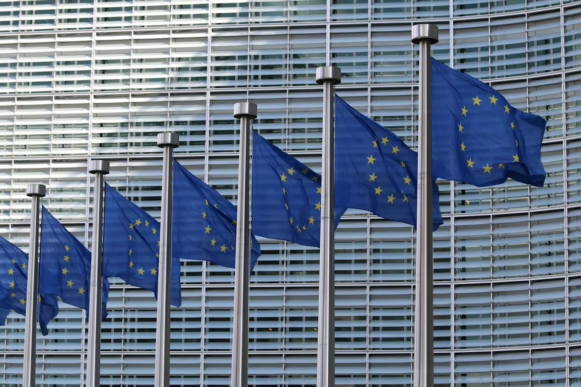
European Commission building displaying the EU emblem as Cyber Resilience Act standards advance.
EU Cyber Resilience Act Moves Toward Technical Standards Ahead of September DeadlineETSI has opened the approval process for 17 draft standards supporting the EU Cyber Resilience Act as manufacturers prepare for vulnerability and incident reporting requirements beginning September 11, 2026.

Related Vendors