Topics

Explore critical topics shaping today’s SAP landscape—from digital transformation and cloud migration to cybersecurity and business intelligence. Each topic is curated to provide in-depth insights, best practices, and the latest trends that help SAP professionals lead with confidence.

Regions

Discover how SAP strategies and implementations vary across global markets. Our regional content brings localized insights, regulations, and case studies to help you navigate the unique demands of your geography.

Industries

Get industry-specific insights into how SAP is transforming sectors like manufacturing, retail, energy, and healthcare. From supply chain optimization to real-time analytics, discover what’s working in your vertical.

Hot Topics

Dive into the most talked-about themes shaping the SAP ecosystem right now. From cross-industry innovations to region-spanning initiatives, explore curated collections that spotlight what’s trending and driving transformation across the SAP community.

Topics

Explore critical topics shaping today’s SAP landscape—from digital transformation and cloud migration to cybersecurity and business intelligence. Each topic is curated to provide in-depth insights, best practices, and the latest trends that help SAP professionals lead with confidence.

Regions

Discover how SAP strategies and implementations vary across global markets. Our regional content brings localized insights, regulations, and case studies to help you navigate the unique demands of your geography.

Hot Topics

Dive into the most talked-about themes shaping the SAP ecosystem right now. From cross-industry innovations to region-spanning initiatives, explore curated collections that spotlight what’s trending and driving transformation across the SAP community.

SAP Regulatory Compliance

SAP Regulatory Compliance focuses on how organizations use SAP systems to meet defined legal, tax, data, security, and reporting obligations across business processes. The topic includes SAP GRC, SAP Access Control, SAP Process Control, SAP Document and Reporting Compliance, SAP S/4HANA, SAP Cloud ERP Private, and related tax, identity, privacy, and controls platforms. For SAP customers, the business value is practical: reduce compliance risk, support audits, manage national tax and e-invoicing mandates, maintain digital sovereignty requirements, and keep regulated processes aligned with changing rules.

What is SAP Regulatory Compliance?

SAP Regulatory Compliance is the use of SAP processes, controls, data, and reporting capabilities to satisfy specific regulatory obligations. In practice, it helps finance, tax, security, privacy, IT, and audit teams prove that SAP-enabled transactions, access, invoices, tax records, cloud configurations, and business controls meet applicable requirements. It is used to manage obligations such as SOX, GDPR, VAT/GST reporting, e-invoicing, statutory reporting, segregation of duties, access governance, and cloud security responsibilities within SAP environments.

SAP Regulatory Compliance focuses on how organizations use SAP systems to meet defined legal, tax, data, security, and reporting obligations across business processes. The topic includes SAP GRC, SAP Access Control, SAP Process Control, SAP Document and Reporting Compliance, SAP S/4HANA, SAP Cloud ERP Private, and related tax, identity, privacy, and controls platforms. For SAP customers, the business value is practical: reduce compliance risk, support audits, manage national tax and e-invoicing mandates, maintain digital sovereignty requirements, and keep regulated processes aligned with changing rules.

What is SAP Regulatory Compliance?

SAP Regulatory Compliance is the use of SAP processes, controls, data, and reporting capabilities to satisfy specific regulatory obligations. In practice, it helps finance, tax, security, privacy, IT, and audit teams prove that SAP-enabled transactions, access, invoices, tax records, cloud configurations, and business controls meet applicable requirements. It is used to manage obligations such as SOX, GDPR, VAT/GST reporting, e-invoicing, statutory reporting, segregation of duties, access governance, and cloud security responsibilities within SAP environments.

How do enterprises use SAP Regulatory Compliance?

Tax Reporting and Tax Legislation

Finance and tax teams use SAP regulatory compliance capabilities to manage country-specific tax rules, VAT/GST requirements, statutory reporting, and local mandates. SAP tax engines, localization tools, and SAP S/4HANA integrations help organizations adapt reporting and transaction processes as legislation changes.

E-Invoicing and Tax Payments

Enterprises use SAP Document and Reporting Compliance and SAP Business Network to support mandated e-invoicing, invoice validation, tax reporting, and government submission requirements. These capabilities help align procure-to-pay and order-to-cash processes with country-specific invoice schemas, clearance models, and audit trail expectations.

Digital Sovereignty and Data Residency

Organizations use SAP compliance practices to address where data is stored, who operates systems, what legal frameworks apply, and how regulated workloads are controlled. This is important for SAP cloud environments where data sovereignty, operational transparency, and contractual safeguards shape compliance.

Access Governance and Segregation of Duties

GRC teams use SAP Access Control and identity tools to monitor sensitive access, detect segregation-of-duties conflicts, and document approvals. This supports audit readiness and reduces the risk of unauthorized transactions across SAP ERP, SAP S/4HANA, and hybrid application landscapes.

Continuous Controls Monitoring

Enterprises use SAP Process Control and third-party GRC platforms to automate control testing, monitor exceptions, and centralize evidence. Continuous monitoring helps teams move from periodic compliance checks to earlier detection of policy violations, configuration drift, and audit issues.

Where does SAP Regulatory Compliance emerge in SAPinsider research?

The Tax Technology in SAP Environments benchmark study shows why tax compliance belongs in this topic: 65% of respondents prioritize integrating tax across the enterprise, while 41% are automating to ensure compliance in direct and indirect tax. The report also highlights e-filing and e-document management at 41%, reinforcing the role of SAP systems in national tax, reporting, and payment-related compliance.

State of the Market GRC in SAP Environments shows that SAP customers are modernizing compliance operations through automation and centralized controls. The report finds that 60% of organizations are automating GRC processes and 53% are centralizing control workflows, reflecting a shift from manual compliance activity toward integrated control management.


Executing your SAP Cloud ERP Strategy with T-Systems
SAP Adds AI, Custom Reporting to Tackle Surge in Global EPR and PPWR RequirementsSAP has repositioned its Responsible Design and Production solution as an AI-enabled compliance engine to better manage the anticipated tripling of global packaging regulations by 2030, moving towards user-defined reports and integrating AI capabilities to streamline regulatory compliance workflows within core ERP systems.
Professional reviewing digital invoice interface on laptop and calculator, representing SAP mandated e-invoicing compliance and electronic tax reporting.
How SAP Supports Mandated E-Invoicing Compliance Across Global JurisdictionsMandated e-invoicing is reshaping invoice processing, regulatory reporting, and system architecture. This article explains how SAP Business Network and SAP Document and Reporting Compliance support clearance, reporting, and global mandate variation.
SecurityBridge SAP security platform logo
RISE with SAP Security: Execution Within the Shared Responsibility Model Defines RiskAs RISE with SAP migration accelerates, security accountability remains with the customer. Execution within the shared responsibility model—not documentation alone—defines governance risk in SAP S/4HANA Cloud environments.
KPMG LLP corporate branding image associated with the Tax AI Accelerator Program and Digital Gateway GenAI platform for corporate tax departments.
KPMG Launches Tax AI Accelerator Program to Advance Generative AI in Corporate TaxThe KPMG Tax AI Accelerator combines structured AI training with Digital Gateway GenAI. This analysis explores its sandbox model, governance design, and architectural positioning.
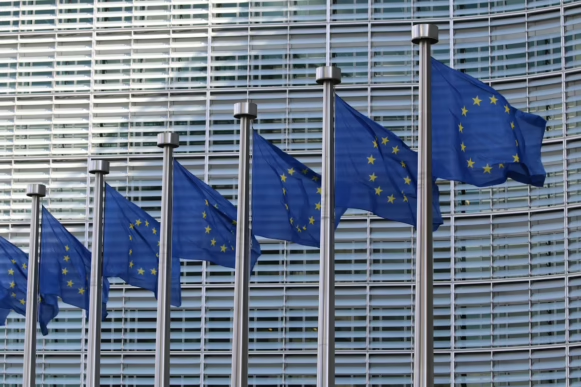
European Union headquarters in Brussels, where DORA digital operational resilience regulations are overseen for financial institutions and ICT providers.
How DORA Is Redefining Accountability for SAP SecurityDORA is redefining how financial institutions manage SAP security. As regulators demand repeatable evidence and operational resilience, accountability now extends deep into live SAP environments and the tools used to monitor them.
NextLabs logo
Why RISE with SAP Security Requires a Data-Centric Zero Trust ModelRISE with SAP and SAP Business Technology Platform are reshaping how SAP environments operate. This article explains why data-centric Zero Trust security is becoming an architectural requirement.
Onapsis logo over modern enterprise office building representing SAP security and cloud transformation.
Why Security Timing Determines Success in RISE with SAP TransformationsSecurity timing often determines whether RISE with SAP transformations stay on track. This analysis examines how late risk discovery undermines migration, execution, and post–go-live outcomes, and why secure-by-design approaches change delivery discipline.
Sustainability simplified with Bayer, SAP and TCSAs most companies worldwide are gearing up for sustainability initiatives, thise webinar will create awareness into how TCS and SAP partnership can help pharma companies in meeting ESG regulatory compliance and sustainability goals.
Contact intelligence
An End-to-End Solution for Global Compliance – cbs’ E-Compliance SolutionGlobal legal and fiscal requirements in business-to-government scenarios such as e-Invoicing, e-Governance, e-Reporting, e-Delivery, and e-Transport are exceptionally stringent. Using the managed cloud solution from cbs, the cbs World Cloud significantly reduces complexity in SAP systems and external interfaces and externalizes unplanned and repetitive tasks, freeing up central IT specialists from local, country-specific tasks and elevating automation levels in business processes. The solution offers a fast return on investment and lowers the total cost of ownership by distributing cloud content across all global customers, thereby reducing costs per customer. Additionally, it includes an automatic legal change monitoring feature where the cbs Legal Change Board tracks, evaluates, and implements legal changes automatically, allowing users to focus on other priorities. Currently, the solution supports over 30 countries, with a dedicated team of experts who continuously monitor regulatory changes to ensure that new regulations and country-specific solutions are implemented within their respective deadlines.
Contact intelligence
Simplifying Tax Compliance with SovosReducing dependence on outdated manual processes is a vital step these organizations must take to free up finance and accounting teams to spend their time on work that adds value to the enterprise. Among intelligent finance functions, none are more popular than invoice and payment processing solutions. More and more organizations are expanding their operations overseas, further complicating compliance. These regulations are constantly in flux, so companies must find solutions beyond what SAP S/4HANA and SAP Central Finance can provide. Read on to learn how Sovos is helping keep SAP organizations compliant.

Related Vendors