Topics

Explore critical topics shaping today’s SAP landscape—from digital transformation and cloud migration to cybersecurity and business intelligence. Each topic is curated to provide in-depth insights, best practices, and the latest trends that help SAP professionals lead with confidence.

Regions

Discover how SAP strategies and implementations vary across global markets. Our regional content brings localized insights, regulations, and case studies to help you navigate the unique demands of your geography.

Industries

Get industry-specific insights into how SAP is transforming sectors like manufacturing, retail, energy, and healthcare. From supply chain optimization to real-time analytics, discover what’s working in your vertical.

Hot Topics

Dive into the most talked-about themes shaping the SAP ecosystem right now. From cross-industry innovations to region-spanning initiatives, explore curated collections that spotlight what’s trending and driving transformation across the SAP community.

Topics

Explore critical topics shaping today’s SAP landscape—from digital transformation and cloud migration to cybersecurity and business intelligence. Each topic is curated to provide in-depth insights, best practices, and the latest trends that help SAP professionals lead with confidence.

Regions

Discover how SAP strategies and implementations vary across global markets. Our regional content brings localized insights, regulations, and case studies to help you navigate the unique demands of your geography.

Hot Topics

Dive into the most talked-about themes shaping the SAP ecosystem right now. From cross-industry innovations to region-spanning initiatives, explore curated collections that spotlight what’s trending and driving transformation across the SAP community.

SAP Process Control

SAP Process Control focuses on how organizations standardize, automate, and monitor internal controls across SAP environments to support compliance, audit readiness, and operational accountability. As part of the SAP GRC suite, SAP Process Control helps risk, compliance, audit, finance, IT, and business process owners connect policies, controls, workflows, and evidence in one governance framework. In SAP landscapes that include SAP S/4HANA, SAP HANA, and Fiori-based user experiences, process control supports continuous monitoring, faster remediation, and clearer visibility into business processes.

What is SAP Process Control?

SAP Process Control is an SAP GRC capability used to manage, test, monitor, and document internal controls across business processes. It gives enterprises a structured way to align risks, controls, policies, workflows, and evidence so compliance activities are not handled only through manual reviews or periodic audits. In practical terms, SAP Process Control helps organizations automate control monitoring, route issues to the right owners, track remediation, and maintain a centralized view of control performance across SAP systems and related business operations.

SAP Process Control focuses on how organizations standardize, automate, and monitor internal controls across SAP environments to support compliance, audit readiness, and operational accountability. As part of the SAP GRC suite, SAP Process Control helps risk, compliance, audit, finance, IT, and business process owners connect policies, controls, workflows, and evidence in one governance framework. In SAP landscapes that include SAP S/4HANA, SAP HANA, and Fiori-based user experiences, process control supports continuous monitoring, faster remediation, and clearer visibility into business processes.

What is SAP Process Control?

SAP Process Control is an SAP GRC capability used to manage, test, monitor, and document internal controls across business processes. It gives enterprises a structured way to align risks, controls, policies, workflows, and evidence so compliance activities are not handled only through manual reviews or periodic audits. In practical terms, SAP Process Control helps organizations automate control monitoring, route issues to the right owners, track remediation, and maintain a centralized view of control performance across SAP systems and related business operations.

How do enterprises use SAP Process Control?

Continuous controls monitoring

Enterprises use SAP Process Control to monitor key controls continuously instead of relying only on quarterly or annual testing cycles. This helps control owners detect exceptions sooner, document findings, and reduce the manual effort required to prepare for audits.

Internal controls testing and evidence management

Finance, audit, and compliance teams use SAP Process Control to schedule control tests, collect evidence, and track signoffs. This creates a more consistent audit trail for controls tied to financial reporting, operational compliance, and enterprise risk management.

Workflow-driven remediation

When a control fails or an exception appears, SAP Process Control can support structured workflows that notify the right owner, assign remediation tasks, and track progress. This helps organizations move from issue identification to resolution with clearer accountability.

SAP S/4HANA transformation governance

During SAP S/4HANA programs, enterprises use process control practices to redesign controls around new processes, data models, and system roles. This helps ensure modernization does not weaken compliance, auditability, or segregation of duties oversight.

Policy and regulatory compliance

Organizations use SAP Process Control to connect internal policies with operational controls and regulatory requirements. This supports consistent monitoring across business units, especially where compliance teams must show that policies are being enforced in day-to-day SAP-enabled processes.

Where does SAP Process Control emerge in SAPinsider research?

State of the Market GRC in SAP Environments shows that SAP customers are moving toward more automated and centralized GRC operating models. In that research, 60% of respondents were automating GRC processes, while 53% were centralizing control workflows to improve efficiency and visibility.

The Automating and Integrating GRC Processes report connects directly to the business case for SAP Process Control by showing how GRC teams are prioritizing automation and integration. The report found that 65% of respondents were focused on end-to-end automated processes to meet compliance and audit requirements.

The Securing RISE with SAP benchmark highlights why continuous monitoring matters as SAP environments shift to cloud operating models. The report found that only 45% of organizations follow the shared responsibility model for SAP Cloud ERP Private security, reinforcing the need for stronger control visibility and ongoing compliance monitoring.

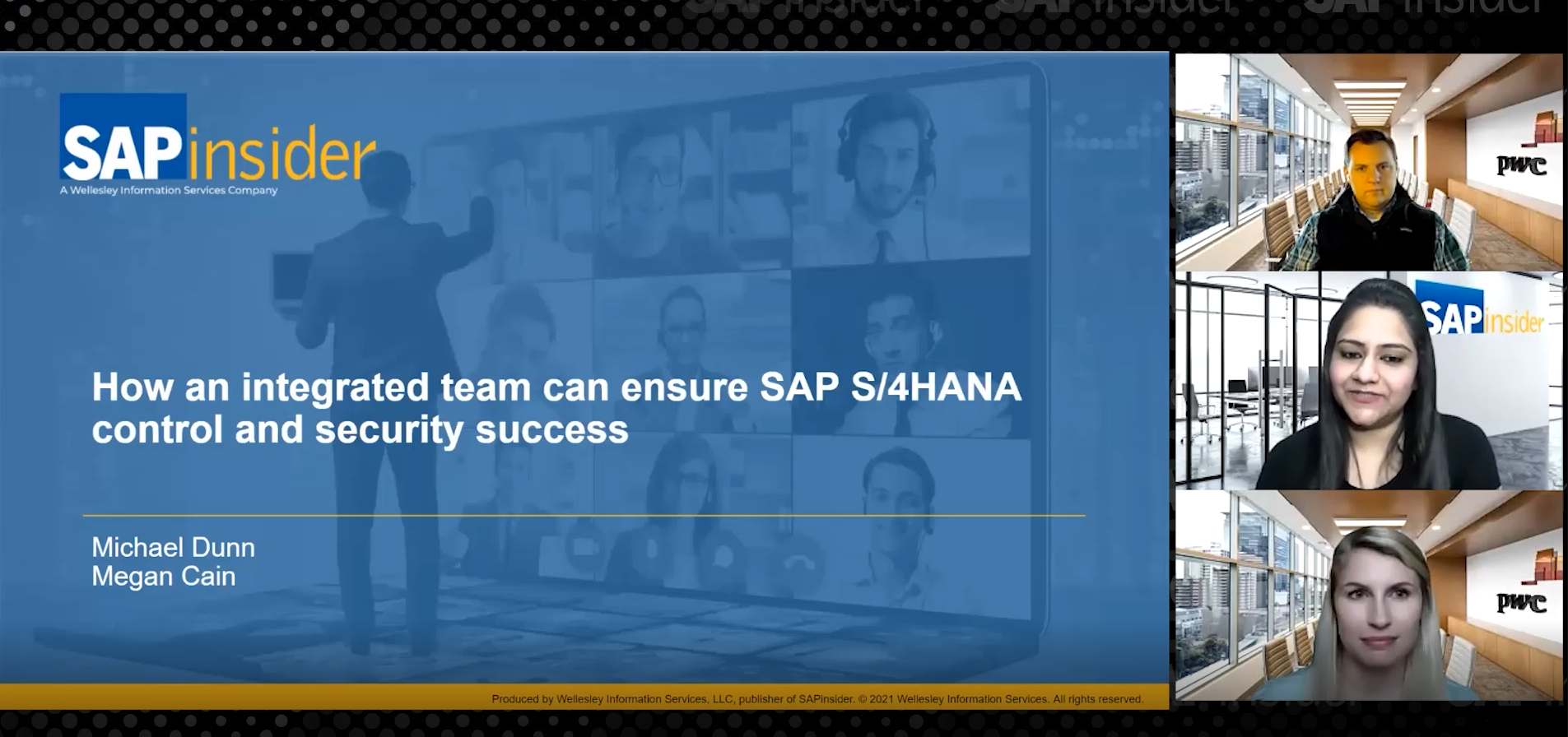
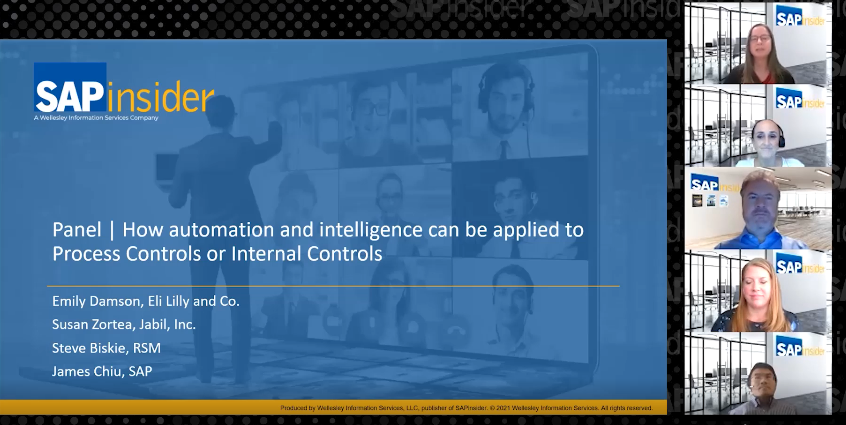
Panel | How automation and intelligence can be applied to Process Control or Internal ControlsAutomating controls within SAP Process Controls is becoming more and more of a “must” than a “want” for organizations in terms of risk identification and transparency. SAP Process Control can perform both semi- and fully automated testing of controls that range from application controls (value checks, blank checks, change log checks) to master data controls (identifying empty fields, or fields without specific values) to transactional controls (with the integration of SAP HANA for even more sophisticated analytics). Continuous control monitoring tracks information continuously, providing critical updates and direction on how to react to alerts. Organizations are applying automation and intelligence to their process and internal controls to reduce data errors and manual processes, maximize ERP returns on investment, and reduce compliance costs such as retesting costs for failed controls. Join this panel discussion for an SAP, consultant, and customer view of how automation within process and internal controls can help organizations more efficiently manage risk.
Creating and deploying automated controls in SAP Process ControlAre you taking full advantage of your SAP Process Control investment with automation? Attend this session to learn how to configure continuous control monitoring in SAP Process Control. Attendees will learn how to: - Define and test data sources to retrieve data from source systems using common sub-scenarios (reports, tables, queries, and so on) - Define business rules using those data sources to set up exception criteria to narrow the results - Return results based upon value or change log checks - Control data returned based upon analysis type, field selection, filters, and more - Automatically categorize result lines based upon deficiency definitions - Understand technical settings and when to consider using calculations, aggregation, and BRF+ functions - Assign business rules to controls and schedule them to run automatically
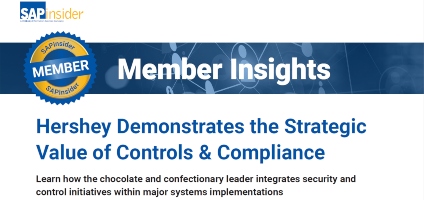
Video: Hershey Demonstrates the Strategic Value of Controls & ComplianceThe mention of Hershey might bring to mind an image of chocolate and it should, but there is a lot more to discover: a chocolate and confectionary leader, The Hershey Company has over 90 brands. Hershey is continuously challenged to innovate and at speed to meet changing consumer preferences and in a global context, like a shift to better-for-you healthy eating, and omnichannel shopping experiences.  The need for greater efficiency in core business processes and controls, better data, analytics and insights, and increased organizational agility, has never been stronger. Watch the video to learn how Hershey integrates security and control initiatives within major systems implementations, and demonstrates the strategic value of controls and compliance.
Hershey Demonstrates the Strategic Value of Controls & ComplianceThe Hershey Company’s move to SAP S/4HANA prompted a reassessment of its governance, risk, and compliance (GRC) strategy. As part of this review, Internal Audit (IA) resources were reviewed, restructured, and incorporated into the SAP S/4HANA project plan. The IA team employs an Agile implementation strategy to build controls into the process, evaluate performance, and adjust when necessary, using version GRC 12.0 of the SAP Access Control and SAP Process Control tools. These tools enable Hershey to manage integration for both SAP and non-SAP systems, provide transparency and accountability, and simplify process execution and risk management. Hershey is rolling out SAP S/4HANA in phases by region, which will give the IA team the ability to examine adoption and control failure rates and determine how IA is leveraging GRC. “Getting involved proactively, especially with an Agile approach, has given us the opportunity to really influence the future design of the process so that controls are innately embedded,” concludes Jon Laubenstine, Senior Director, Internal Audit, at Hershey. Read this article and learn: - How Hershey is reassessing its GRC strategy as part of its move to the SAP S/4HANA platform; - Why Hershey is rolling out the SAP S/4HANA platform in regional phases; - The important of including the IA team at the beginning of your SAP S/4HANA migration.
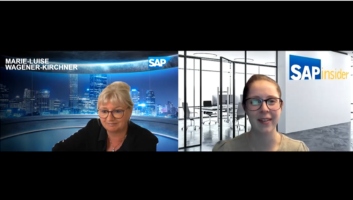
Expert Q&A: Best Practices for Continuous Control MonitoringMany SAP users are simplifying and automating continuous control monitoring (CCM) to manage their GRC environment. Marie-Luise Wagener-Kirchner, Vice President of Governance, Compliance and Digital Services at SAP, recently sat down with SAPinsider to share best practices for CCM. Wagener-Kirchner has been involved in the SAP ecosystem for approximately 20 years, always with a focus on audit controls and security. In her current role she is responsible for internal and external reporting, governance around reporting guidelines and policies, and for the GRC systems and the automated internal controls at SAP. In the following video she explains how customers are utilizing CCM in innovative ways, what components make up a good control setup for successful monitoring, and common pitfalls that organizations should watch out for. First, says Wagener-Kirchner, you need to understand where the control comes from, what makes a good control, and be able to identify inherent risk in your business processes. Watch the video to learn more.
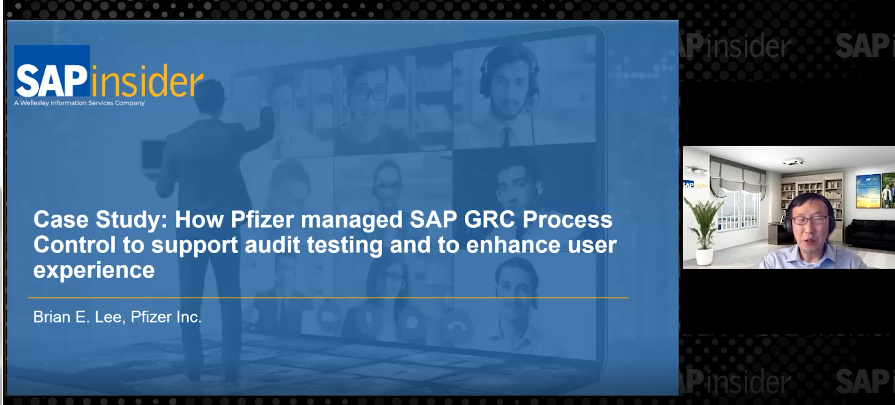
Case Study | How Pfizer supports audit testing & enhances user experience in SAP GRC Process ControlEffectively administrating and governing control creation and execution in SAP Process Control (PC) requires a series of developments, knowledge, and experience. Hear from Pfizer on proven control design administration and master techniques for effective control maintenance, execution, monitoring, and audit testing. Attend this session to: - Take a deep dive into a governance model that management should know and consider before deploying controls in SAP PC - Understand key areas and elements to be considered for a successful internal control testing - Manage challenges and opportunities in developing SAP PC capabilities and user experience
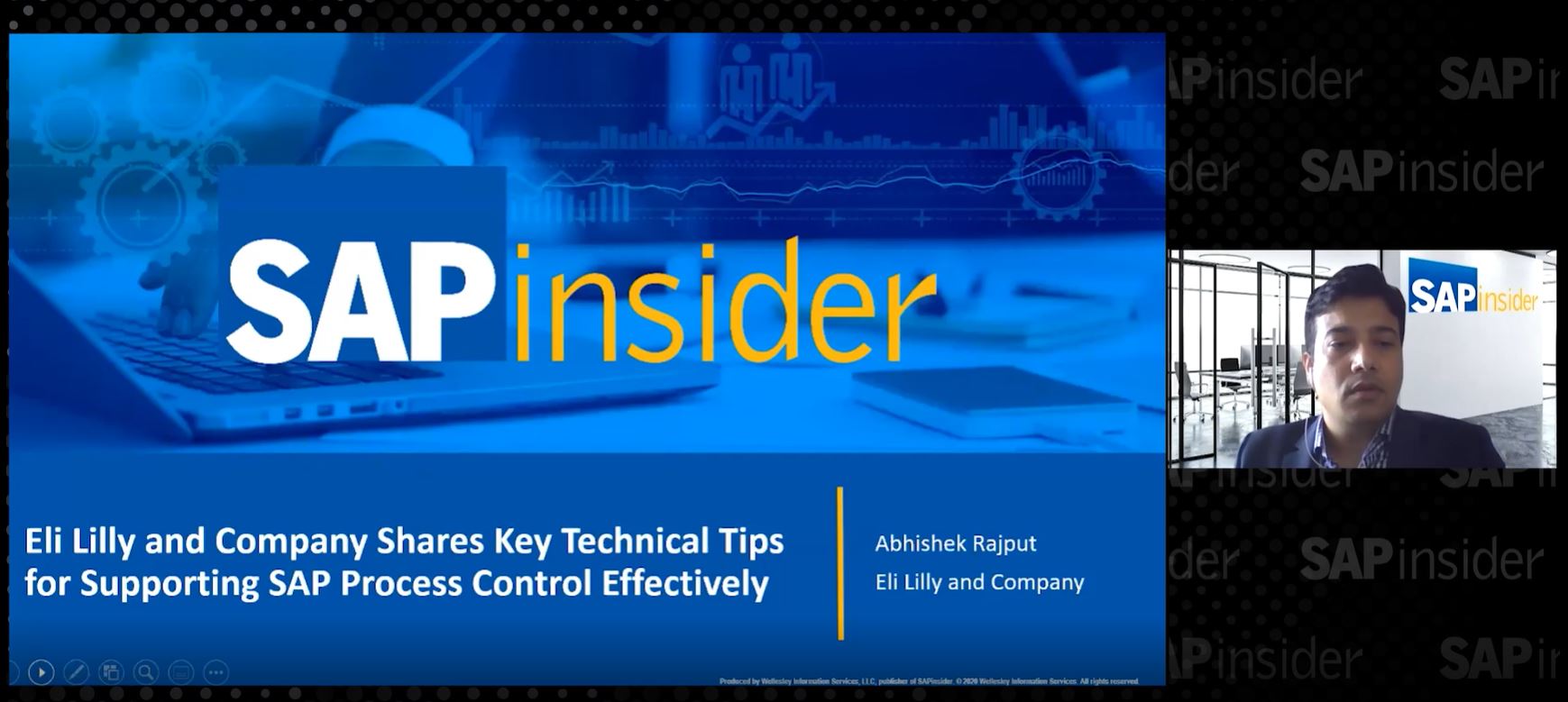
Eli Lilly and Company Shares Key Technical Tips for Supporting SAP Process Control EffectivelyNow that you’re live on SAP Process Control, learn from Eli Lilly and Company about many of the key tables and reports that have helped the organization support its system effectively. This session provides a deeper dive into the technical details of Lilly’s use of SAP Process Control, with an emphasis on the technical support building blocks that have helped the business run smoothly. Attendees will: - Learn the key standard and custom reports that can save time and effort when troubleshooting everyday problems - Discover how to develop custom queries and provide those to end users via SAP Business Client - Take home examples of key tables used to create custom reports - Learn how Lilly is moving data to SAP HANA to enable better report creation
Compliance goes digital – new and updated SAP solutions for Internal Controls and GRCSAP is now applying its strategy to move towards mobile devices to the GRC. Therefore it has implemented a large portion of the relevant GRC functions on a Fiori Launchpad. These now appear as tiles (on that Launchpad) and offer a unified entry point for all GRC Fiori Apps. Also, each user is able to personalize their own Launchpad and can add, remove or sort apps via drag and drop. Attend this session to: - See a demo of new Fiori interfaces in Process Control - Learn about the new intuitive way of Dashboards and Launchpads in Process Control - Explore new features which enhance the User Experiences - Understand the new way of working with GRC Process Control
Process, Controls, and AutomationDue to organization complexity and moves to SAP S/4HANA, many processes change from customized to standardized. How do you maintain vigilance, apply machine learning and artificial intelligence, to monitor and manage internal controls within your GRC landscape? Explore how companies are using automation and advanced control monitoring capabilities to protect business processes and ensure compliance. Learn how to apply intelligence and automation to become more efficient in your controls management. Build a more automated and integrated compliance and risk management landscape by enhancing your GRC investments with the addition of intelligent capabilities.
Life Sciences Compliance: A Strategic Imperative for Profitability and Innovation
Pfizer Standardizes Process Controls and Moves to Continuous Remote AuditsThis case study explains how the Manual Control Performance (MCP) capability in SAP Process Control empowered Pfizer, an American multinational pharmaceuticals company headquartered in New York City with approximately 88,300 employees worldwide, to standardize controls across all sites, centralize, control performance, and perform continuous control monitoring (CCM).

Related Vendors