Topics

Explore critical topics shaping today’s SAP landscape—from digital transformation and cloud migration to cybersecurity and business intelligence. Each topic is curated to provide in-depth insights, best practices, and the latest trends that help SAP professionals lead with confidence.

Regions

Discover how SAP strategies and implementations vary across global markets. Our regional content brings localized insights, regulations, and case studies to help you navigate the unique demands of your geography.

Industries

Get industry-specific insights into how SAP is transforming sectors like manufacturing, retail, energy, and healthcare. From supply chain optimization to real-time analytics, discover what’s working in your vertical.

Hot Topics

Dive into the most talked-about themes shaping the SAP ecosystem right now. From cross-industry innovations to region-spanning initiatives, explore curated collections that spotlight what’s trending and driving transformation across the SAP community.

Topics

Explore critical topics shaping today’s SAP landscape—from digital transformation and cloud migration to cybersecurity and business intelligence. Each topic is curated to provide in-depth insights, best practices, and the latest trends that help SAP professionals lead with confidence.

Regions

Discover how SAP strategies and implementations vary across global markets. Our regional content brings localized insights, regulations, and case studies to help you navigate the unique demands of your geography.

Hot Topics

Dive into the most talked-about themes shaping the SAP ecosystem right now. From cross-industry innovations to region-spanning initiatives, explore curated collections that spotlight what’s trending and driving transformation across the SAP community.

SAPinsider Research

Access the definitive State of the Market guides, with your steps to success from benchmarking the performance of SAP professionals worldwide. See which strategies are yielding the best results, what sets Leaders apart from their peers. Discover actionable, data-driven insights to ensure the success of your initiatives.

RISE with SAP
RISE with SAP 2023Nov 30, 2023  —  Over the last two years, RISE with SAP went from being a somewhat confusing business-transformation-as-a-service offering to the core of SAP’s cloud ERP strategy. To further demonstrate the value of the offering, SAP recently announced RISE with SAP Premium Plus. It provides access to a new embedded generative AI assistant called Joule, new sustainability features, and advanced finance and cash flow capabilities. SAP also revealed that there are now more than 4,300 RISE with SAP customers. But does RISE with SAP resonate in the broader SAP community? This report will focus on what organizations currently understand about RISE with SAP, the concerns they have, and the offering fits into their needs for ERP and innovation. The survey asked the respondents to about their familiarity with RISE with SAP, how much they know about the components of RISE with SAP, what about RISE with SAP provides the most benefit, how they plan on selecting a cloud service provider for RISE with SAP, and what the biggest factors are impacting their plans for ERP and innovation. When SAPinsider first started researching RISE with SAP there was limited knowledge about the offering, and a significant proportion of respondents claimed to know little about it. That changed over the last two years, and this year only 7% of respondents reported that they were not at all familiar with RISE with SAP. Download the benchmark report to read the full data analysis from 229 members of the SAPinsider community and receive recommendations for your own plans. - Explore how much organizations currently know about RISE with SAP - Learn what they see as offering the most benefit from the offering - Understand whether there is concern about moving to RISE with SAP - See what the drivers, actions, and requirements are for ERP and innovation
Cash Management and Visibility – Benchmark Research ReportNov 30, 2023  —  In 2023, finance leaders in SAP customer organizations are prioritizing accurate cash flow forecasting amidst an evolving economic landscape. SAPinsider’s research indicates a significant challenge: only 5% of these organizations have a comprehensive view of cash and liquidity. The survey, involving 128 finance community members, highlights an increased focus on agile decision-making to counter economic uncertainties and enhance profitability. The demand for precise cash flow forecasting has grown, with 31% of respondents citing it as a primary concern, marking a 6% increase from 2022. This trend underscores the importance of effective cash management strategies in today’s dynamic financial environment. The SAPinsider research conducted in 2023 has unveiled some critical insights into the strategic priorities of finance leaders at SAP customer organizations. The study highlights a growing focus on accurate cash flow forecasting, with 31% of respondents emphasizing this in 2023, a rise from the previous year. The increasing complexities of the economic landscape have led to a renewed emphasis on cash as a crucial asset. As a result, businesses are reevaluating their strategies to make informed financial decisions in light of rising borrowing costs, inflationary pressures, and foreign currency volatility. The research also reveals a shift towards technology-driven solutions to address challenges in cash management processes. Organizations are leaning more towards third-party cloud solutions, AI-based tools, enhanced reporting tools, and closer collaborations with vendor partners to streamline operations and enhance decision-making capabilities. From a broader perspective, the most challenging cash management processes identified by the respondents were cash forecasting, working capital, and credit management. This shows a growing emphasis on streamlining cash flow predictions, improving financial efficiency, and managing credit risk effectively. For SAP customer organizations, the critical goals for 2023 include efficient end-to-end processes, transparency, and real-time information. These objectives underscore the importance of optimizing operational performance, enhancing visibility, and leveraging digitized data and processes for real-time insights and analytics. Finally, the research reveals that several organizations are considering implementing new or updated SAP technologies, solutions, or services to enhance their cash management and treasury functions. Among these, SAP S/4HANA appears to be the most popular choice, with almost half of the respondents planning to adopt it. Other options like GROW with SAP, RISE with SAP, SAP S/4HANA Public Cloud, SAP BTP, and SAP Signavio also garnered attention as potential solutions to improve cash management and treasury operations. In conclusion, the SAPinsider research provides valuable insights into how SAP customer organizations are reshaping their strategies to navigate the ever-changing economic landscape effectively. The emphasis on accurate cash flow forecasting, efficient processes, transparency, real-time information, and the adoption of modern technologies highlights the evolving priorities of finance leaders in these challenging times.
Financial Close Transformation 2023 – Benchmark ReportNov 30, 2023  —  Financial close processes are undergoing significant transformation, driven by the need for efficiency and accuracy in today’s dynamic business environment. The report reveals a trend towards automation and digitalization, with a focus on overcoming challenges posed by manual methods. Intercompany accounting emerges as a key concern, exacerbated by complexities in global business structures. SAP S/4HANA coupled with modern financial close management solutions are identified as a critical strategy in addressing these challenges, enabling faster, more reliable closes. The findings highlight the importance of integrating advanced technologies in financial systems to streamline processes, enhance data integrity, and support strategic decision-making from finance teams at SAP organizations.
RISE with SAP
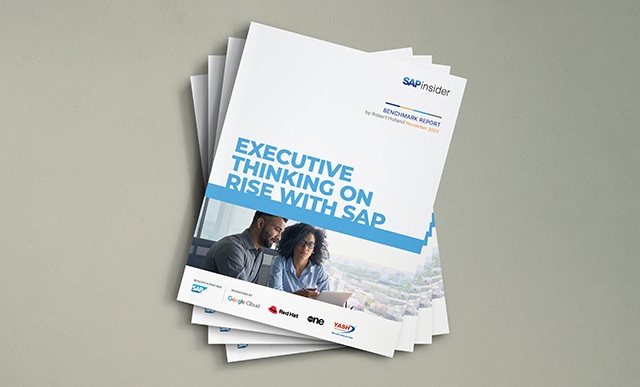
Executive Thinking on RISE with SAPNov 30, 2023  —  Over the past year, SAP has significantly shifted its strategy for RISE with SAP. However, while RISE with SAP has been the focus of cloud ERP strategy since its release in 2021, SAP has made the transition to SAP S/4HANA more difficult for organizations opting not to use the RISE with SAP framework. The recent announcements stating that some innovations will be exclusive to customers with RISE with SAP contracts, followed by the statement that only RISE with SAP Premium Plus will incorporate new sustainability and generative AI features, has led to confusion among the SAP customer base. This report will focus on what executives are thinking about RISE with SAP and the impact that SAP's most recent statements are having on that thinking. The survey asked the respondents to about the role of RISE with SAP in plans for ERP modernization and transformation, whether SAP's most recent statements around generative AI capabilities only being available to RISE with SAP customers are having an impact, and where concerns still exist about RISE with SAP. Although responses indicate that while a plurality of respondents (29%) reported planning on evaluating RISE with SAP, it was only slightly more than those who had no plans to evaluate RISE with SAP (25%).  Download the benchmark report to read the full data analysis from 229 members of the SAPinsider community and receive recommendations for your own plans. - Explore the impact that SAP's most recent statements are having on thinking about RISE with SAP - Learn about the role that RISE with SAP is playing in plans for ERP modernization and transformation - Understand whether organizations have concerns about moving to RISE with SAP - See how organization size has an impact on the approach to RISE with SAP
cybersecurity priorities
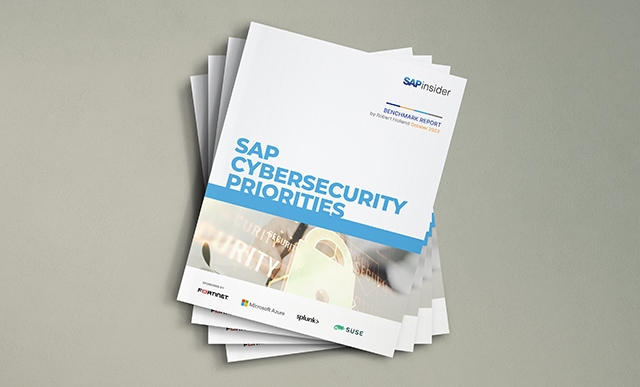
SAP Cybersecurity PrioritiesOct 31, 2023  —  Cyberattacks and cyber crime continue to grow across the globe. The latest statistics show growth in both the frequency and cost of attacks, and as many as two thirds of organizations may have experienced a cyberattack during the past year. With cybersecurity on the minds of many businesses, it is important to examine what organizations are prioritizing when it comes to their SAP systems. Earlier this year, SAPinsider research revealed that ransomware attacks, unpatched systems, and compromised credentials were the top three cybersecurity threats to SAP systems. This report will focus on what organizations are prioritizing to secure their SAP systems and how they are ensuring their teams are ready to meet these threats. The survey asked the respondents to about their cybersecurity priorities, the teams involved in setting those priorities, how they are protecting their SAP systems, in which areas they are prioritizing cybersecurity investment, and the impact of the current economic climate on their cybersecurity priorities. Protecting the data in SAP systems remains the top priority for respondents (57%), with risk assessment and management (33%) and identify and access management (30%) much less important. This aligns with the fact that 53% of respondents reported that the biggest factor impacting their cybersecurity priorities is the need to keep sensitive and confidential data in SAP systems protected from potential threats. Download the benchmark report to read the full data analysis from 144 members of the SAPinsider community and receive recommendations for your own plans. - Explore the factors that are most impacting cybersecurity priorities for SAP systems - Learn about the actions being taken to support cybersecurity priorities - Understand the types of security education and training being prioritized - See the list of cybersecurity priorities and cybersecurity threats to SAP systems
CIO - Featured Image
The CIO’s Transformation Report Card 2023Oct 31, 2023  —  Over 50% of tech leaders are prioritizing two transformation initiatives: business process automation, standardization, or redesign, and transitioning to SAP S/4HANA. This is according to SAPinsider’s CIO 2023 Transformation Report Card and represents a considerable growth compared to last year, with 17 and 22 percentage point increases. Tech leaders identified two main drivers of digital transformation. Nearly 50% of respondents cited the business need for greater flexibility and innovation as the top driver of transformation, 17 points higher than last year. Over a third of respondents noted the upcoming end of maintenance for ECC, 18 points higher than last year. Regarding SAP’s role in transformation initiatives, a shift in perception has been observed over the past 12 months. This year, 47% reported using SAP for core ERP, new cloud solutions and innovation, 11 points higher than last year, and 33% reported SAP would be back-end primarily while best-of-breed would provide cloud and innovation, down 9 points from last year.
Enterprise Cloud – Landscape, Transformation, and IntegrationSep 29, 2023  —  For the last four years, SAPinsider has been following the move to the cloud. Initially our research followed cloud workloads in general, but for the last two years we have focused on how SAP workloads are moving to the cloud. This year, cloud usage continues to increase across the enterprise landscape. SAP’s push for cloud ERP and the adoption of the SAP Business Technology Platform (BTP) is partly responsible for this, but organizations are also moving data, as well as both SAP and non-SAP workloads to cloud environments. In the SAP space, many organizations are still running older systems on local infrastructure, while newer solutions are more likely to be running in the cloud. But a significant proportion of those workloads still running on local infrastructure are likely to move to the cloud over the next few years. The survey asked the respondents to about the SAP workloads they are running, the infrastructure used for those workloads, whether they planned on moving on-premise workloads to the cloud, the cloud providers they were using, and the factors most impacting their decisions to move SAP workloads to the cloud. As has been the case in the past, it is older SAP workloads that are most likely to be still be running on-premise. This includes sales solutions (45%) and SAP ECC or SAP Business Suite (38%). Most of these workloads will move to the cloud over the next few years, although those running new offerings like SAP HANA (55%) and SAP S/4HANA (47%) have no plans to move those workloads to the cloud likely because they are based on new infrastructure investments. Download the benchmark report to read the full data analysis from 170 members of the SAPinsider community and receive recommendations for your own plans. - Explore the factors that are most impacting how organizations will move SAP workloads to the cloud - Learn about the criteria being used by respondents for selecting a cloud provider - Understand the measurement criteria for cloud deployments - See how organizations are integrating cloud deployments with other workloads both on-premise and in the cloud
EAM Report
Elevating Enterprise Asset Management (EAM) in the Digital AgeAug 31, 2023  —  For asset-intensive industries such as utilities, oil and gas, transportation, and discrete and process manufacturing, Enterprise Asset Management (EAM) has been a crucial necessity. It includes the management, support, and maintenance of a company’s physical assets throughout their complete lifecycle. This lifecycle encompasses capital planning, procurement, installation, performance, maintenance, repair, regulatory compliance, risk management, and asset decommissioning and disposal.
Deployment Approaches to SAP S/4HANA 2023Jul 31, 2023  —  For the last three years, SAPinsider tracked how organizations deploy SAP S/4HANA. During that time, adoption of the solution grew steadily, although a significant proportion of respondents either still have no plans for SAP S/4HANA or are only at the point of evaluating the business case. The most likely deployment model for these organizations continues to be a system conversion or brownfield implementation with a new implementation being second. However, over the last two years a greater proportion of respondents indicated that a selective data transition is an option as existing SAP ERP users with complex implementations have started to move to SAP S/4HANA. The survey asked the respondents to about whether they were running SAP S/4HANA, their time frame for switching, how they planned to deploy, the infrastructure they planned on using, and the factors most impacting their SAP S/4HANA deployment decisions. As has been the case the last three years, the proportion of respondents planning on using a selective data transition continues to grow just as more long-time SAP ERP customers move to the offering. But while a quarter (27%) of organizations have already switched to SAP S/4HANA, more than half the respondents to this survey (53%) indicated that they do not plan to switch before 2025. This has the potential to create a resource bottleneck for partners that are experienced with deploying SAP S/4HANA as the 2027 end of maintenance deadline approaches. Download the benchmark report to read the full data analysis from 168 members of the SAPinsider community and receive recommendations for your own plans. - Explore the factors that are most impacting how organizations will deploy SAP S/4HANA - Learn about the types of deployments being used and what those trends mean - Understand the time line for when respondents planned to switch to SAP S/4HANA - See the infrastructure that organizations plan on using for their deployments
Evolving BI
Evolving BI and AnalyticsJun 30, 2023  —  Creating a cohesive data fabric is integral to organizational business intelligence (BI). However, while many organizations strive to reach this goal, there is often a gap between building cohesive data fabric strategy and its execution. The introduction of SAP Datasphere earlier this year aimed to address this need by harmonizing mission-critical data across the enterprise while maintaining its business context. However, SAPinsider research shows that a need to demonstrate return on investment (ROI) and provide faster time to value may override such broader, strategic goals. Although four in five respondents reported that their organization was currently considering, planning, or implementing business intelligence solutions, most are still in the early phases of their deployments. The challenges that they face in deploying these initiatives relate to budget, change management issues, and embarking on broader programs rather than trying to provide quick wins. Despite the need for a cohesive data fabric, respondent organizations are constrained with demonstrating ROI, faster time-to-value, and limit expenditure. This may preclude them from meeting their broader business intelligence objectives even though there is a need for more agility and cross-enterprise capabilities in business intelligence. However, as operational business intelligence gets embedded in strategic plans and roadmaps, organizations will be able to better engage with their business intelligence plans. Download the benchmark report to read the full data analysis from 178 members of the SAPinsider community and receive recommendations for your own plans. - Explore the factors behind the need for business intelligence and analytics to evolve - Learn whether business intelligence objectives are part of long-term strategic and enterprise planning - Understand the challenges that organizations face with deploying business intelligence programs - See what data consumption tools, technology platforms, and databases/data lakes are being used

Related Vendors