



Mar 16-19, 2026Las Vegas, Nevada, NV
SAP Hyperscalers
Featured Insiders
Upcoming Events
SAPinsider Las Vegas 2026
Related Vendors
SAP Hyperscalers: An Overview and Key Considerations
What Are SAP Hyperscalers?
Hyperscale computing is the ability of an architecture to scale as needed to support increased demand. But what most people think about when discussing the term “hyperscaler” is the scale of the computing environment. Typically distributed, hyperscale environments can include thousands or tens of thousands of servers. SAP Hyperscalers refers to the public cloud providers that SAP uses as hosting partners for their cloud solutions and services. The primary vendors that fit the criteria of SAP Hyperscalers are:
These three organizations are the market leaders in infrastructure-as-a-service (IaaS) and platform-as-a-service (PaaS) computing today, and all are close partners of SAP. While not as significant in the global cloud services market, Alibaba Cloud is very prominent in the APJ region and also partners closely with SAP.
Key Considerations for SAPinsiders
SAP Hyperscalers: An Overview and Key Considerations
What Are SAP Hyperscalers?
Hyperscale computing is the ability of an architecture to scale as needed to support increased demand. But what most people think about when discussing the term “hyperscaler” is the scale of the computing environment. Typically distributed, hyperscale environments can include thousands or tens of thousands of servers. SAP Hyperscalers refers to the public cloud providers that SAP uses as hosting partners for their cloud solutions and services. The primary vendors that fit the criteria of SAP Hyperscalers are:
These three organizations are the market leaders in infrastructure-as-a-service (IaaS) and platform-as-a-service (PaaS) computing today, and all are close partners of SAP. While not as significant in the global cloud services market, Alibaba Cloud is very prominent in the APJ region and also partners closely with SAP.
Key Considerations for SAPinsiders
- SAP Hyperscalers offer a scalable environment that can help facilitate change. When SAPinsider spoke to MSC Industrial about why they decided to move forward with a hyperscaler, they explained that it allowed them to consolidate their IT footprint and refocus their IT resources on strategic priorities. Not only did they receive support from SAP for their deployments, they also received just as much support from their hyperscaler partner. This meant that they were able to consider how they could do more with their existing technology, a change that they did not previously believe was possible.
- Cloud computing is likely to be a hybrid future for SAP customers. SAPinsider research in 2021 revealed that, of those organizations running SAP workloads in the public cloud, most were using more than one public cloud provider. And when RISE with SAP was launched, one of the factors that SAP emphasized was the choice available for organizations in their hosting partner. Markus Noga, SUSE’s Vice President, Solutions Technology, agrees that organizations are becoming more discerning about where they deploy solutions. Hybrid cloud environments, whether they involve some on-premise and some cloud-based deployments, or simply leverage multiple SAP Hyperscalers, are the way forward when working with hyperscale computing.
- RISE with SAP provides customers with the choice of their hosting partner, though the contract is managed by SAP. When organizations purchase SAP’s new RISE with SAP offering, they can choose their hosting partner. Many are choosing to go with the SAP Hyperscalers mentioned above, even though they will not be able to leverage their existing contracts with these cloud providers. This is because RISE with SAP is a single contract with SAP, and SAP manages all the other contracts involved. This article provides insight on RISE with SAP contracts, and four other things that you should know about RISE with SAP.
20 results
Why Security Timing Determines Success in RISE with SAP TransformationsFeb 2 — Security timing often determines whether RISE with SAP transformations stay on track. This analysis examines how late risk discovery undermines migration, execution, and post–go-live outcomes, and why secure-by-design approaches change delivery discipline.
4 minute read




A Closer Look at Why Choice Matters – SAP Landscapes Powered by Intel ProcessorsDec 1, 2023 — Click Here to View Session Deck. In this session, you will hear from Intel experts why the right choice for your infrastructure with your hyperscaler of choice matters and how these decisions can optimize your SAP landscape towards improved TCO and performance. Intel experts will outline architectural examples designed for performance and reduced costs as […]
1 minute read

Large Brazilian Renewable Energy Company Predicts the WindNov 15, 2021 — The clean energy industry is expected to grow as governments develop regulations that require businesses to consider their impact on the environment. In fact, according to the Brazilian government, almost 83% of Brazil’s electricity matrix originates from renewable sources.
For Casa dos Ventos Energias Renovaveis (Casa dos Ventos), a pioneer in Brazil’s renewable energy market, the company is particularly interested in wind, and solar, and green hydrogen. The company is the biggest wind developer in Brazil. Nearly one-third of all the wind power being generated in Brazil is developed by Casa dos Ventos, says Chief Information Officer (CIO) Roberto Oikawa.
Oikawa is focused on expanding the company’s operations and expects to become one of the largest energy generators in Brazil with the completion of new wind farms. To get there requires the essential task of digitizing the energy sale.
His first step was to change the culture of the company’s IT enterprise. And second, Casa dos Ventos needed a partner and IT infrastructure that allows the company to perform machine learning and artificial intelligence studies with the flexibility and agility that the business requires, says Oikawa.
That partnership came in the form of hosting SAP S/4HANA on Google Cloud Platform (GCP).
Read more and learn:
• How Oikawa transformed the culture of the IT enterprise by focusing on IT staff that knows how to get information, learn, and be proactive.
• What led Casa dos Ventos to choose SAP and Google as strategic partners for its wind farm initiative.
• How Oikawa learned to get the most from the company’s cloud environment and achieve the outcome he needed.
• What the keys to success were for making Casa dos Ventos’ projects a success and the road ahead.
6 minute read

Which Side Are You on in the War of the Hyperscalers ?Jul 11, 2021 — By Kumar Singh, Research Director, Automation & Analytics, SAPinsider The war of the hyperscalers There is no doubt that hyperscalers like Azure, AWS and Google cloud seem to be taking over the technology ecosystem. These companies are not only dominating cloud services but dominating related domains as well. We are increasingly seeing more and more […]
3 minute read
SAP S/4HANA on Azure with SAP Business Technology PlatformJun 11, 2021 — Organizations implementing SAP S/4HANA are looking to minimize disruption and maximize business value. Microsoft and SAP are working together to simplify and accelerate that process for SAP S/4HANA on Microsoft Azure.
Attend this session to:
Learn why SAP S/4HANA is a foundational requirement to support the intelligent enterprise
Learn about Microsoft and SAP’s expanded partnership, foundations, investments, and services to simplify and accelerate your journey to SAP S/4HANA on Microsoft Azure
Understand how to optimize and automate processes with SAP S/4HANA and Microsoft Azure combined with SAP Business Technology Platform
1 minute read
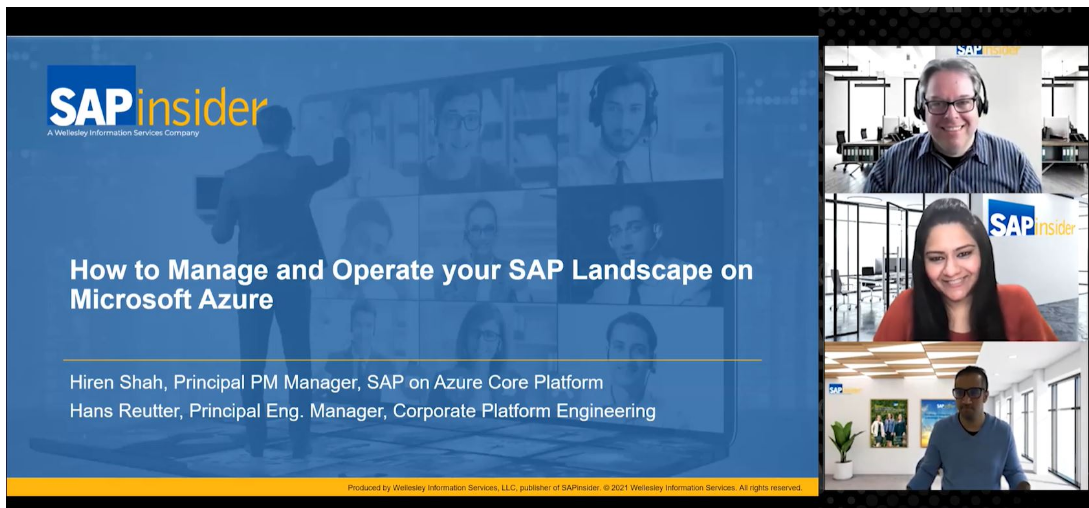
How to manage and operate your SAP landscape on Microsoft AzureJun 11, 2021 — Running SAP in the public cloud delivers new levels of agility and efficiency. Learn from Microsoft’s Azure Product Group how to use cloud technology to optimize and automate the day-to-day management of your SAP landscape. Microsoft IT has been operating Microsoft’s large SAP installations for over 3 years on Azure and will share hands-on best practices and lessons learned.
1 minute read
Simplification and Innovation with SAP on AzureMay 28, 2021 — Join us for this complementary roundtable to find out how two of your strategic partners are working together to help you simplify, automate, and innovate! We will be exploring the benefits of running SAP’s business applications on the Microsoft Azure platform and reviewing real-world deployment examples. We will also look at the opportunities for integration, analytics, and innovation extensions using a combination of the SAP Business Technology Platform and Azure products and services.
1 minute read