Topics

Explore critical topics shaping today’s SAP landscape—from digital transformation and cloud migration to cybersecurity and business intelligence. Each topic is curated to provide in-depth insights, best practices, and the latest trends that help SAP professionals lead with confidence.

Regions

Discover how SAP strategies and implementations vary across global markets. Our regional content brings localized insights, regulations, and case studies to help you navigate the unique demands of your geography.

Industries

Get industry-specific insights into how SAP is transforming sectors like manufacturing, retail, energy, and healthcare. From supply chain optimization to real-time analytics, discover what’s working in your vertical.

Hot Topics

Dive into the most talked-about themes shaping the SAP ecosystem right now. From cross-industry innovations to region-spanning initiatives, explore curated collections that spotlight what’s trending and driving transformation across the SAP community.

Topics

Explore critical topics shaping today’s SAP landscape—from digital transformation and cloud migration to cybersecurity and business intelligence. Each topic is curated to provide in-depth insights, best practices, and the latest trends that help SAP professionals lead with confidence.

Regions

Discover how SAP strategies and implementations vary across global markets. Our regional content brings localized insights, regulations, and case studies to help you navigate the unique demands of your geography.

Hot Topics

Dive into the most talked-about themes shaping the SAP ecosystem right now. From cross-industry innovations to region-spanning initiatives, explore curated collections that spotlight what’s trending and driving transformation across the SAP community.

SAP Audit Management

SAP Audit Management focuses on how SAP customers plan, execute, document, and monitor internal and external audits across complex enterprise environments. The topic covers audit planning, risk evaluation, evidence collection, issue tracking, audit reporting, and integration with SAP governance, risk, and compliance processes. It is relevant for internal audit teams, compliance leaders, finance controllers, IT risk owners, and SAP security stakeholders. In SAP environments, audit management helps organizations move away from manual documentation and toward more consistent, automated, and defensible audit workflows that support compliance, operational resilience, and executive oversight.

What is SAP Audit Management?

SAP Audit Management is the practice of using SAP capabilities and connected GRC processes to manage the audit lifecycle from planning through reporting and remediation. It helps organizations define audit scope, assess risks, assign audit work, collect documentation, track findings, and monitor corrective actions. In practical terms, SAP Audit Management gives internal audit, compliance, finance, and IT teams a structured way to prove that business processes, controls, and system activities are being reviewed and governed. It is especially important where SAP systems support regulated finance, supply chain, procurement, HR, and data privacy processes.

SAP Audit Management focuses on how SAP customers plan, execute, document, and monitor internal and external audits across complex enterprise environments. The topic covers audit planning, risk evaluation, evidence collection, issue tracking, audit reporting, and integration with SAP governance, risk, and compliance processes. It is relevant for internal audit teams, compliance leaders, finance controllers, IT risk owners, and SAP security stakeholders. In SAP environments, audit management helps organizations move away from manual documentation and toward more consistent, automated, and defensible audit workflows that support compliance, operational resilience, and executive oversight.

What is SAP Audit Management?

SAP Audit Management is the practice of using SAP capabilities and connected GRC processes to manage the audit lifecycle from planning through reporting and remediation. It helps organizations define audit scope, assess risks, assign audit work, collect documentation, track findings, and monitor corrective actions. In practical terms, SAP Audit Management gives internal audit, compliance, finance, and IT teams a structured way to prove that business processes, controls, and system activities are being reviewed and governed. It is especially important where SAP systems support regulated finance, supply chain, procurement, HR, and data privacy processes.

How do enterprises use SAP Audit Management?

Internal Audit Planning

Enterprises use SAP Audit Management to prioritize audits based on business risk, regulatory requirements, and control exposure. Internal audit teams can structure annual audit plans around SAP processes such as finance, procurement, access management, and data privacy.

Control Testing and Evidence Collection

Audit teams use SAP Audit Management to collect evidence, document control testing, and maintain audit trails. This reduces reliance on spreadsheets and email while helping auditors prove that controls were reviewed consistently across SAP and non-SAP environments.

Issue Tracking and Remediation

Organizations use audit management workflows to record findings, assign owners, monitor remediation, and escalate overdue actions. This helps compliance, finance, IT, and business process teams close gaps before they become repeat audit findings or regulatory risks.

SAP GRC and Access Risk Reviews

Enterprises connect audit management with SAP GRC activities such as segregation of duties analysis, access certification, and privileged access review. This gives audit teams better visibility into who can access sensitive SAP transactions and whether controls are working.

Audit-Ready Finance and AI Workflows

As SAP finance teams adopt automation and AI, audit management helps capture approvals, exception handling, data lineage, and change logs. This is becoming important for SAP S/4HANA, SAP Business AI, record-to-report, AP automation, and close orchestration.

Where does SAP Audit Management emerge in SAPinsider research?

State of the Market GRC in SAP Environments shows audit management emerging within broader GRC modernization. The report finds that 60% of organizations are automating GRC processes, while 53% are centralizing control workflows to improve efficiency and visibility.

The Automating and Integrating GRC Processes report highlights the role of automation in meeting compliance and audit requirements. In the report, 65% of respondents focus on end-to-end automated processes, underscoring why audit teams need integrated workflows and documentation.


Aerial view of blue solar panels in a solar energy field, representing financial and ESG data in a modern environment.
Why ESG Is Moving into Finance Systems—and How CCH Tagetik Supports That ShiftESG is moving into finance systems as organizations apply financial discipline to sustainability data. This article examines how CCH Tagetik integrates ESG into performance management, reporting, and planning processes.
Water fountains at the Bellagio hotel, where SAP security and zero-day risk were discussed.
Zero-Day Risk Reshapes SAP Security as Attacks Grow Faster and More ComplexZero-day vulnerabilities are becoming expected in SAP environments. At SAPinsider Las Vegas 2026, experts explained how rising attack frequency, identity-based threats, and patching limitations are reshaping enterprise security strategies.
Develop an Effective SAP Automated Controls Benchmarking StrategyDiscover requirements and guidance on how auditors should conduct their audit of Internal Control Over Financial Reporting.
image of finance document
Achieving Internal Audit Relevance with ProtivitiGlobal consulting firm Protiviti recently released the results of its 2023 report Internal Auditing Around the World®, Volume XIX, its nineteenth annual edition. To find out the different paths to relevance, Protiviti spoke with industry leaders like Bayer AG, Hilton, PNC, Vanderbilt University Medical Center, and many more. By sourcing information from across different disciplines, regions, and sizes of organizations, this report was able to provide readers with a full picture of the tools that chief audit executives have at their disposal to remain relevant and add value to their organizations. In this article, we will explore some of the key lessons learned from the report, how internal audit teams should position themselves, and strategies they can leverage to maximize their value and relevance within the company. Internal audit teams play an essential role in the larger GRC functions of a business. By minimizing risk, creating value, and staying up to date on the latest technological tools, these teams can remain relevant within their organizations. It is important to note that there is not one single path for internal audit teams to successfully achieve relevance. There are many different options and methodologies these teams can implement to meet the requirements set forth by business leaders.
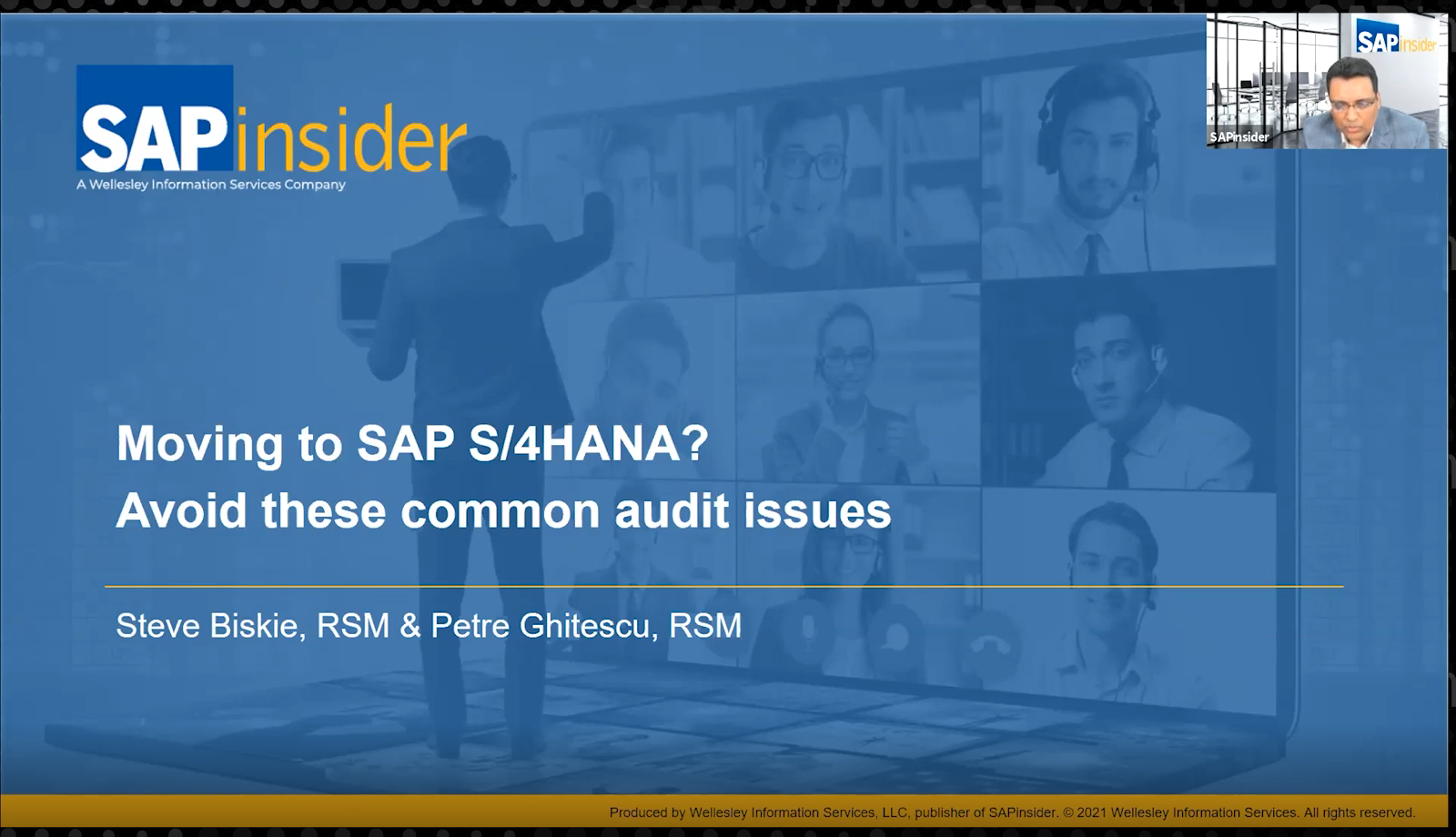
Moving to SAP S/4HANA? Avoid these common audit issuesAlthough transformative to businesses, SAP S/4HANA implementations have revealed some common, audit-relevant issues that could create risks for organizations. Because much of the focus of these implementations (and upgrades) is on ensuring that business functionality is enabled and the system goes live quickly, controls and security considerations are often neglected, or severely under-scoped. Implementation issues, from lack of requirements traceability to poor assumptions about implementer responsibilities, can easily be avoided with knowledge and planning. Join RSM partners Steve Biskie and Kari Sklenka-Gorden - each of whom have been involved in more than a dozen SAP S/4HANA projects - for some real-world tips and tricks on avoiding the worst and preparing for the best. Attend this session to: - Learn the risk themes that seem consistent across organizations and implementation partners - Understand proven strategies for identifying and mitigating these risks - Build a case for creating proper enterprise-wide data governance - Hear how functional testing can fail to confirm controls are working, and when an organization might want to re-think existing control settings - Learn how to document control decisions for auditability
Effective Internal Auditing in the Digitalized Era: Adding value to the businessWe see a strong push towards organizations adopting cloud-based software while still having on-prem operations, automation of as many processes as possible, use of many types of artificial intelligence, and ongoing decentralized and home working. What needs to be audited, and how it is audited, is changing. In this session you will: - Obtain a view about the future and pressures for the internal audit function in the new digitalized era - See how some SAP customers’ internal audit function are innovating their approach and actively assisting their businesses - Discover how you can provide more visibility and demonstrate the vital value of your internal audit function
Video: Delivery Hero’s Auditing Success Depends on Innovation and a Risk-Based ApproachDelivery Hero’s vision is to always deliver an amazing experience fast, easy, and to your door. This may not seem unusual for an order and delivery service organization, but with over 1 billion orders per year, and continued growth and expansion, it appears the company is delivering on its ambitious vision. Berlin-based, Delivery Hero is present in over 50 countries across four continents, and operations include hundreds of entities. Given the diversity of markets and regulatory requirements with many potential localized risks to track, having strong assurance is essential to their success. Learn how Delivery Hero’s Internal Audit team, created in 2017 and continuously expanding, has gone from scratch to impact. How are they doing more with less, leveraging resources for greater productivity, insights, and value?
Case Study | How Delivery Hero’s better audit management helped improve the customer experienceOn the face, internal audit processes are rather elementary. Planning, fieldwork, reporting, and follow-up very familiar to us and we are used to performing tasks within these sub-processes in all of our audits. However, how do we leverage technology perform our internal audit tasks in a more effective and efficient manner? The devil is certain in the details. In this presentation, we will tell the story of how we established our internal audit function and also how we are levering SAP products to add value to our organization. Attend this session to learn how to: - Create a vision for your digitized future - Establish and build your internal audit function from scratch - Focus your internal audit innovation projects on what matters

Related Vendors