1 minute read
Meet the Authors
Key Takeaways
-
SAP is positioning Cloud ALM as a central execution platform for end-to-end transformation.
-
New AI capabilities aim to shift ALM from reactive operations to predictive decision-making.
-
The platform connects implementation, monitoring, and change management across SAP landscapes.
At SAPinsider Las Vegas 2026, SAP outlined how SAP Cloud ALM is evolving beyond a monitoring tool into a central execution platform designed to support implementation, operations, and continuous transformation across increasingly complex SAP landscapes.
The session focused on a key question many SAP customers are now asking: Where does Cloud ALM fit across the transformation lifecycle – particularly in hybrid and cloud ERP environments?
Speakers Deepti Patil and Ankita Nandanwar positioned Cloud ALM as the layer that connects execution activities across business applications. The session highlighted how SAP Cloud ALM helps organizations manage complexity as SAP environments expand across systems such as ERP, finance, HR, procurement, and supply chain.
Explore related questions
“Who is going to help you give you that end-to-end transparency?” Patil asked during the session. “Cloud ALM… is that layer… to give you transparency [across] your end-to-end business transformation.”
Cloud ALM as the Execution Layer for Complex SAP Landscapes
SAP positioned Cloud ALM as part of an integrated transformation toolchain alongside SAP Signavio and SAP LeanIX. In this model, Signavio identifies process improvements, LeanIX maps architecture, and Cloud ALM executes transformation. “Cloud ALM is where you are going to execute that strategy,” Patil said.
This reflects a shift toward continuous transformation across planning, implementation, and operations. As SAP environments grow more complex – with interconnected systems across SAP S/4HANA, SAP BTP, and third-party applications – Cloud ALM provides end-to-end visibility, integrated monitoring, and centralized governance to help organizations manage and trace changes across the landscape.
Execution, Monitoring, and the Shift Toward Autonomous ALM
At the execution layer, Cloud ALM links business requirements directly to transports and production changes, helping teams track what was deployed, why it was needed, and how it impacts the business. At the same time, its monitoring capabilities extend beyond system health to business outcomes, allowing users to identify issues such as delays in procurement or transaction processing in real time.
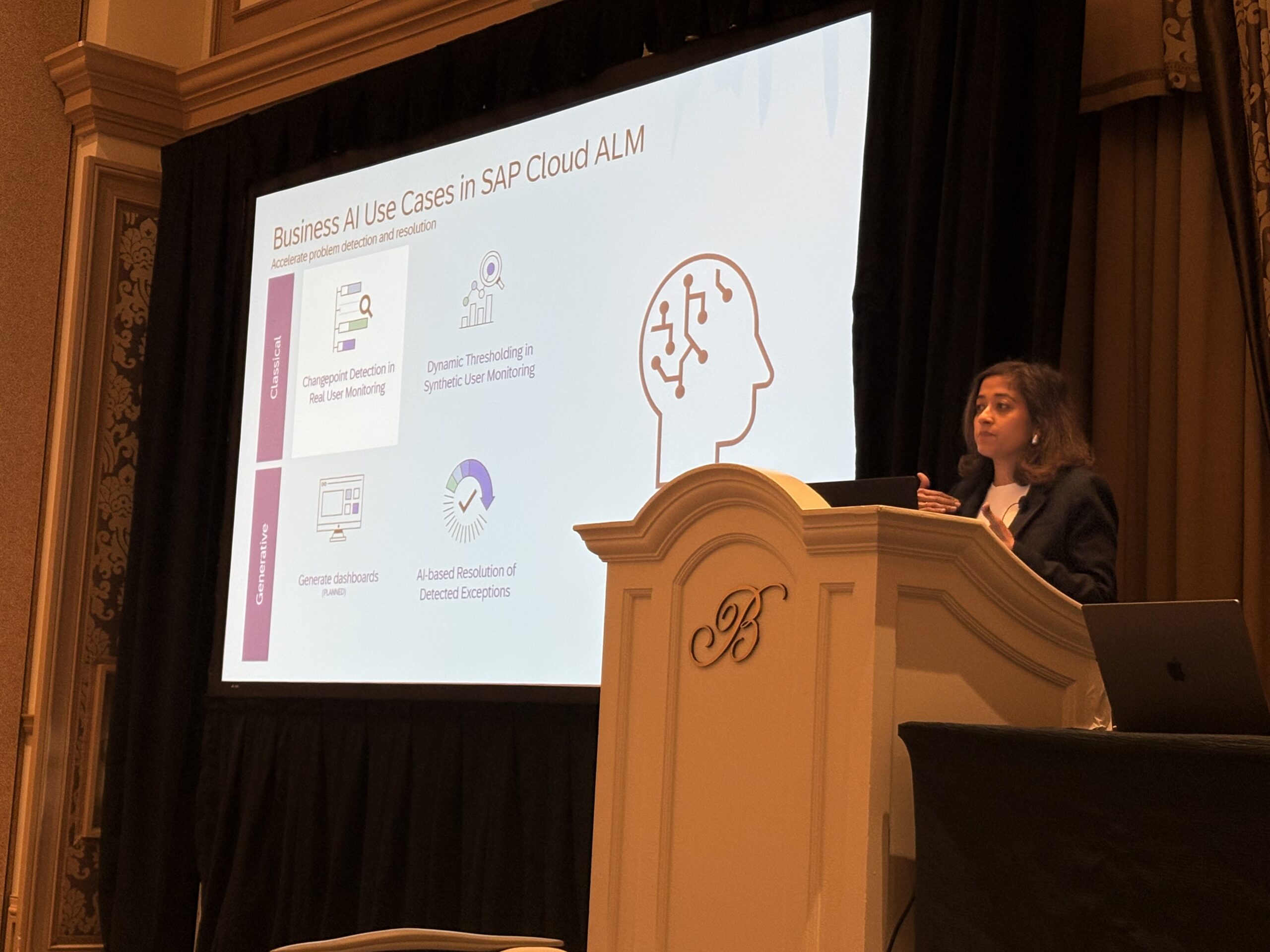
Looking ahead, SAP is advancing SAP Cloud ALM toward what it describes as “autonomous ALM,” where AI augments monitoring and issue resolution. Early capabilities such as change-point detection, dynamic thresholding, and anomaly identification are designed to shift organizations from reactive troubleshooting to more proactive and predictive operations, SAP said.
SaaS Delivery Model and Continuous Updates
Unlike legacy tools such as SAP Solution Manager, Cloud ALM is delivered as a SaaS solution, with updates released on a biweekly basis, Patil said.
This eliminates the need for patching and dedicated maintenance teams, while ensuring customers receive new capabilities continuously.
“All the customers get all the features… we release the features on a biweekly basis,” she added.
In a post-session conversation with SAPinsider, when asked how SAP prioritizes features within its roadmap, Ankita Nandanwar said that while SAP defines the broader roadmap, customer input influences prioritization. “There is an influence portal where customers can raise requests,” she said, adding that features are evaluated based on demand, with highly requested items moving into the development pipeline.
When asked what areas of the roadmap are most exciting right now, SAP identified AI-driven functionality as a key area of investment.
“I think top of mind is always the AI features,” Nandanwar said.
Nandanwar said upcoming capabilities include AI-assisted requirement generation, automated test case creation, and AI-driven dashboard generation, which is currently in testing. The dashboard feature, in particular, aims to allow business users to generate monitoring views dynamically using conversational inputs, reducing reliance on manual dashboard configuration.
While no firm general availability date was provided for the dashboard generation feature, Nandanwar said the capability is currently being tested with pilot customers, with ongoing validation informing its broader release timeline.
What This Means for SAPinsiders
Execution platforms will define transformation success. As landscapes span cloud and on-premises, coordination across tools and teams becomes critical. A centralized execution layer like Cloud ALM aligns delivery, testing, and operations to reduce risk.
Execution, not planning, limits transformation outcomes. Many organizations define strategy with process and architecture tools but struggle to deliver consistently across releases. Platforms that connect requirements to deployments improve traceability, governance, and speed of change.
AI will shift ALM from reactive to predictive. Early capabilities like change-point detection and dynamic thresholds surface issues before users escalate them. Over time, automation and generated insights can cut manual monitoring effort and improve decision-making across complex landscapes.
More Resources
See All Related Content
Securing SAP Systems from Cyber Attack with SAP Solution ManagerProtecting SAP systems against advanced cyber threats using standard tools available to all SAP support customers is vital. This includes System Recommendations for patch management, Configuration Validation for vulnerability management, System Monitoring for threat detection, and Guided Procedures for incident response.
Some important questions are:
- How can I manage cyber threats with tools that do not require additional licensing from SAP or third parties?
- Can I address cyber risks using tools that are included in SAP Solution Manager and bundled with SAP Support?
Attend this session to:
- Tackle cyber threats using available platforms and applications in SAP landscapes
- Leverage the capabilities of SAP Solution Manager Increase the ROI on SAP licensing
- Minimize third party software and software supply chain risks
1 minute read

Moving away from SAP SolMan ITSM – what alternatives are there for SAPinsiders?SAP is retiring its on-premise Solution Manager by the end of 2027 in favor of the cloud-based SAP Cloud ALM, which, despite promising benefits like reduced costs and ease of use, lacks crucial IT Service Management features, prompting users to seek alternative ITSM solutions such as STA Technologies’ ITSM Connector to maintain operational efficiency during the transition.
2 minute read

SolMan End-of-Life in 2027: What are you going to do next?SAP Solution Manager (SolMan) has been a widely used tool for SAP Change and Release Management for years. However, with its support set to end in 2027, and even the possible maintenance extension only stretching up to 2030, organizations need to evaluate their options and transition to a more advanced and future-proof solution. This is where ReleaseOwl comes in.
2 minute read