


2 minute read
Meet the Experts
Ingram Micro, a distributor of information technology products and services, has been relying on SAP and Vertex solutions to meet its unique business and tax department needs. Ingram Micro implemented Vertex O Series On-Demand for North America several years ago and since then, has worked towards deploying Vertex for their tax process automation globally. The…
More Resources
See All Related Content
Brazil’s Tax Reform: Building a Resilient SAP-Centered Tax Compliance ArchitectureBrazil's tax reform is already underway—and it is not only redefining compliance, it is reshaping how companies operate at scale. As new mandates, electronic document types, and dual-system tax models take effect, organizations are rethinking the role of technology in managing tax determination, transaction reporting, and operational resilience.
In this on-demand session, Sovos experts Antonio Garcia and Helton Arsenio, hosted by SAPinsider's Sean Byers, examined how leading companies operating in Brazil are adapting their architectures to thrive in this new environment. Through three real-world customer cases, they explored how global enterprises are modernizing tax processes, externalizing tax logic from SAP, and building scalable platforms to absorb constant regulatory change.
The session detailed how organizations handling millions of transactions per month are preparing their SAP landscapes to support Brazil's new CBS and IBS tax framework—without compromising operational performance. Cases covered included a major Brazilian retailer operating across all 27 states requiring centralized, SAP-certified tax determination; a major airline managing millions of electronic tickets (BPE) with complex cancellation and rebooking workflows; and a global telecom company processing hundreds of documents per second across legacy systems inherited through acquisitions. Each case revealed how companies are turning regulatory pressure into an opportunity to modernize core systems and eliminate reliance on manual, spreadsheet-based processes.
Viewers will come away with:
- An understanding of Brazil's dual-system transition period (running through 2033), during which companies must manage legacy and new tax regimes simultaneously
- Why 2026 is the critical year for alignment and testing—and why 2027 marks the beginning of real government validation and enforcement
- How new electronic document formats (NFCom for telecom, BPE for airlines) and dramatically expanded XML invoice data requirements demand tighter master data governance
- How the government's move to transaction-by-transaction, item-by-item real-time control—including "assisted calculation"—makes dispute readiness essential
- Strategies for connecting SAP to certified tax engines without over-customizing existing systems
- How Sovos Intelligence applies AI and business intelligence tools to enable natural language querying of tax data and proactive planning
The organizations that will navigate Brazil's reform successfully are those treating tax technology not as a compliance cost, but as a foundation for scale, resilience, and competitive advantage. With 2026 already here and 2027 enforcement approaching, the window to build that foundation is narrow.
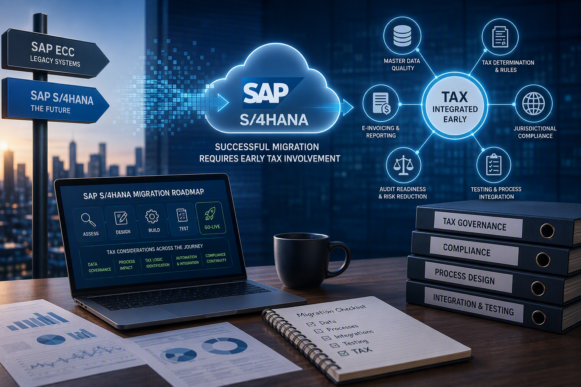
The Costly Mistake: Leaving Tax Out of SAP S/4HANA Migration PlanningSAP S/4HANA migrations often push tax into a late-stage compliance review, but hidden risks around tax determination, master data, and audit exposure demand earlier involvement. This article explains why leading organizations bring tax into governance from day one to protect timelines and Clean Core goals.
4 minute read
From SAP Transactions to Tax Intelligence: How AI Is Redefining Compliance for SAP ShopsSAP runs the transactions that power your business — but who is processing your tax compliance data? Most SAP-run enterprises are sitting on a goldmine of tax and transaction data, yet tax teams are still making manual corrections before every filing, reconciling across disconnected systems, and identifying audit exposure after the fact. As tax requirements become more real-time and global e-invoicing mandates expand, compliance can no longer be managed as a reactive process.
In this on-demand session, Sovos and SAPinsider explore a new model: AI-powered tax compliance intelligence built for SAP environments. Watch to see how leading SAP customers are connecting tax determination, e-invoicing, and indirect tax filing into a unified compliance layer — without replacing existing ERP infrastructure — while turning SAP transaction data into a real-time source of truth for compliance.
What You'll Learn:
- How to connect tax determination, e-invoicing, and indirect tax filing into one unified compliance layer for SAP environments
- How to use AI to map product tax codes in seconds instead of days
- How to surface exceptions before they become penalties or audit exposure
- How to answer "why was tax charged?" in plain language, directly inside the platform
- How to build a roadmap for modernizing tax compliance across S/4HANA, ECC, migrations, and global e-invoicing mandates
1 minute read