
3 minute read
Meet the Authors
Key Takeaways
What you need to know
Indirect tax determination, master data, and audit exposure must be addressed early in SAP S/4HANA migration planning to avoid costly rework.
Vertex research shows that IT teams often absorb tax-related defects late in SAP S/4HANA projects when tax is treated as a downstream compliance checkpoint.
Embedding tax automation and governance into SAP S/4HANA migration design helps protect Clean Core goals, reduce custom code, and preserve go-live timelines.
SAP S/4HANA migrations are usually framed around the visible transformation work, including process redesign, data conversion, system architecture, Clean Core strategy, testing, and go-live readiness. Tax often enters the conversation later, after finance and IT have already made decisions about master data, integrations, custom code, and process design.
That sequencing is becoming harder to defend.
SAP will provide mainstream maintenance for SAP Business Suite 7 core applications until the end of 2027, followed by optional extended maintenance until the end of 2030. That timeline continues to push organizations toward SAP S/4HANA planning. But the migration pressure is not only technical. It is also exposing process areas that were easy to manage through workarounds in SAP ECC but harder to sustain in a cleaner, more standardized SAP S/4HANA environment.
Explore related questions
Ask SAPi
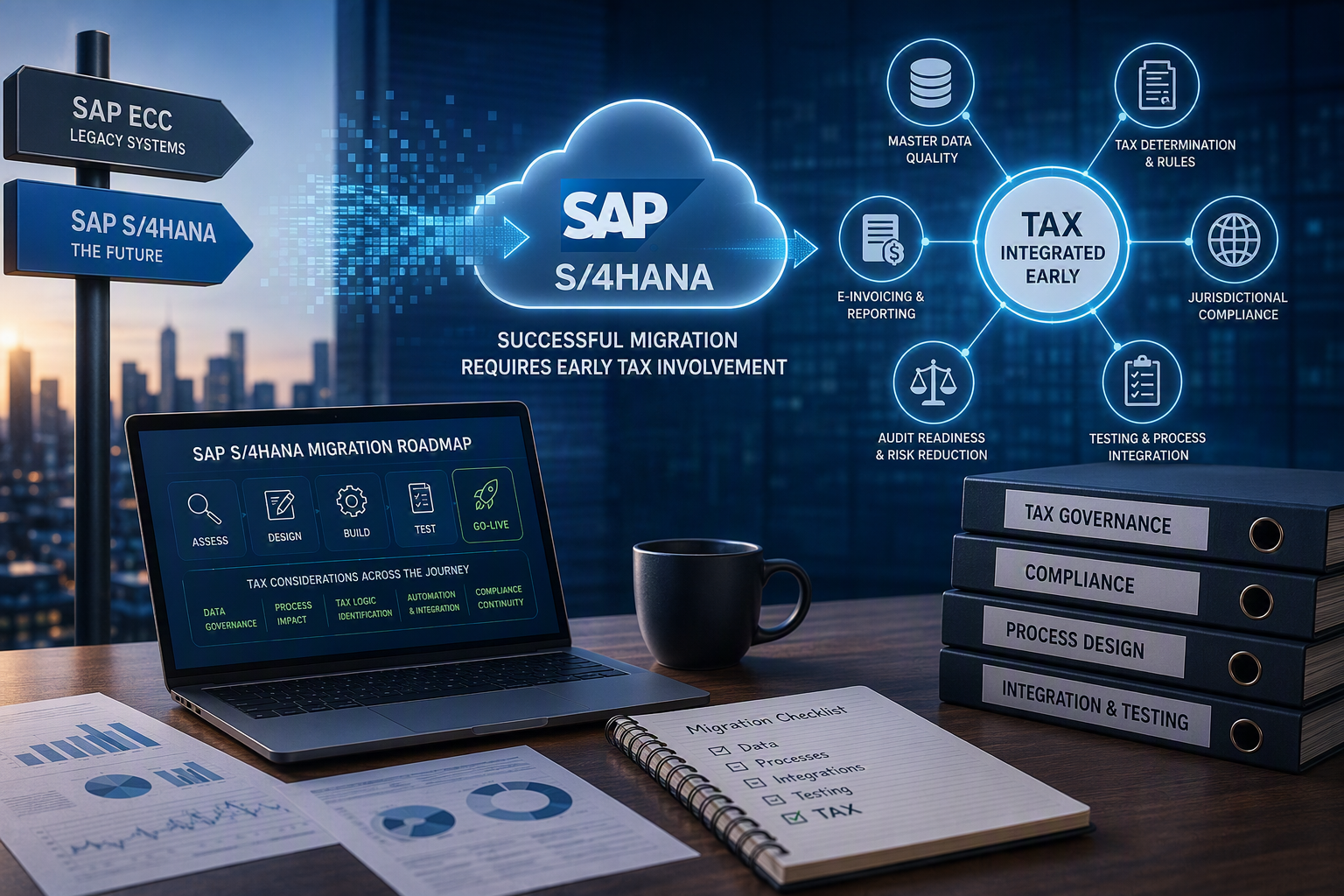
Indirect tax is one of those areas. When tax is treated as a downstream compliance function, organizations can carry hidden risk into the program. Tax determination rules, master data quality, jurisdictional variation, e-invoicing requirements, audit exposure, and invoice accuracy all depend on decisions being made much earlier in the migration.
Tax Problems Inside ERP Transformation
Tax is deeply connected to the business processes SAP S/4HANA programs are trying to modernize. Procure-to-pay, order-to-cash, customer and vendor master data, invoicing, billing, returns, intercompany transactions, and market expansion all carry tax implications.
Vertex’s SAP S/4HANA migration e-book argues that while IT typically leads modernization initiatives, tax is deeply affected and often overlooked. Vertex identifies several tax-side challenges that can surface during migration, including coding errors, master data issues, remediation effort, tax update burdens, customer and vendor impact, audit exposure, and the risk that business operations changes go unnoticed by tax teams.
That last point is especially important. SAP S/4HANA migrations often change processes, data structures, integrations, and operating models. A shift in supply chain operations, sales channels, customer treatment, or vendor processing can change tax determination. If tax is not involved until late testing, the program may discover issues only after design choices have already hardened.
The consequence is not just compliance exposure. Tax errors can affect invoices, payments, customer experience, vendor processing, reporting, and audit readiness. Once those problems are embedded in the migration timeline, they become IT problems as well.
Why IT Feels the Pain
Tax requirements often look narrow until they reach the implementation team. Then they show up as custom logic, integration gaps, test scripts, defects, tickets, and late-stage design changes.
SAP S/4HANA does not automatically deliver a fully automated, end-to-end tax process out of the box. If tax requirements are not addressed through the right design and tooling, IT resources may have to “plug the tax holes” during a migration. That creates additional testing, rework, support burden, and potential showstoppers.
The IT challenges are familiar to anyone managing an SAP transformation.
- Custom tax logic embedded in legacy systems can increase complexity during cloud migration.
- Limited tax code structures and changing local requirements can create maintenance burdens.
- Multijurisdictional rollouts need consistent tax determination across regions.
- Real-time tax calculation has to scale without slowing critical SAP processes.
- Integration choices must support SAP applications, commerce platforms, procurement tools, and future digital mandates.
IT wants fewer customizations, cleaner architecture, fewer tickets, faster testing, and a more maintainable SAP environment. Tax wants accurate determination, regulatory agility, audit readiness, and visibility into the processes that drive compliance. Those goals are not in conflict if tax is part of the migration design early enough.
What High-Performing Programs Do Differently
The strongest SAP S/4HANA programs bring tax into planning before integration and testing decisions are finalized. That does not mean tax owns the ERP program. It means tax has a defined seat in the governance model alongside finance, IT, enterprise architecture, procurement, and business process owners.
That early involvement should focus on four areas.
First, organizations need ownership of tax-related data. Customer, vendor, product, exemption, jurisdiction, and transaction data all affect tax outcomes. If ownership is unclear, migration testing may validate the system while missing the tax exceptions that appear in real operations.
Second, teams should identify where legacy tax logic exists today. Custom code, manual review steps, spreadsheets, local tax rules, and country-specific workarounds should be surfaced before design decisions are locked.
Third, migration teams need to test tax inside end-to-end business processes, not as a standalone calculation. Tax outcomes depend on how procurement, sales, billing, invoicing, returns, and intercompany flows actually run.
Fourth, organizations should evaluate whether migration is the right moment to modernize tax automation. Treating tax as part of the transformation workstream can reduce downstream remediation and help the company avoid rebuilding old complexity in the new SAP environment.
Tax cannot be a back-office checkpoint at the end of SAP transformation. The organizations that recognize that earlier will have a better chance of protecting timelines, reducing custom code, preserving Clean Core goals, and maintaining compliance as they move to SAP S/4HANA.
What This Means for SAPinsiders
CIOs should treat tax as a transformation workstream. Indirect tax requirements touch data, integration, process design, testing, and Clean Core strategy, so they need to be governed as part of the SAP S/4HANA program rather than handled as a late-stage compliance review.
Tax leaders should move earlier in migration planning cycles. By engaging before architecture, data, and integration decisions are finalized, tax teams can help prevent rework, reduce audit exposure, and ensure that business process changes do not create hidden compliance gaps.
Systems integrators and SAP partners should rethink traditional project sequencing. Tax design, automation, and testing should be embedded into the broader migration plan so SAP teams can reduce custom code, protect go-live timelines, and build a cleaner foundation for future regulatory change.
More Resources
See All Related Content
BD Consultores Extends SAP Banking Migration Practice with Spain LaunchBD Consultores has launched operations in Spain, expanding its SAP banking migration practice. The Latin American SAP Gold Partner leverages 17 years of experience in core-banking and S/4HANA, offering a comprehensive approach that includes AI/ML development on SAP BTP.

Alta Via Consulting Sustains a Single-Platform NetSuite Focus as ERP Buyers Reassess OptionsAlta Via Consulting, a German provider, maintains a decade-plus NetSuite-only focus, positioning itself as "THE NetSuite specialists in Europe." This strategy emerges as legacy ERP deadlines compel mid-market companies to re-evaluate their vendor options.
3 minute read

SAP 2027 Deadline: What Happens If You Don’t Migrate to S/4HANA?The SAP 2027 deadline signifies an end to mainstream support for Business Suite 7 core apps, transitioning companies into a higher-cost support environment post-2027, with increased security, talent scarcity, and innovation gaps, making timely migration to S/4HANA crucial for maintaining competitiveness.
4 minute read