3 minute read
Meet the Authors
Key Takeaways
What you need to know
CONA Services completed a high-risk brownfield migration from SAP ECC to SAP S/4HANA in a single weekend using downtime-optimized conversion, reducing business downtime from an estimated 136 hours to about 50 hours.
The migration mattered because CONA used aggressive data archiving and SAP HANA Native Storage Extension to cut the active database footprint by more than two-thirds.
CONA’s clean-core S/4HANA foundation shows how shared-platform companies can modernize safely while keeping order-to-cash and supply chain processes stable.
CONA Services sits behind most Coca‑Cola bottles sold in North America. The Atlanta‑based IT services company runs a common SAP platform for the largest independently owned Coca‑Cola bottlers, supporting more than 30,000 daily users and processing around 160,000 sales orders a day—roughly $24 billion in annual revenue.
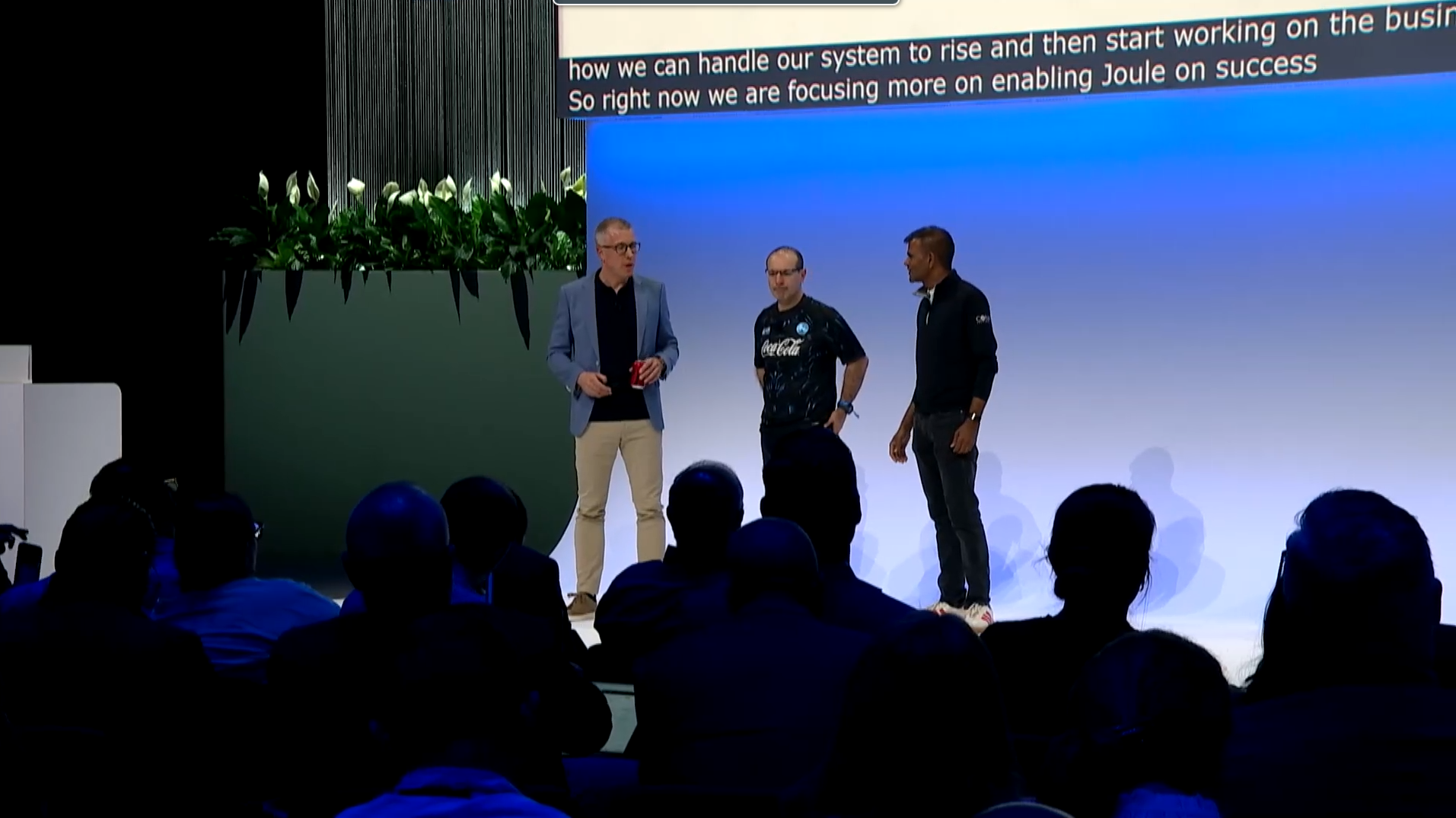
At SAP Sapphire 2026, leaders from CONA and SAP walked through how the company executed a high‑risk brownfield S/4HANA migration from ECC to SAP S/4HANA over a single weekend, using SAP MaxAttention, SAP Mission Control Center, and a tightly coordinated partner ecosystem to reduce downtime and build a clean‑core foundation for SAP Cloud ERP Private (formerly RISE with SAP) and AI.
Why CONA Focuses on Shared Platforms and Measurable Bottler Value
Francesco Quinterno, CIO of CONA Services, opened by introducing CONA as the shared digital backbone for 11 of Coca‑Cola’s largest North American bottlers, running a single platform for order‑to‑cash, procure‑to‑pay, and related enterprise processes across SAP, Salesforce, Snowflake, and other systems.
Explore related questions
Ask SAPi
Each bottler’s data is segregated, but they share one end‑to‑end platform that CONA often describes as “the cloud provider” for the network. Together, these bottlers account for the majority of U.S. Coca‑Cola bottling volume, so when they sell, produce, ship, and invoice product, the transactions behind that activity typically flow through CONA’s SAP landscape rather than CONA operating plants itself.
“Over the last six years, stability is under our belt, and now we’ve continued to explore new platforms,” Quinterno said, describing a shift from “just a strict IT company” to CONA 2.0, where every initiative is evaluated in terms of concrete bottler value. By late 2022, that mindset ran straight into an aging ECC core that was becoming a liability.
What Made CONA’s ECC to S/4HANA Migration So Risky
That combination of scale, 24×7 operations, and a hard 50‑hour downtime window forced CONA to rethink how it would get from ECC to S/4HANA without disrupting bottler business.
Uday Reddy, manager and head of dept at CONA, stressed that the goal was not just getting to S/4HANA but ensuring the system was “operationally stable” when users logged back in on Monday. CONA chose a brownfield conversion using SAP’s Downtime Optimized Conversion (DOC) after initially exploring near‑zero‑downtime techniques, then changing course because DOC was less complex, lower cost, and gave more control and visibility into data movement.
The final result was about 31 hours of technical downtime and roughly 50 hours of business downtime—a reduction of around 70–77% compared with the original 136‑hour estimate. “We went down on a Friday night and came back on a Sunday night, and some of our stakeholders thought we had canceled,” Quinterno said. “That’s how smooth it went.”
Data footprint and architecture choices were central to that outcome. Reddy described archiving as playing “a major role” in making the cutover feasible, with CONA aggressively archiving data and using SAP HANA Native Storage Extension (NSE) to move older, less‑used information to a lower‑cost tier while keeping it available. That work effectively cut the active database size by more than two‑thirds and allowed CONA to stay on a single 24 TB Azure node instead of adopting a more complex scale‑out architecture.
If the technical design was the backbone of the project, SAP’s services organization operated as the nervous system connecting customer, partners, and product engineering. CONA engaged SAP MaxAttention early to help select the right conversion strategy, reduce the data footprint, and validate the architecture and downtime optimization plan. “MaxAttention played a major role in not just helping us doing the migration,” Reddy noted. “They also helped us picking the right approach… and enabling NSE, making sure that we are not doing a scale‑out.”
Quinterno was explicit about the importance of relationships. “SAP was critical to making this happen,” he said, adding that other partners were “equal stakeholders” and that the smooth go‑live was the product of those alliances as much as CONA’s own discipline.
How CONA’s S/4HANA Core Sets Up SAP Cloud ERP and AI
Stefan Steinle, EVP, head of global customer support, customer value group at SAP tied CONA’s story into SAP’s evolving services and support roadmap. In 2026, SAP restructured its portfolio around a Foundational Success Plan embedded in cloud subscriptions and tiered Advanced and Max Success plans for customers needing deeper, proactive guidance. MaxAttention engagements like CONA’s will transition into the Max Success Plan over time, preserving familiar capabilities while adding elements such as a 15‑minute SLA for priority‑one incidents, orchestration of complex support cases, and access to a catalog of value‑adding services.
What This Means for SAPinsiders
Brownfield can be strategic, not just defensive. CONA shows that a brownfield path, when architected around downtime‑optimized tools and data reduction, can deliver both business continuity and a cleaner core, rather than simply dragging ECC complexity into S/4HANA.
Data strategy decides how much “transformation” you get. By combining archiving with NSE and staying on a single node, CONA used the migration to simplify infrastructure and data tiers, turning a technical constraint—database size—into an opportunity to de‑risk future innovation.
Clean core is a prerequisite for credible AI roadmaps. Because CONA used this project to reduce footprint, clarify architecture, and standardize around SAP Cloud ERP Private, its AI ambitions now rest on a platform designed for continuous change, not on an aging ECC estate.
More Resources
See All Related Content
AI Moves into the Property ERP: What the Aareon Summit 2026 Signals for SAP in Real EstateAt the Aareon Summit 2026, AI moved from pilot to product inside the property ERP, with an AI-optimized operating cost settlement built on an SAP S/4HANA foundation. The announcements mirror SAPinsider's 2026 finding that AI now outranks the 2027 deadline in shaping ERP strategy.
The Importance of ERP Knowledge Transfer During ImplementationWhile go-live is often viewed as the finish line of an ERP implementation, the long-term success of the system depends heavily on the activities that follow. Establishing structured knowledge transfer processes and maintaining comprehensive documentation helps organizations support user adoption, preserve critical system knowledge, and ensure the ERP solution continues to deliver value well beyond implementation.
1 minute read

Webinar: From SAP BW to AI-Ready Data: A Practical Guide for Global EnterprisesThe article promotes a webinar on treating SAP BW migration as a critical AI initiative, offering a proven strategy and live demo to help enterprises complete migrations on time and make their data AI-ready before mainstream maintenance ends in 2027.
1 minute read
Beyond Assessment: How CoreAssess Enables Actionable SAP Clean Core ModernizationYou’ve Completed the Assessment. Now What? The dashboards are clear. The risks are visible. The custom code footprint is mapped. Yet many SAP teams reach this point and pause. Not due to lack of intent, but due to lack of execution clarity. Hundreds of objects need decisions. Effort is uncertain. Architecture choices carry long-term impact. […]
4 minute read