1 minute read

Meet the Authors
Key Takeaways
What you need to know
SAP manufacturing teams running ECC or S/4HANA can automate material certification and batch genealogy by integrating SAP Document Management System, Microsoft SharePoint and an EDI middleware platform, replacing manual document search with instant retrieval from standard SAP transactions.
Centralized certification document management matters because it improves audit readiness, regulatory compliance, and batch traceability while reducing errors, version conflicts and slow customer response times in multi-plant manufacturing operations.
This SAP integration approach delivers major ROI for quality, supply chain, and customer service teams, including about 4,000 labor hours saved annually, faster compliance responses and full visibility into raw materials, finished goods, and certification records.
SAP shops running ECC or S/4HANA across multi-plant manufacturing environments frequently face operational bottlenecks in material certification and batch genealogy workflows. Quality engineers and supply chain teams often spend hundreds of hours annually retrieving certification documents from fragmented repositories when responding to customer audits or regulatory compliance requests, undermining the traceability capabilities built into SAP’s batch management framework.
One global manufacturer eliminated this challenge by architecting an integrated solution combining SAP Document Management System (DMS), Microsoft SharePoint, and the Seeburger BIS Integration Suite. The implementation centralized certification document storage in SharePoint while leveraging SAP DMS to automatically link material certificates to batch records within SAP ERP, enabling instant retrieval of compliance documentation directly from standard SAP transactions.
The resulting architecture delivered 4,000 hours in annual labor savings while dramatically improving audit response capabilities. However, success required careful attention to integration design, metadata mapping between SAP and external document repositories, and phased deployment across multiple manufacturing facilities to address site-specific quality workflows and data governance requirements.
Explore related questions
Ask SAPi
The Challenge of Material Certification and Batch Traceability
Manufacturing companies often face increasing pressure to provide detailed certification documentation and batch traceability for the products they supply. Customers, regulators and quality auditors request supporting documents such as:
- Material test certificates
- Supplier compliance documentation
- Quality inspection reports
- Batch genealogy records.
In many organizations, these documents are stored across multiple systems or even maintained manually. As a result, responding to customer certification requests can become a time-consuming process requiring coordination among supply chain, quality assurance and engineering teams.
Before implementing automation, the organization relied on a manual process for retrieving certification documents. When a customer requested documentation for a particular shipment or batch, employees needed to:
- Identify the relevant production batch in SAP
- Locate the associated certification documents stored in local repositories
- Verify document validity and revision levels
- Compile and deliver the documentation package along with the shipment.
Across multiple manufacturing plants, this process consumed thousands of labor hours annually and introduced risks of delays or incomplete responses during customer audits.
To address these challenges, the organization designed an automated certification management architecture integrating SAP with enterprise document management using EDI technologies.
Solution Architecture Overview
The automated solution was designed to create a centralized and fully traceable certification management system that links material batches in SAP to their associated certification documents.
The architecture integrates three core enterprise platforms:
| System | Role |
| SAP ERP | Source of production batch and material traceability data |
| SharePoint | Centralized storage repository for certification documents |
| Seeburger Integration Suite | Middleware for document processing and integration |
SAP Operating as the System of Record
SAP maintains the authoritative record for:
- Material master data
- Batch numbers
- Production orders
- Delivery and shipment information.
Certification documents must be traceable to these batch records to support regulatory compliance and customer audits.
Document Storage and Governance
SharePoint provides a centralized repository for storing certification documents, enabling:
- Structured document folder based on plant location
- Secure access management
- Long-term document retention
- Mapping to material/batch by users.
Integration Layer
The Seeburger integration platform orchestrates document processing workflows, including:
- Receive metadata from SharePoint
- IDoc Mapping
- SAP document linking.
This architecture ensures certification documents are automatically associated with their corresponding material batches and can be retrieved instantly when needed.
Automating Certification Document Management
The automated certification management process begins when certification documents are received from suppliers or generated internally during production.
These documents typically include:
- Supplier certificates of analysis
- Quality inspection reports
- Material compliance statements.
Instead of locally storing these documents, the automated system performs several key functions.
- Document Ingestion. Certification documents are uploaded into SharePoint when they are received from vendors via email to a plant specific email address. Users review these documents meta and enrich it with material/batch information. This triggers the workflow to send the meta data to EDI via .csv file.
- Metadata Extraction. Key data elements are extracted from each document, including the material, batch and document number as well as the certification type and any document revisions. This metadata allows the system to associate each certification document with the correct material/batch.
- SAP Document Linking. Using the SAP document management framework, the system automatically creates links between the certification documents and relevant SAP objects such as material batches, inspection lots and production orders. This ensures users can retrieve certification documents directly from SAP transactions without searching external systems.
Enabling Batch Genealogy and Traceability
One of the most critical aspects of manufacturing compliance is the ability to trace materials across the production lifecycle. Batch genealogy enables organizations to identify:
- Raw materials used in production
- Intermediate components
- Finished goods shipped to customers.
By integrating certification documents with batch genealogy data in SAP, the solution provides full traceability across the manufacturing supply chain.
A custom transaction was developed to list all the batches used in a finished goods batch along with a link to the material certification document. This capability allows quality teams and customer service representatives to respond quickly to documentation requests.
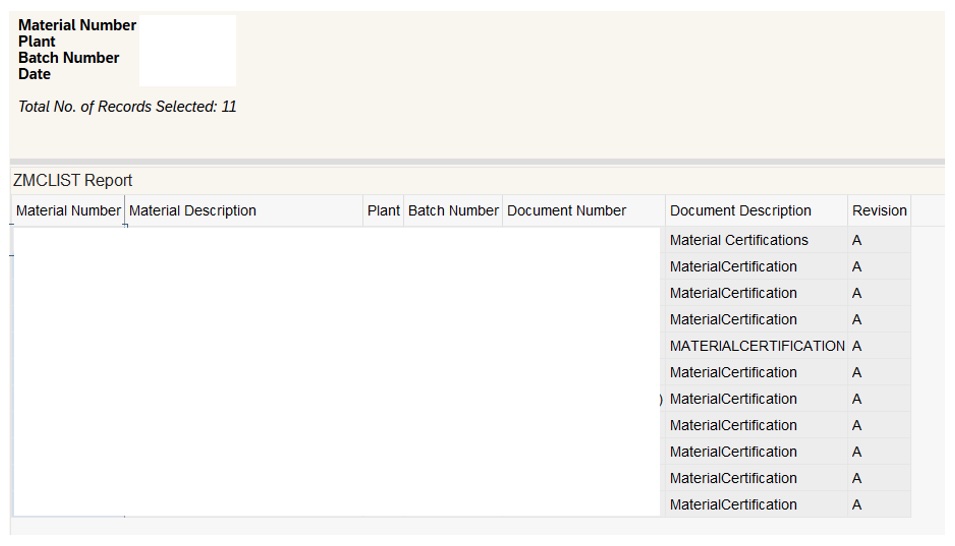
For example, when a customer requests certification documentation for a shipment, the system can automatically identify:
- The finished goods batch shipped to the customer
- The raw material batches used in production
- The certification documents associated with those batches.
The result is a complete documentation package that can be generated within seconds rather than hours.
Implementation Approach, Results
Deploying the automated certification solution required careful coordination across multiple technical and operational teams.
The implementation followed several phases:
- Architecture design. The first step involved defining the integration architecture and data flow between SAP, SharePoint, and the integration platform.
- Data mapping. Key metadata fields were mapped between systems to ensure certification documents could be linked accurately to SAP material batches.
- Integration development. Custom interfaces were developed to enable document ingestion, metadata extraction, SAP document linking and automated document retrieval.
- Identifying issues. During testing, issues included document number length in SAP restricted to 25 and re-triggering the meta data csv file in case incomplete material/batch information.
Business Impact and Operational Benefits
The automated certification management system delivered several measurable benefits across the organization.
The most significant impact was the reduction in manual effort associated with certification document management. Prior to automation, employees spent substantial time locating, verifying, and compiling certification documents for customer requests.
By automating document linking and retrieval, the system eliminated much of this manual work, resulting in an estimated 4,000 hours of labor savings annually.
Additional benefits included:
- Faster response to customer compliance requests
- Improved audit readiness
- Reduced risk of documentation errors
- Centralized control of certification records
- Enhanced visibility into batch genealogy.
These improvements strengthened the organization’s ability to meet stringent customer and regulatory requirements while reducing operational overhead.
Key Lessons Learned
Organizations considering similar automation initiatives should keep several lessons in mind.
First, establishing a single authoritative source for certification documents is critical. Centralized document storage ensures consistency and prevents version conflicts.
Second, accurate metadata is essential for successful integration. Careful attention must be paid to mapping material numbers, batch identifiers, and document types across systems.
Third, user adoption plays a key role in realizing the benefits of automation. Training programs and clear documentation helped ensure employees understood how to access certification documents through SAP.
Automating material certification and batch genealogy processes can significantly improve operational efficiency and compliance in manufacturing environments. By integrating SAP with enterprise document management and EDI platforms, organizations can eliminate manual document handling and enable rapid retrieval of certification records.
The architecture described in this article demonstrates how centralized document management and automated integration can transform certification workflows across global manufacturing operations. With thousands of hours saved annually and improved responsiveness to customer requests, the solution highlights the value of combining SAP’s traceability capabilities with modern document automation technologies.
As regulatory and customer requirements continue to evolve, automated certification management systems will play an important role in ensuring compliance and operational agility.
Editor’s Note: What This Means for SAPinsiders
SAP Document Management integration demands renewed focus pre-S/4HANA. Organizations still running ECC must evaluate whether batch genealogy and certification workflows justify custom development now or warrant deferral until S/4HANA migration when embedded document processing capabilities could eliminate middleware dependencies.
EDI integration patterns reveal modernization pathways beyond RISE. The Seeburger-SharePoint architecture highlights persistent demand for hybrid integration strategies that preserve existing investments while enabling cloud-adjacent document repositories.
Batch traceability ROI justifies targeted custom transactions. Achieving 4,000 annual labor hours saved through specialized batch genealogy screens proves that vertical-specific SAP enhancements deliver measurable operational value in regulated manufacturing environments.
More Resources
See All Related Content