6 minute read
Meet the Experts
Key Takeaways
What you need to know
SAP Sapphire 2026 unifies SAP Business Technology Platform, SAP Business Data Cloud, and SAP Business AI into the SAP Business AI Platform, which changes enterprise AI from separate tools into a governed, end-to-end AI stack. This matters because SAP customers can now build and deploy AI agents on trusted business data, and it impacts enterprises, CIOs, and SAP platform teams planning their ERP and AI roadmap.
SAP launched the SAP Autonomous Suite and redefined Joule as the primary enterprise interface for running business processes, not just answering questions. This matters because AI agents can now execute financial close, supply chain, procurement, HR, and customer experience workflows at scale, impacting SAP customers that want faster automation, especially organizations moving from ECC to S/4HANA Cloud.
SAP-connected vendors and system integrators must adapt to an AI-driven supply chain where clean data, API-first integration, and agent orchestration determine success. This matters because manual processes and weak data quality will create friction or exclusion from automated workflows, impacting suppliers, partners, and SAP consultants that need to modernize integrations, governance, and AI delivery capabilities.
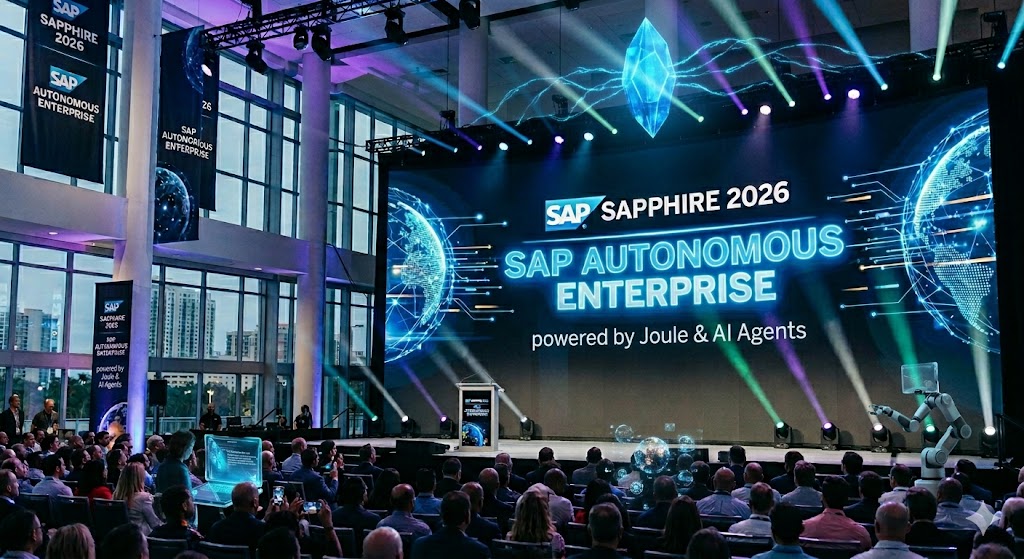
If you attended SAP Sapphire 2026 or followed the announcements from Orlando, you heard a lot of bold language about the Autonomous Enterprise, AI agents, and the future of business software.
Beneath the keynote energy, there are concrete announcements with real implications for every SAP customer, every vendor operating in an SAP-connected supply chain, and every system integrator whose business model is built on SAP implementations.
This piece cuts through the narrative and answers the practical question: What does this actually mean for you, and what do you need to do about it?
Explore related questions
Ask SAPi
First, understand what changed at Sapphire 2026.
Three major things happened at Sapphire that you need to internalize.
SAP unified its technology platform. SAP Business Technology Platform, SAP Business Data Cloud, and SAP Business AI are no longer separate products in a portfolio. They are now the SAP Business AI Platform, a single governed environment for building and deploying enterprise AI.
- SAP launched the SAP Autonomous Suite, a collection of over 50 Joule Assistants and more than 200 specialized AI agents that can run business processes end-to-end across finance, supply chain, procurement, HR, and customer experience. These are not chatbots. These are process operators.
- SAP also redefined Joule. It is no longer an AI assistant layered on top of SAP applications. Joule is now the primary way users interact with SAP, and increasingly with other business systems. Users describe outcomes. Joule determines which agents, workflows, and data sources are required, executes the work, and delivers the results.
- The architecture behind this includes SAP Business Data Cloud as the trusted data foundation, the SAP Knowledge Graph providing business context through structured relationships, the Autonomous Suite executing processes, and Joule delivering the user experience.
This is a vertically integrated AI stack built specifically for enterprise business processes. It is fundamentally different from layering general-purpose AI on top of existing systems.
What this means for enterprise customers:
If you are an SAP customer, whether on S/4HANA Cloud, SAP ECC, or in transition, these announcements directly impact your technology roadmap and investment priorities over the next 12 to 36 months.
Financial close is one of the most immediate opportunities. The Autonomous Close Assistant automates journal entries, reconciliation, and error resolution, reducing close cycles from weeks to days. The acceleration comes from AI coordination, not increased human effort.
Supply chain operations become proactive. AI agents can detect risks, reroute orders, and adjust procurement plans in real time. SAP demonstrated this with offshore wind operations, where historical data is used to generate pre-filled work orders and prevent downtime.
HR becomes less transactional and more automated. Payroll processes become proactive, recruiting and onboarding flow end-to-end, and employee service requests are handled instantly. These capabilities are designed to better connect workforce data to business performance.
The key implication is clear. Legacy environments, especially ECC, will struggle to support these capabilities. SAP has made it explicit that AI functionality requires modern cloud architecture. The path forward leads through S/4HANA Cloud, supported by new migration tooling designed to reduce effort and increase predictability.
For RISE with SAP customers, Joule Assistants will be activated within the first year. For GROW customers, the full Joule portfolio is available at onboarding. Adoption barriers are being intentionally lowered.
What this means for vendors in SAP-connected ecosystems:
If you are part of a supply chain or procurement network connected to SAP customers, these changes affect you immediately.
Procurement and invoicing are becoming real-time and AI-driven. AI agents make decisions based on structured data. Vendors relying on manual processes or inconsistent data formats will face increasing friction.
Supplier data quality becomes a competitive advantage. Performance, compliance, pricing, and contract adherence are continuously evaluated by AI. Vendors with clean, structured, and accessible data will be favored.
API-first, AI-ready systems are now essential. SAP’s ecosystem is built on interoperability across platforms like AWS, Google Cloud, and Microsoft. Vendors unable to participate in these integrations risk exclusion from automated workflows.
The takeaway is straightforward. Audit your integrations, identify manual processes, and build a roadmap to eliminate them.
What this means for system integrators and partners:
For system integrators, this represents a fundamental shift in value delivery.
The traditional model of configure, implement, train, and support still exists, but it becomes a smaller part of the overall value proposition.
The emerging opportunity is in AI orchestration and agent design. Joule Studio enables development of AI agents and workflows using intent-based approaches and modern frameworks. The development model shifts from manual configuration to outcome-driven design.
Early results indicate significant efficiency gains. Development cycles that once took days can now be completed in minutes, with high-quality outputs requiring minimal refinement.
SAP’s €100 million partner fund is designed to accelerate this transition. It supports partners building new AI agents, extending existing ones, and developing industry-specific solutions.
There is also a shift toward ongoing AI operations. Deployed agents require monitoring, governance, and continuous improvement. This creates recurring value opportunities beyond project-based work.
Industry-specific AI solutions further expand opportunities for niche and specialized partners, embedding domain expertise directly into AI-driven processes.
The six actions to prioritize this quarter:
Assess your data foundation. AI depends on clean, governed data. Treat data as a discipline, not just a system.
Accelerate your cloud ERP strategy. Define your S/4HANA Cloud path with clarity and urgency.
Identify high-value automation opportunities such as financial close, payroll, supplier risk, and talent acquisition.
Engage with Joule Studio early. Build internal capability before competitors do.
Audit your integration landscape. Eliminate manual handoffs and move toward API-based connectivity.
Establish governance frameworks. Define compliance, auditability, and human oversight before deploying autonomous agents.
The bottom line:
SAP Sapphire 2026 represents a shift in how enterprise work is executed. AI agents take on coordination and execution, while humans focus on decision-making and strategy.
Joule becomes the interface. The Knowledge Graph provides context. The Autonomous Suite executes processes. The Business AI Platform underpins everything.
Organizations that move quickly, establish strong governance, and build the right capabilities will be best positioned to benefit.
The opportunity to lead this transition is open now.
More Resources
See All Related Content

Building Business Applications and AI Agents for SAP, Wherever You Are on Your SAP JourneyIn a September 17, 2026 SAPinsider webinar, Neptune Software's Stefan Captijn and Dan Wiseman argued that the execution gap between SAP systems and daily work, not SAP itself, is what stalls AI in the enterprise. A Yazaki Brazil stock-planning case shows how SAP-native AI applications close that gap in weeks.
4 minute read