3 minute read
Meet the Authors
Key Takeaways
What you need to know
Enterprise software is evolving from fixed interfaces to generative UI systems that dynamically assemble data and actions based on user intent and real-time context.
The transition impacts SAP landscapes significantly, as it emphasizes the need for consistent master data and cohesive integration strategies.
As user interfaces become more dynamic, governance must adapt by moving control into orchestration layers rather than relying on fixed workflows.
Enterprise software is shifting away from fixed interfaces toward systems that assemble data, context, and actions at runtime. The key question is no longer how applications are designed, but how quickly they can produce something usable when a decision needs to be made.
SAP’s push into generative UI—a model where interfaces are dynamically assembled at runtime based on user intent, live data, and underlying business logic—points to that shift, but the more important change is architectural. Interfaces are starting to move closer to the execution layer, where data models, workflows, permissions, and integrations determine what users see in real time.
This is a departure from how ERP systems have traditionally been designed. For decades, applications have been structured around stable screens tied to specific processes. Those interfaces encoded business logic, guided users through workflows, and enforced consistency.
Explore related questions
Ask SAPi
That model still works for repeatable transactions. It becomes inefficient when work cuts across domains, systems, and time horizons, which is increasingly the norm in finance, supply chain, and procurement.
The Problem Is Fragmentation
Much of the discussion around generative UI focuses on improving user experience. That framing is incomplete.
The underlying issue is fragmentation across enterprise systems. Data sits in multiple SAP and non-SAP environments. Workflows span applications. Decisions require stitching together signals that were never designed to be consumed together.
Traditional UI approaches try to solve this by adding more dashboards or expanding navigation layers. That increases surface area without resolving the underlying disconnect.
Generative UI takes a different approach. Instead of asking users to navigate fragmentation, it attempts to resolve it at runtime by assembling the relevant data and actions into a single, task-specific workspace. This only works if the system can reliably interpret intent and map it to the right combination of data, logic, and permissions.
Why SAP Landscapes Are Exposed
SAP environments are particularly affected because they already operate as system-of-record backbones for finance, supply chain, and operations. In most SAP landscapes:
- Core transactions sit in SAP S/4HANA or SAP ECC
- Planning and analytics are distributed across multiple tools
- External systems handle banking, logistics, or customer interaction
- Integration layers connect but do not unify these environments.
Generative UI introduces pressure to treat that landscape as a coherent, “query-able” system, not a collection of connected applications.
For example, a request to assess supplier risk is not a single-system query. It requires elements like supplier master data, open purchase orders, inventory positions, logistics constraints, and financial exposure.
Today, that analysis is spread across transactions, reports, and external tools. Generative UI assumes it can be assembled dynamically. That assumption forces a reevaluation of how data is structured, accessed, and governed across SAP landscapes.
Data Models, Orchestration Determine Success
The limiting factor for generative UI, per SAP, is not the ability to generate screens, but the ability to produce reliable outputs from enterprise data. In SAP environments, that depends on the:
- Consistency of master data across systems
- Alignment between transactional and analytical models
- Clarity of data lineage
- Latency between source systems and consumption layers.
If those conditions are not met, a dynamically generated interface will surface inconsistencies faster than a static report would. This is why generative UI is tightly coupled with data governance. The more flexible the interface becomes, the more rigid and disciplined the underlying data model must be.
Generative UI also shifts where control resides in enterprise systems. In traditional applications, control is embedded in the interface. Users follow predefined paths, and the system enforces rules through those paths.
In a generative model, the interface is no longer fixed. Control moves into orchestration layers that determine what data is retrieved, what logic is applied, what actions are available, and what permissions govern execution.
SAP’s positioning around Joule and agent-based workflows reflects this, but the implication is broader. Enterprise systems are moving toward a model where orchestration defines behavior, and the interface becomes a transient representation of that behavior.
This raises new governance questions:
- How are decisions validated when interfaces are dynamic?
- How are controls enforced across multi-system workflows?
- How is auditability maintained when interactions are not tied to fixed screens?
These are architectural and compliance concerns.
New Layer Above Existing SAP Interfaces
Generative UI will not eliminate traditional SAP interfaces. Transaction-heavy processes still require stability, predictability, and efficiency. What will change is where users spend their time.
Static interfaces will remain for execution. Generative interfaces will emerge around cross-functional analysis, exception handling, scenario modeling, and decision support. In those areas, the ability to assemble context-specific workspaces can reduce the need to move between systems and reconcile data manually.
The impact is not the removal of applications, but the introduction of a new interaction layer that sits above them.
What This Means for SAPinsiders
The bottleneck shifts from UI design to data architecture. Generative UI increases the visibility of data inconsistencies and integration gaps. SAP teams should prioritize master data alignment, data lineage, and real-time access across SAP S/4HANA and connected systems before investing heavily in interface innovation.
Integration strategy is central to user experience. User experience will increasingly depend on how well systems are connected, not how individual applications are designed. End users should evaluate whether their integration layers support real-time, cross-system queries and actions rather than batch-based data exchange.
Governance must move into orchestration layers. As interfaces become dynamic, control points shift away from fixed workflows. Organizations will need to define how permissions, approvals, and audit trails are enforced across agent-driven processes that span multiple systems.
More Resources
See All Related Content
SAP Puts AI Token Spending Under Finance ControlSAP is incorporating AI token spending into its finance processes after identifying a triple-digit-million-dollar financial risk. Its internal framework combines cost allocation, token caps, model routing, tool rationalization, and forecasts tied to business value.


conarum Frames RFC-to-RAP OData Migration as an Architecture Governance DecisionConarum provides guidance on migrating from RFC to RAP-based OData, emphasizing architectural governance over automatic upgrades. The firm advises retaining RFC for SAP-to-SAP scenarios where stable, and using RAP OData for broader consumer landscapes, applying these same principles to its proconarum platform development.
3 minute read
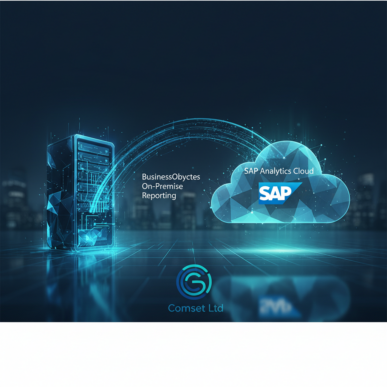
Comset’s Long-Term BusinessObjects Work Highlights a Path From On-Premise Reporting to SAP Analytics CloudComset's long-term engagement with a global banking client demonstrates a successful path from on-premise SAP BusinessObjects to a cloud-based SAP BusinessObjects Private Cloud Edition and SAP Analytics Cloud environment, preserving existing BusinessObjects universes.
3 minute read