Topics

Explore critical topics shaping today’s SAP landscape—from digital transformation and cloud migration to cybersecurity and business intelligence. Each topic is curated to provide in-depth insights, best practices, and the latest trends that help SAP professionals lead with confidence.

Regions

Discover how SAP strategies and implementations vary across global markets. Our regional content brings localized insights, regulations, and case studies to help you navigate the unique demands of your geography.

Industries

Get industry-specific insights into how SAP is transforming sectors like manufacturing, retail, energy, and healthcare. From supply chain optimization to real-time analytics, discover what’s working in your vertical.

Hot Topics

Dive into the most talked-about themes shaping the SAP ecosystem right now. From cross-industry innovations to region-spanning initiatives, explore curated collections that spotlight what’s trending and driving transformation across the SAP community.

Topics

Explore critical topics shaping today’s SAP landscape—from digital transformation and cloud migration to cybersecurity and business intelligence. Each topic is curated to provide in-depth insights, best practices, and the latest trends that help SAP professionals lead with confidence.

Regions

Discover how SAP strategies and implementations vary across global markets. Our regional content brings localized insights, regulations, and case studies to help you navigate the unique demands of your geography.

Hot Topics

Dive into the most talked-about themes shaping the SAP ecosystem right now. From cross-industry innovations to region-spanning initiatives, explore curated collections that spotlight what’s trending and driving transformation across the SAP community.

SAPinsider Research

Access the definitive State of the Market guides, with your steps to success from benchmarking the performance of SAP professionals worldwide. See which strategies are yielding the best results, what sets Leaders apart from their peers. Discover actionable, data-driven insights to ensure the success of your initiatives.
Enterprise Data and Analytics in the Era of AINov 30, 2025  —  Digital business generates more data than traditional business, and that information is foundational to supporting innovation and realizing desired business outcomes such as improved forecasting accuracy, faster and better decision-making, enhanced customer and user experiences, and setting up the ground work  for AI adoption and innovation. Companies that have invested in modernizing their data and analytics strategies and technologies are seeing results, both in the outcomes mentioned as well as many Key Performance Indicators (KPIs). To identify the key factors, strategies, expectations, challenges, and technologies driving enterprise data and analytics strategies, SAPinsider surveyed community members across multiple industries, locations, and roles. This research explored the data and analytics maturity of respondents’ organizations and identified key traits across maturity segments as they journey towards becoming data-driven and AI-enabled. Download the benchmark report to read the full data analysis and receive recommendations for your own plans. Understand the factors impacting SAPiniders’ data and analytics strategies. - Explore the impact that data and analytics maturity has on desired business outcomes and KPIs. - Learn about the technologies that are in use to build data and analytics foundations. - Discover how Data Leaders are succeeding with their data and analytics strategies.
The Technology Leader’s 2025 Transformation Report CardNov 30, 2025  —  When we asked technology leaders about their agenda for 2025, SAP S/4HANA and AI were among their top focuses over and over again. As 2025 is coming to a close, some organizations made progress on those fronts, while others are still too far behind in their overall transformation process look at value-added emerging technologies such as AI. SAPinsider surveyed technology leaders in September through November of 2025 to review how they did on their paths to transformation and digitization over the year. This included a maturity analysis, examining how the strategies and technologies at Digital Leaders compares to Digital Beginners. Download the benchmark report to read the full data analysis and receive recommendations for your own plans. - Understand the factors driving Technology Leaders’ transformation and AI strategies. - Explore the impact that transformation maturity has on key business outcomes. - Learn about the SAP S/4HANA strategies and deployment preferences of Technology Leaders - Discover how Digital Leaders have achieved success on their transformations and are accelerating AI adoption.
Screenshots of RISE with SAP 2025 report.
SAPinsider Benchmark Research – RISE with SAP 2025Nov 26, 2025  —  As 2025 ends, the narrative around SAP migration has shifted from “why move?” to “how fast?” This SAPinsider report, based on a survey of 122 community members conducted in late 2025, highlights a marked acceleration in cloud ERP adoption as the 2027 end-of-maintenance deadline approaches. Now commercially referred to as SAP Cloud ERP Private, the RISE with SAP package is seeing varied adoption rates; smaller organizations (under $2 billion in revenue) are currently twice as likely to be live on the solution compared to larger enterprises, which are predominantly in the planning or exploration phases. While SAP’s dedicated transition support and license conversion credits are the primary drivers for migration, cost and unclear business value remain significant barriers for holdouts. The report also identifies a growing influence of Generative AI on ERP strategy. However, it warns of critical gaps in security compliance and an impending shortage of skilled implementation resources. Download the benchmark report to read the full data analysis and receive recommendations for your own plans. - Understand why there is a concerning lack of security awareness - Why we forecast that implementation partners will struggle to staff the volume of concurrent projects required to meet the 2027 and 2030 deadlines. - How SAP’s direct support and financial incentives are driving adoption rates
SAPinsider 2025 Benchmark Study: Tax Technology in SAP EnvironmentsNov 26, 2025  —  This year’s tax technology report highlights global AI and automation practices, including regional insights. Respondents throughout the year shaped this global view of tax technology and automation in SAP® environments. Tax and finance leaders in SAP environments are continuing digital transformation initiatives globally. Benchmarking against industry-wide global tax automation practices offer an opportunity to measure an organizations’ existing path and celebrate or take course correcting action where needed. Across the globe tax technology adoption (e.g., intelligent mapping, RPA, AI, and Machine Learning) is accelerating. This is good news. AI and automation adoption in tax is paramount to removing blockers that slow business value creation. Value creation today is dependent on high-performing ecosystems, a web in which tax plays a key role in ensuring an organization’s high performance. Fueled by unique challenges, automation and AI adoption priorities differ by region. Europe, Middle East, and Africa (EMEA) lead in adoption to address strategic transformation (63%) and ESG requirements. Asia Pacific, Australia, and New Zealand (APC & ANZ) are advancing integration and compliance capabilities (43%). North America (NA) and Latin America (LATAM) are using AI and automation to drive efficiency, and audit readiness. These differences highlight how important it is for tax automation and AI adoption paths to be regionally specific. Read the full report for details and more findings on AI and Automation in Tax including, approaches to tax process automation, tax technology innovation strategies, use of AI, ML, RPA, and intelligent mapping, and improvements experienced from adopting AI and automation
Cloud Architecture for SAPOct 31, 2025  —  SAPinsiders have been moving to the cloud for over a decade but the transformation process is far from complete. In addition, most organizations take a unique path to the cloud. Some started with a lift and shift of older on-premise systems to infrastructure-as-a-service environments, while others may have directly moved to SAP S/4HANA or even RISE with SAP/SAP Cloud ERP Private. Some started their remediation processes for data and code early, while others have done it following the move to SAP S/4HANA, or even after the move to RISE with SAP. What this has made clear is that, while establishing and maintaining cloud architecture for SAP is on nearly everyone’s roadmap, most organizations are still in the middle of that transition. What is clear from this data is that leaders have generally made more progress in their adoption of cloud technologies than either cloud beginners or the hybrid majority. However, that is not true in every instance. For example, more than two thirds (69%) of leaders are already using SAP Business Technology Platform (BTP), but this is only slightly more than the hybrid majority (60%) or cloud beginners (57%). This difference is more marked with the adoption of SAP S/4HANA Cloud which is being used by 62% of leaders, 51% of the hybrid majority, and only 23% of cloud beginners. This year's research also explored the cloud or hybrid cloud platforms actively in use in SAP environments, the top priorities for evolving SAP architecture over the next 12-24 months, the impact of adopting cloud or hybrid cloud architecture in transforming SAP workloads, and the challenges encountered when adopting cloud or hybrid cloud architectures for SAP workloads. The findings indicate that SAPinsiders will not be able to continue to run legacy applications forever. And with the end of 2027 just over two years away, that change will likely come first with the need to move to SAP S/4HANA Cloud through the auspices of a RISE with SAP/SAP Cloud ERP Private contract. SAPinsiders must be prepared for this change, and should follow the guidance of cloud leaders in making this possible.  Download the benchmark report to read the full data analysis and receive recommendations for your own plans. - Understand the benefits experienced from adopting cloud or hybrid cloud architecture for SAP or SAP-adjacent systems. - Explore the impact of adopting cloud or hybrid cloud architecture in transforming SAP landscapes. - Learn about the factors impacting cloud or hybrid cloud architecture strategy for SAP workloads. - See what SAPinsiders need to do to be successful in their cloud transformations.
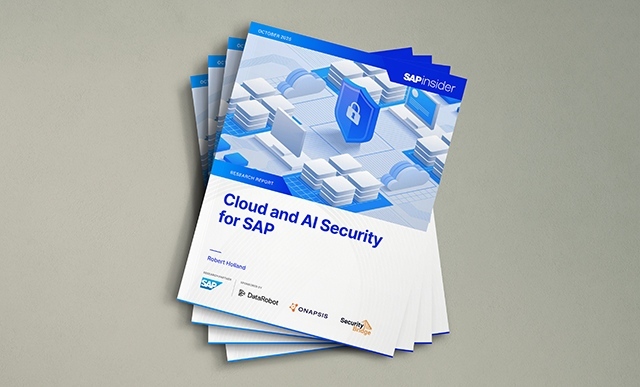
Cloud and AI Security for SAPOct 31, 2025  —  Most SAP customers are now running at least some enterprise systems in the cloud. At the same time, organizations are exploring ways to incorporate AI into their enterprise workloads. This convergence of technologies is hugely important from a security standpoint and raises questions about how organizations are planning on securing their expanding cloud footprints while ensuring that their use of AI is protected. In addition, the expanding use of AI to both protect systems as well as defend against attacks is both complicating, while potentially streamlining, the task of protecting cloud-based systems and AI workloads from attack. In exploring the factors most responsible for influencing cloud and AI security strategy for SAP systems, the differences between these respondent groups were significant. For example, more than half the leaders reported that their strategies were most impacted by the emergence of AI-enhanced attack techniques targeting ERP and SAP systems. Meanwhile, the majority group were still focused on tasks like ERP modernization and a demand to standardize security across cloud and hybrid environments. These are factors that are of lesser importance to leaders, reflecting the fact that leaders are more likely to have already addressed these concerns or are on their way to completing modernization plans This year's research also explored the owners of SAP cloud and AI security strategy, how risk associated with using AI in SAP-related operations is being managed, and measurable security outcomes achieved through adoption of cloud or AI security capabilities for SAP workloads. The findings indicate that organizations must start planning for how they will manage security for cloud and AI use in their SAP environments if they are to successfully secure these workloads in the future. Download the benchmark report to read the full data analysis and receive recommendations for your own plans. - Understand how SAPinsiders are adjusting their security strategy to manage cloud and AI workloads. - Explore the technologies and partner solutions in use to protect cloud and AI workloads. - Learn about how SAPinsiders are managing risk when it comes to cloud and AI security strategy. - See what SAPinsiders can learn from those leading in cloud and AI security.
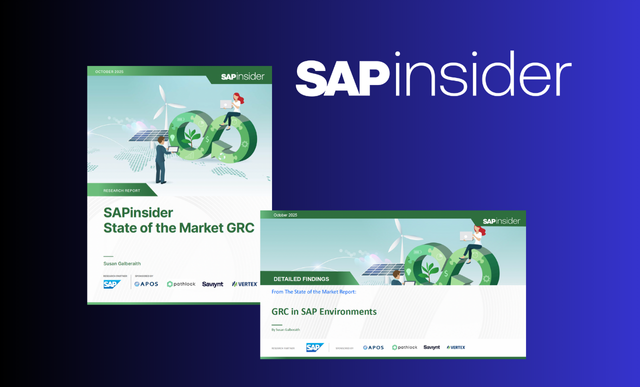
State of the Market GRC in SAP EnvironmentsOct 31, 2025  —  Organizations operating in SAP environments face increasing pressure to modernize Governance, Risk, and Compliance (GRC) practices amid rising regulatory complexity, digital transformation, and audit fatigue. Many enterprises still rely on manual control testing and fragmented access governance, which limits visibility and increases risk exposure. GRC landscapes are dimensional and diverse. This SAPinsider report presents a comprehensive analysis of GRC practices across SAP landscapes, based on data from 339 respondents between 2023 and 2025. The findings reveal a dynamic shift toward automation, integration, and intelligence in GRC strategies, driven by cybersecurity threats, regulatory complexity, and technology modernization. We see SAP-centric approaches as well as a strong reliance on third-party solutions. Organizations leaning into or inheriting third-party solutions are integrating GRC platforms that extend SAP’s capabilities across hybrid landscapes. Vendors such as Pathlock, SailPoint, Saviynt, OneTrust, BlackLine, Trintech, and Experian, offer automation, continuous control monitoring, and identity solutions that span SAP and non-SAP environments ─ as lifecycle offerings or with specialized capabilities. These platforms are included in our research to highlight how together with SAP-native offerings they support the full GRC lifecycle. - Strategic Drivers and Priorities: Organizations are increasingly automating GRC processes (60%) and centralizing control workflows (53%) to improve efficiency and visibility. - GRC Maturity and Integration: 80% of respondents place themselves at Level 3 maturity, where GRC is integrated into business processes with formal governance and enabling technologies. However, few have reached Level 4 where GRC initiatives are enterprise wide. - Technology Adoption and Automation: Most organizations are combining SAP Process Control (47%) and the SAP Integrated GRC Suite (40%) with third-party technologies (e.g., Pathlock, Saviynt, OneTrust, SailPoint). - Data Governance and Privacy: While 53% have formal data classification policies, only 47% have centralized privacy offices or conduct regular privacy impact assessments, indicating uneven adoption of privacy governance. Read the full report for details and more findings on risk management and security threats, financial governance, leadership and team structure, budgets, and investments.
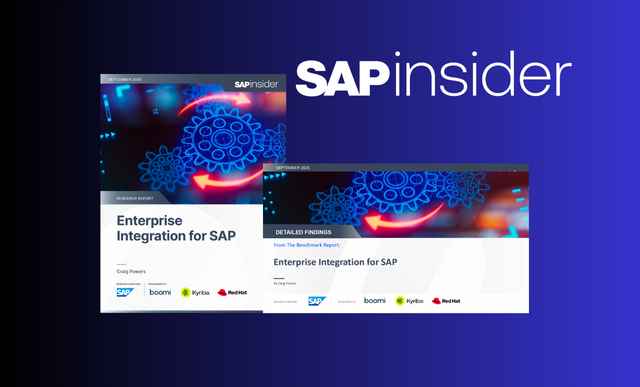
Enterprise Integration for SAP 2025Sep 30, 2025  —  Enterprise integration is essential in the digital business era. Expectations around digital and self-service experiences are driving the need for seamless, enterprise-wide integration across multiple systems, whether they are SAP or non-SAP. Access to the data that moves through critical applications and platforms is key to building data-driven strategies and collaborative workspaces. To identify the key factors, strategies, expectations, challenges, and technologies driving enterprise integration strategies, SAPinsider conducted a survey of community members across multiple industries, locations, and roles from May to August 2025. Respondents revealed that while many organizations are on the path to integrating their systems in a cohesive and automated manner, only a select few have achieved integration at a level where all systems are fully integrated with real-time data flow. This research also explored the integration maturity of respondents' organizations, and identified key traits across maturity segments as they journey towards enterprise-wide integration and governance. Download the benchmark report to read the full data analysis and receive recommendations for your own plans. - Understand the how SAPinsiders are integrating their systems and the strategies they use. - Explore the factors that are having the biggest impact on enterprise integration. - Learn about the technologies that are in use to build connections between critical systems. - Discover how SAP S/4HANA impacts integration strategies
Global E-Invoicing Management in SAP S/4HANA MigrationsSep 30, 2025  —  This report explores how leading enterprises are addressing the challenge of global E-Invoicing management in SAP S/4HANA migrations.  It highlights that enterprises tackling global E-Invoicing management during SAP S/4HANA migrations face complexities influenced by various factors. A significant number of organizations are rapidly progressing in their migrations while emphasizing the importance of integrating E-Invoicing strategies to prevent future compliance and reporting issues. Large numbers of customers (63%) are well down the path of their SAP S/4HANA migrations, having completed the move, currently moving, or planning to move within 12 months. Deployment approaches are undetermined (24%), with third-party solutions (20%) and SAP DRC (17%) leading in preference ahead of other approaches that vary widely. Across the board, organizations are realizing value in aligning E-Invoicing projects with SAP S/4HANA migrations resulting in improved end-to-end process integration (60%), accelerated compliance with new regulations (46%), and better scalability for new countries and requirements.
Deployment Approaches to SAP S/4HANA 2025Jul 31, 2025  —  The first productive release of SAP S/4HANA, version 1511, is just a few months shy of being 10 years old. In that time the market has changed significantly, although that change has been accelerating over the last 12-18 months as against changing steadily over time. Despite the launch of RISE with SAP in 2021, and SAP's push towards cloud ERP in general, most SAPinsiders have followed a more traditional approach in terms of both licensing and deployment. This has largely involved perpetual software licenses installed in on-premise infrastructure, although there has been a shift towards more of these deployments being in infrastructure-as-a-service environments in the private or public cloud. Despite not being new, it was originally launched not long after SAP S/4HANA itself, SAP S/4HANA Cloud has seen an increase in adoption over the years particularly due to the connection with RISE with SAP. However, that SAP S/4HANA Cloud adoption only represented a relatively small proportion of the SAP S/4HANA customer base. This year that has changed. For the first time there is significant movement in the SAP S/4HANA market and the upcoming end of mainstream maintenance is driving that change. A majority of SAPinsiders are now focused on moving to SAP S/4HANA as quickly as possible. More than a third plan on deploying SAP S/4HANA Cloud through either RISE with SAP or GROW with SAP. And nearly a quarter of SAPinsiders now report that they will not complete a transition to SAP S/4HANA until after 2027. The combination of these factors, along with other data from the research, shows a market that has changed rapidly over the last year. This year's research also explored the deployment model that SAPinsiders plan to use. The emphasis on getting to SAP S/4HANA quickly means that more organizations than in the last few years are considering a system conversion, or brownfield, deployment. However, SAPinsiders must weigh this approach against the work that they will have to do after deployment to achieve a cleaner core. The findings indicate that the race to deploy SAP S/4HANA before 2027 has become more serious, and that many SAPinsiders have realized that this goal is not readily achievable. However, for those that have been properly preparing, there is still time. Download the benchmark report to read the full data analysis and receive recommendations for your own plans. - Understand the how SAPinsiders are deploying SAP S/4HANA and the environments they will use. - Explore the factors that are having the biggest impact on deployment timeline. - Learn about the infrastructure that is planned for those SAP S/4HANA deployments. - See what role SAP Cloud ERP is playing moving forward.

Events

29Oct
SAPinsider New Orleans SummitNew Orleans, Louisiana, United States
17Nov
SAPinsider Copenhagen 2026Copenhagen, Denmark
18Nov
Mastering SAP Collaborate, an SAP TechEd on Tour eventSydney, New South Wales, Australia
View All

Related Vendors