Jul 28, 2026
•2 minute read
An Enterprise Resource Planning (ERP) system makes it possible for organizations to run within a single system their core processes for finance, manufacturing, human resources (HR), supply chain, services, procurement, and other key business functions.
An Enterprise Resource Planning (ERP) system makes it possible for organizations to run within a single system their core processes for finance, manufacturing, human resources (HR), supply chain, services, procurement, and other key business functions.
SAP ERP solutions are based on over 40 years of experience across all industries and business sizes. They leverage technology that is constantly updated to build ERP tools that can be constantly updated.
The first official SAP ERP solution was the introduction of mySAP ERP in 2004, although this was based on much of the functionality and experience SAP had gained with the SAP R/2 and SAP R/3 business application software suites. While the mySAP ERP solution was targeted at a smaller audience, SAP ERP Central Component (SAP ECC) was introduced in the same and provided all the core business processing capabilities along with data warehouse and enterprise management capabilities in a single system.
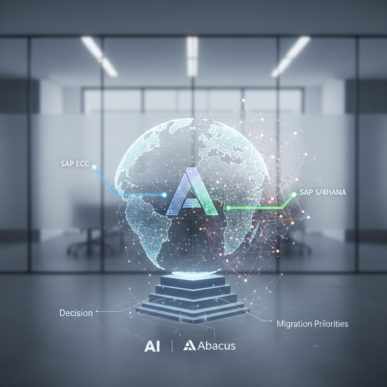
The most recent SAP ERP system, SAP S/4HANA, was introduced in 2015 and was a significant shift for SAP as it runs exclusively on the SAP HANA database. A software-as-a-service version of the solution, SAP S/4HANA Cloud, was introduced a year later in 2016. There is a new major release of the on-premise version of SAP S/4HANA each year, while the cloud editions are released quarterly. SAP has announced that they will end the mainstream maintenance and support of all ERP systems other than SAP S/4HANA at the end of 2027.
SAP started to shift their strategy in 2020 to focus more on the cloud-based software-as-a-service ERP system SAP S/4HANA Cloud. This has been done in conjunction with a shift in messaging toward cloud ERP. While most SAP ERP customers are still running older solutions such as SAP ECC, this focus on cloud ERP has been done in conjunction with RISE with SAP.
The biggest factors impacting organizations’ move to newer SAP ERP systems include the opportunity to re-engineer processes or correct configurations from an older system, the upcoming end of maintenance of existing ERP releases, and a desire to transform existing solutions and create a centralized model and structure.
SAP has many implementation partners that will assist organizations with either their initial SAP ERP deployment or a move to SAP S/4HANA from an earlier ERP release. These range from global solution service partners like Capgemini, Cognizant, Deloitte, and T-Systems to smaller partners like smartShift and SoftwareONE that offer solutions and software to help with migration, as well as partners specializing in the migration process itself like Lemongrass.
An Enterprise Resource Planning (ERP) system makes it possible for organizations to run within a single system their core processes for finance, manufacturing, human resources (HR), supply chain, services, procurement, and other key business functions. SAP ERP solutions are based on over 40 years of experience across all industries and business sizes. They leverage technology that is constantly updated to build ERP tools that can be constantly updated.
By centralizing key functions like sales, security, analytics, and much more into one SAP system, an ERP can help provide a more interconnected experience for users and business leaders. Relying on an ERP can help standardize security measures, help boost sales performance, making the overall experience better for both users and customers.
SAP ERP systems offer significant benefits to their customers. These solutions are available to organizations of all types and sizes. One of the chief benefits is flexibility. SAP ERPs are easily customizable, both in terms of the applications themselves and how they connect and interact within a network overall. ERPs are available in public and private clouds, so users can have online access to the network from anywhere. They can also be used in on-premise only scenarios, offering users the option to keep their IT and security in-house. ERP systems from SAP centralize critical business functions like planning, analytics, and finance all in one place. This saves employees from significant manual work, allowing them to instead spend their time on more value-added tasks.
Organizations range in size, operate in different industries, and may have unique business needs, so SAP offers several different ERP solutions to meet these challenges.
SAP’s flagship ERP solution is SAP S/4HANA. Released in 2015, this ERP solution runs exclusively on the SAP HANA database. It features modules like Asset Management, Finance, Human Resources, Manufacturing, R&D/Engineering, Sales, Service, Sourcing and Procurement, and Supply Chain. These modules all have different features and functions to meet the needs of their industry.
The full-scale ERP suite is used by companies of all different sizes and provides organizations with the flexibility to respond to shifting business environments. Recent versions of SAP S/4HANA now feature enhanced technological features like machine learning, automation, AI, and other capabilities.
The primary reason that organizations opt for SAP S/4HANA is its simplicity. The system standardizes and simplifies IT and business processes throughout organizations by acting as the core of the business. It can centralize data access from sources within other SAP systems and outside of SAP. This provides business leaders with end-to-end visibility, enhancing their decision-making capabilities.
SAP S/4HANA relies on SAP Fiori as its user interface, which makes interacting with the ERP system a more personalized and user-friendly experience.
SAP S/4HANA is not SAP’s only ERP offering. For smaller and midsize businesses, SAP offers Business One. Billed as a “a long-time favorite of smaller firms and subsidiaries of large enterprises” by SAP, SAP Business One also features cloud capabilities on a more affordable scale for businesses with fewer processes to oversee.
SAP also offers midsized firms a more specialized cloud-based ERP suite known as SAP Business ByDesign. Designed to meet the needs of organizations that are scaling rapidly, SAP Business ByDesign also connects core functions across the breadth of an enterprise.
Some organizations still run on SAP ECC 6.0, a legacy system that predates SAP S/4HANA as SAP’s flagship ERP. That ERP system is being phased out as SAP pushes organizations to complete the transition to SAP S/4HANA. Support and maintenance for the legacy SAP ECC ERP will come to an end in 2027, though SAP does offer users the option of using the SAP ECC 6.0 Enhancement Pack 8 through 2030. Yet to make the most out of an SAP ERP system and gain the benefits of flexibility and the full power of SAP HANA, it is recommended that companies make the switch to SAP S/4HANA.
Organizations should perform a self-evaluation and research the different possibilities to determine which SAP ERP benefits would bolster their enterprise processes the most.












Your request has been successfully sent