
4 minute read

Meet the Authors
Key Takeaways
What you need to know
Abacus's June 2026 SAP ECC to S/4HANA migration guide positions this year as the last full planning window before delivery capacity tightens ahead of the 2027 maintenance deadline.
SAPinsider's ERP Migration and Transformation 2026 benchmark finds SAP's AI announcements (43%) have overtaken the 2027 deadline (39%) as the top external factor shaping ERP strategy.
With 55% of organizations deployed on SAP S/4HANA but only 34% fully switched, Abacus's RISE with SAP and cloud migration cost guidance targets the long parallel-run gap in between.
Abacus, a global professional services company that has delivered technology, outsourcing, and consulting services for nearly four decades, has spent the first half of 2026 sharpening its guidance for SAP customers still running SAP ECC. In its June 2026 publication, SAP S/4HANA vs ECC: The Complete Migration Guide for 2026, the firm frames this year as a planning window rather than a countdown. It argues that organizations that begin early can sequence data preparation, custom code review, and integration work with room to think. At the same time, those who delay enter their programs with tighter timelines and greater pressure on costs and resources.
Why ECC Endured, and Why It Now Slows Change
The guide is direct about why SAP ECC lasted so long. It reliably carried out month-end close, supply chain coordination, procurement, and reporting for years, and organizations built deeply customized operations around it. That same strength is now the burden. Abacus describes ECC landscapes shaped by accumulated custom code, layered reporting structures, batch-driven processes, and interfaces that require ongoing maintenance. None of this makes ECC obsolete, the firm notes, but it does make change slower, costlier, and harder to manage.
Against that baseline, the guide positions SAP S/4HANA around four differences: a leaner architecture on the SAP HANA in-memory database, reporting that sits much closer to live operations, a role-based SAP Fiori user experience, and readiness for automation, analytics, and AI-enabled workflows. Abacus also grounds its case in SAPinsider data, citing 2025 research showing that 34% of organizations had completed their move to SAP S/4HANA while another 41% planned to move before the end of 2027.
Explore related questions
Ask SAPi
What the 2026 Benchmark Data Adds
SAPinsider’s more recent ERP Migration and Transformation 2026 benchmark report, based on a survey of 296 community members conducted between December 2025 and March 2026, sharpens that picture. While 55% of respondents report having deployed a version of SAP S/4HANA or SAP S/4HANA Cloud, only 34% have fully switched their daily operations to it. The research also found that SAP’s AI announcements have overtaken the 2027 maintenance deadline as the top external factor shaping ERP strategy, cited by 43% of organizations versus 39% for the deadline, and that 35% of respondents intend to switch to SAP S/4HANA before the end of 2026. That intention will strain delivery capacity, which makes the early groundwork Abacus describes more consequential.
Structure and Cost as the Other Two Levers
Abacus addressed the execution model earlier in the year. Its recent blog argues that transformations lose direction when effort spreads across initiatives and priorities diverge. The firm presents RISE with SAP as a corrective: a defined methodology with checkpoints, plus a managed cloud model that consolidates infrastructure operations, security monitoring, and availability under service-level agreements. Abacus points to its own delivery for Mayfair Asian Food Industries. This food producer used RISE with SAP to align production, supply chain, and distribution processes, and notes that organizations applying this model have reported up to a 70% improvement in agility.
The third leg is cost. In its July 2026 guide, Abacus warns that budgets built by comparing current infrastructure spend with a future cloud estimate miss the work in between: assessment, parallel environments during cutover, skills development, governance, and post-migration optimization. That caution aligns with SAPinsider’s Technology Leaders’ Strategic Agenda for 2026, in which 70% of technology leaders named increasing operational efficiency and reducing costs as their top priority and 63% expect pressure to reduce IT and SAP-related costs this year.
For CIOs and ERP program managers, the combined message from Abacus’s 2026 output is consistent: the migration question is no longer whether to move, but whether data readiness, execution structure, and cost governance are being handled early enough to make the move controlled rather than reactive.
What This Means for SAPinsiders
Treat 2026 as the last full planning year. With 35% of organizations telling SAPinsider they intend to switch to SAP S/4HANA before the end of 2026, partner and internal delivery capacity will tighten. ECC holdouts should complete landscape, data, and custom code assessments now rather than alongside execution.
Build the business case around AI access and the deadline. SAPinsider’s 2026 benchmark shows AI announcements now outrank the 2027 maintenance deadline as a migration driver. ERP program managers should define which AI capabilities the organization actually needs and which ERP foundation it requires.
Budget the full lifecycle, not the platform. Abacus’s cost guidance and SAPinsider’s finding that 55% have deployed but only 34% have switched both point to long parallel-run periods. Finance and IT leaders should explicitly fund dual environments, testing, and post-go-live optimization.
More Resources
See All Related Content

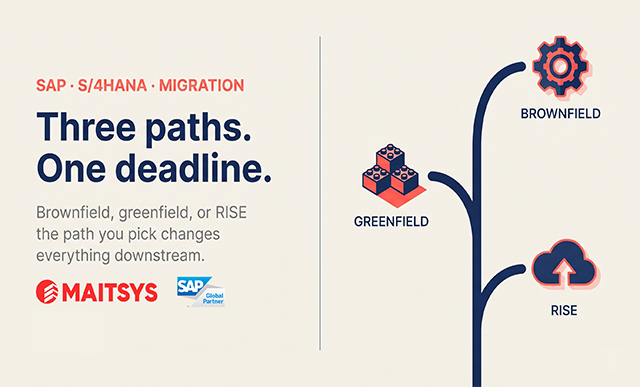
ECC to S/4HANA: Brownfield, Greenfield, or Selective Data Transition?To effectively transition from SAP ECC to S/4HANA, organizations must separately decide on their system transformation approach—whether through system conversion, new implementation, or selective data transition—and their operational model, with RISE with SAP primarily addressing the latter.
8 minute read

Beyond Greenfield and Brownfield: Rethinking SAP ModernizationIn a recent Lemongrass Live discussion, experts emphasized that SAP organizations should prioritize creating immediate business value through AI innovations rather than solely focusing on the Greenfield or Brownfield migration paths to S/4HANA.
3 minute read