Topics

Explore critical topics shaping today’s SAP landscape—from digital transformation and cloud migration to cybersecurity and business intelligence. Each topic is curated to provide in-depth insights, best practices, and the latest trends that help SAP professionals lead with confidence.

Regions

Discover how SAP strategies and implementations vary across global markets. Our regional content brings localized insights, regulations, and case studies to help you navigate the unique demands of your geography.

Industries

Get industry-specific insights into how SAP is transforming sectors like manufacturing, retail, energy, and healthcare. From supply chain optimization to real-time analytics, discover what’s working in your vertical.

Hot Topics

Dive into the most talked-about themes shaping the SAP ecosystem right now. From cross-industry innovations to region-spanning initiatives, explore curated collections that spotlight what’s trending and driving transformation across the SAP community.

Topics

Explore critical topics shaping today’s SAP landscape—from digital transformation and cloud migration to cybersecurity and business intelligence. Each topic is curated to provide in-depth insights, best practices, and the latest trends that help SAP professionals lead with confidence.

Regions

Discover how SAP strategies and implementations vary across global markets. Our regional content brings localized insights, regulations, and case studies to help you navigate the unique demands of your geography.

Hot Topics

Dive into the most talked-about themes shaping the SAP ecosystem right now. From cross-industry innovations to region-spanning initiatives, explore curated collections that spotlight what’s trending and driving transformation across the SAP community.

SAP IT Automation

As SAP landscapes grow more complex, with hybrid architectures, cloud migrations, and parallel SAP S/4HANA transitions running simultaneously, manual IT operations have become a costly and unsustainable liability. SAP IT automation addresses this directly by replacing repetitive administrative work with orchestrated, policy-driven workflows. From job scheduling and workload management to patch deployment and event-driven failure response, automation enables IT teams to operate leaner, deliver faster, and redirect skilled staff toward strategic priorities rather than routine day-to-day maintenance tasks.

What Is SAP IT Automation?

SAP IT automation refers to the use of tools, platforms, and frameworks to execute IT tasks across SAP environments without manual intervention. It encompasses workload automation, job scheduling, host provisioning, configuration validation, and real-time system monitoring. Leading solutions such as Red Hat Ansible Automation Platform and Redwood RunMyJobs enable organizations to standardize operations, eliminate human error, and confidently scale SAP systems management across complex, multi-system, multi-country deployments. The result is consistent, repeatable, and fully auditable processes that meaningfully reduce operational risk and IT overhead enterprise-wide.

As SAP landscapes grow more complex, with hybrid architectures, cloud migrations, and parallel SAP S/4HANA transitions running simultaneously, manual IT operations have become a costly and unsustainable liability. SAP IT automation addresses this directly by replacing repetitive administrative work with orchestrated, policy-driven workflows. From job scheduling and workload management to patch deployment and event-driven failure response, automation enables IT teams to operate leaner, deliver faster, and redirect skilled staff toward strategic priorities rather than routine day-to-day maintenance tasks.

What Is SAP IT Automation?

SAP IT automation refers to the use of tools, platforms, and frameworks to execute IT tasks across SAP environments without manual intervention. It encompasses workload automation, job scheduling, host provisioning, configuration validation, and real-time system monitoring. Leading solutions such as Red Hat Ansible Automation Platform and Redwood RunMyJobs enable organizations to standardize operations, eliminate human error, and confidently scale SAP systems management across complex, multi-system, multi-country deployments. The result is consistent, repeatable, and fully auditable processes that meaningfully reduce operational risk and IT overhead enterprise-wide.

What Use Cases Are Referenced?

Red Hat Ansible and AI Deliver 668% ROI on SAP Operations

An IDC study sponsored by Red Hat found organizations using Ansible Automation Platform for SAP achieved a 668% three-year ROI, 68% faster compute provisioning, and 46% fewer unplanned outages. Ansible Lightspeed integrates generative AI to accelerate playbook creationSAPinsider published these findings.

SAP Automation Adoption Gaps Reveal Untapped Opportunity

SAPinsider research shows 84% of organizations use IT automation, but only 14% have made it an enterprise standard. One-third still do not automate SAP tasks directly. Red Hat Ansible Automation Platform delivers 44% faster change management operations, offering a proven path to closing the gap between partial adoption and enterprise-wide standardization.

Kaeser Compressors Unifies 40-Country SAP Workflow with RunMyJobs

Kaeser Compressors consolidated more than 40 country-specific SAP processes into a single automated flow using Redwood RunMyJobs, migrating from SAP BPA. The result was faster throughput, stronger resilience, and reduced administrative effort without adding IT headcount. SAPinsider covered this deployment in June 2024.

Daikin Europe Cuts Overnight Supply Chain Processing from 11 Hours to 6

Daikin Europe implemented Redwood RunMyJobs and reduced overnight supply chain processing times by nearly half, from 11 hours to 6. The deployment reduced failures in the cut process, reduced manual intervention, and accelerated order fulfillment. SAPinsider reported on this case.

Ansible Eliminates SAP S/4HANA Operation Burden at Scale

At SAPinsider Las Vegas 2026, Red Hat’s Jim O’Donnell and Azizur Rahman showed that organizations standardizing on a common Linux and Ansible stack reported hundreds of thousands of dollars in annual benefits per 100 VMs. Ansible automates host preparation, deployment, patching, and configuration validation. SAPinsider covered the session.

What SAPinsider Research Supports This Topic?

Technology Leaders: Strategic Agenda for 2026

SAPinsider benchmark research finds 70% of technology leaders cite cost reduction and operational efficiency as their top priority. Foundational platform investments, including SAP BTP, outpace direct AI spend, signaling that automation infrastructure remains a primary lever for enterprise technology strategy heading into 2026.

ERP Migration and Transformation 2026

With 55% of organizations having deployed S/4HANA and 34% fully transitioned, the 2027 maintenance deadline is intensifying pressure to automate migration and operational workflows. SAPinsider benchmark research tracks how automation tooling is accelerating transformation timelines and reducing the manual burden of large-scale ERP transitions.

Building Resilient and Agile Supply Chains 2024

Sixty percent of organizations surveyed by SAPinsider prioritize operational resilience as a core supply chain objective. Automation of SAP-connected workflows, from job scheduling to event-driven response, is a foundational capability for organizations seeking to eliminate processing delays and maintain SLA performance under demand volatility.


Using Automation to Address ChangeToday’s infrastructure and environments are changing more rapidly than ever. Cloud infrastructure and cloud-based solutions are becoming part of enterprise landscapes, while at the same time there is a critical need to bring together data from across the enterprise to provide a greater depth of understanding of the business. But as organizations start to use these new landscapes, they often struggle with the rate of change that they are expected to achieve. An inability to keep pace with change can then impact how quickly organizations can comply with changing needs and requirements. Change is accelerating for SAP customers. After years of running environments that have had minimal adjustments, landscapes, infrastructure, and the solutions that are running on them are shifting rapidly. Many organizations are struggling to keep up with this change, and are looking for ways in which they can better manage this change, reduce costs, and streamline the management of their environments. o The pace of change will continue to increase, so organizations must be prepared to manage these infrastructure and environmental shifts. o In addition to changing, environments are also more likely to become more complex. With the mixture of cloud and on-premise environments that will exist while enterprise solutions move to the cloud, it is important to be agile enough to react as necessary. o Implementing an automation platform will provide the ability to streamline manual, repetitive administrative tasks and scale the ability to patch, remediate, and release new systems and infrastructure.
SAP Environment
Future-Proofing and Scaling Workload Automation with RunMyJobs by Redwood SoftwareOrganizations need to ensure their automation initiatives enable innovation and adaptability to evolving business needs. However, while identifying optimal starting points and potential areas for expansion is key, integrating tools across both on-premise and cloud-based systems is essential. Equally important is reducing adoption barriers for both IT teams and business users to facilitate a smooth and effective digital transition. Redwood Software offers a comprehensive range of IT solutions, focusing on workload automation and file transfer to provide complete business process automation end-to-end. Workload automation offerings include three products: Tidal, ActiveBatch and their flagship enterprise solution, RunMyJobs. RunMyJobs is a full stack enterprise job scheduler and batch processor that automates mission-critical processes in complex computing environments for your SAP and non-SAP tech stack.
SAP Landscape and Efficiency OperationsClick Here to View Session Deck. Infrastructure and Application Automation is a key skill and technology set every IT professional needs. SAP applications can be demanding to manage and thus helpful to automate. This session will show how to harness the power of SAP Landscape Management and SAP Cloud Appliance Library to develop extensive automation […]
Business Automation Challenges and SolutionsBusinesses today are struggling to keep moving in the right direction. Infrastructure and environments are changing more rapidly than ever, and there is an increased need to bring data together across the organization to provide a better understanding of the business. Organizations need more connected applications, more efficient processes, and more specialized skill sets if they are to effectively manage this all. It is also becoming increasingly important to operationalize artificial intelligence in IT environments. This will allow AIOps platforms to learn patterns from monitoring to better comprehend IT asset relationships, define applications, predict events, and automate resolutions.
SAP Environment
Case Study: How Stonebranch’s Universal Automation Center Drives BusinessIn this article, we are taking a look at the Universal Automation Center from IT orchestration and automation solutions provider Stonebranch. They were able to help a client replace its burdensome legacy workload automation system with a modern, scalable and secure automation solution. The client struggled with an outdated platform with an outdated licensing scheme and a cumbersome client. It needed better self-service capabilities to deliver value, yet the prospect of updating its software seemed time-intensive and costly at the outset. We will explore how Stonebranch was able to deliver business value through automation throughout the organization without disrupting workflows.
Business Automation Challenges and SolutionsBusinesses today are struggling to keep moving in the right direction. Infrastructure and environments are changing more rapidly than ever, and there is an increased need to bring data together across the organization to provide a better understanding of the business. Organizations need more connected applications, more efficient processes, and more specialized skill sets if they are to effectively manage this all. It is also becoming increasingly important to operationalize artificial intelligence in IT environments. This will allow AIOps platforms to learn patterns from monitoring to better comprehend IT asset relationships, define applications, predict events, and automate resolutions.
IT Automation
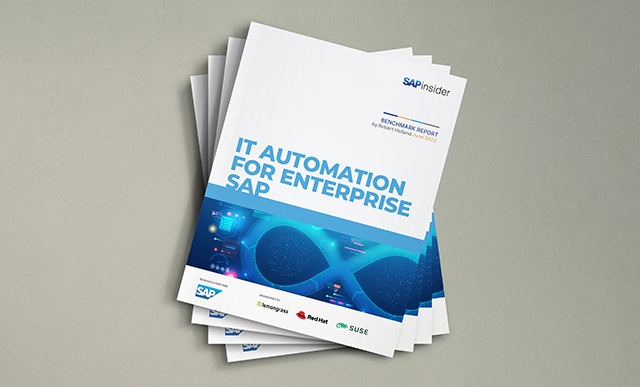
Webinar: IT Automation for Enterprise SAPThe goal of IT automation is to create an environment that contains a clean landscape, is running smoothly, and is easy to patch. While simple in concept, this is much more difficult to achieve in practice. IT automation offers many benefits as it reduces errors and enhances efficiency by automating manual and repetitive tasks, and increases regulatory compliance and security as system patching and monitoring get automated. However, IT automation projects may have a significant up-front cost and require a robust technology platform to support desired automation capabilities. Despite this, the move to cloud-based environments has made it possible for SAP customers to implement and leverage IT automation within their enterprise SAP environments. The survey asked the respondents to about how far they had reached with implementing IT automation for their SAP systems and environments, and in which areas they were utilizing automation. They were most likely to be leveraged in operations, maintenance, and testing, though more organizations planned to implement automation in the areas of patching and testing. Respondents were concerned about skill gaps and integrating automation solutions with existing systems, but expected to optimize costs and resources, reduce errors, and enhance reliability and quality. Download the benchmark report to read the full data analysis from 137 members of the SAPinsider community and receive recommendations for your own plans. - Explore the factors that are influencing the need for IT automation for enterprise SAP systems - Learn how far organizations have reached with implementing IT automation - Understand the most important features for IT automation - See the areas in which organizations are utilizing IT automation for SAP
IT Automation
IT Automation for Enterprise SAPThe goal of IT automation is to create an environment that contains a clean landscape, is running smoothly, and is easy to patch. While simple in concept, this is much more difficult to achieve in practice. IT automation offers many benefits as it reduces errors and enhances efficiency by automating manual and repetitive tasks, and increases regulatory compliance and security as system patching and monitoring get automated. However, IT automation projects may have a significant up-front cost and require a robust technology platform to support desired automation capabilities. Despite this, the move to cloud-based environments has made it possible for SAP customers to implement and leverage IT automation within their enterprise SAP environments. The survey asked the respondents to about how far they had reached with implementing IT automation for their SAP systems and environments, and in which areas they were utilizing automation. They were most likely to be leveraged in operations, maintenance, and testing, though more organizations planned to implement automation in the areas of patching and testing. Respondents were concerned about skill gaps and integrating automation solutions with existing systems, but expected to optimize costs and resources, reduce errors, and enhance reliability and quality. Download the benchmark report to read the full data analysis from 137 members of the SAPinsider community and receive recommendations for your own plans. - Explore the factors that are influencing the need for IT automation for enterprise SAP systems - Learn how far organizations have reached with implementing IT automation - Understand the most important features for IT automation - See the areas in which organizations are utilizing IT automation for SAP

Related Vendors