
8 minute read

Meet the Authors
Key Takeaways
What you need to know
SAP, Prestige Auto, and Softtek modernize Mercedes-Benz Argentina’s ERP systems.
Migration to SAP S/4HANA on Microsoft Azure enables real-time data and AI readiness.
Transformation focuses on operational efficiency, continuity, and scalable growth.
SAP Argentina, Prestige Auto, and Softtek have signed an agreement to modernize the core ERP systems underpinning Mercedes-Benz operations in Argentina. The project, which began in 2025 and is set to go live during 2026, will migrate the company’s existing SAP ECC environment to SAP S/4HANA, hosted on Microsoft Azure, with a view to improving operational efficiency and enabling future-ready digital capabilities.
This initiative comes at a pivotal moment for Prestige Auto, which assumed control of Mercedes-Benz Argentina operations in 2025 and is now investing in upgrading its digital backbone to support growth, scalability, and operational continuity.
Cloud ERP Migration Anchors Transformation Strategy
The migration aims to establish a standardized, scalable ERP foundation capable of supporting real-time data access, advanced analytics, and integrated business processes.
Explore related questions
Ask SAPi
Softtek will lead implementation and licensing support, while SAP Argentina provides the underlying cloud services framework. A joint executive committee has also been established to govern the program, ensuring alignment across stakeholders and minimizing disruption during the transition.
The transformation is expected to deliver:
- Faster and more efficient operations
- Real-time access to business data and performance indicators
- Improved integration across enterprise systems
Fernanda Pérez, country manager at SAP Argentina, said, “This project marks a significant step forward in the technological modernization of Mercedes-Benz in Argentina. At SAP, we are supporting Prestige Auto in its transition to a cloud platform designed for continuous innovation, capable of enabling more agile, secure, and efficient processes. With SAP S/4HANA, the company not only ensures operational continuity but also lays the foundation for boosting its growth, utilizing AI, automation, and the latest version of SAP’s integrated cloud ERP.”
Building a Foundation for AI and Automation
Beyond ERP modernization, the initiative is designed to enable the adoption of advanced digital capabilities, including automation, AI, and analytics. By transitioning to a modern SAP S/4HANA environment, Prestige Auto is positioning Mercedes-Benz Argentina to leverage intelligent technologies embedded within its ERP core.
The project also emphasizes user experience improvements through web-based interfaces accessible across devices, supporting a more intuitive and flexible way of working.
Security and compliance are also key priorities, with integration of identity and access management tools aligned to global standards such as SOX, GDPR, and ISO.
Ensuring Continuity While Modernizing Core Systems
A critical requirement of the program is maintaining uninterrupted operations during the transition. The companies have emphasized a low-disruption approach, ensuring business continuity while replacing legacy tools and modernizing core processes.
The transformation also extends to HR-related processes, including recruitment, performance management, and goal tracking, reflecting a broader move toward integrated enterprise-wide digital operations.
By consolidating systems and standardizing processes, the initiative aims to reduce complexity, optimize costs, and create a unified digital ecosystem across the organization.
How SAP is transforming automotive sales: from ERP modernization to AI-driven CX
SAP’s work in the automotive and car sales ecosystem reflects a broader shift toward data-driven operations and customer-centric transformation.
For example, Toyota South Africa Motors modernized its core vehicle management and HR systems through a migration to SAP S/4HANA with IBM, enabling real-time data visibility, improved inventory optimization, and faster responsiveness to customer demand. The project was delivered with minimal disruption, highlighting the importance of continuity in large-scale automotive operations.
Similarly, at the customer experience layer, BMW Group KSA has taken a different but complementary approach, using SAP Customer Data Platform (CDP) to unify first-party customer and ERP data into a single view. This has enabled AI-driven personalization and real-time engagement across channels, allowing the company to move from fragmented interactions to data-led, one-to-one customer experiences.
Taken together, these examples show how SAP’s role in the automotive sector spans both core operational transformation and front-office innovation.
What This Means for SAPinsiders
Automotive ERP modernization is becoming a platform strategy. This deal shows ERP is no longer a back-office upgrade but a foundation for operations, data, and AI. Large enterprises should align ERP decisions with long-term digital architecture and growth plans.
Zero-disruption transformation is now a board-level expectation. Automotive and manufacturing firms cannot afford downtime during ERP shifts. Organizations should design migrations around continuity, using phased approaches and governance models that protect revenue and customer commitments.
ERP decisions now shape customer experience capabilities. As seen across SAP’s automotive work, ERP and customer data platforms are converging. Enterprises should think beyond core systems and plan for integrated, real-time customer and operational data.
More Resources
See All Related Content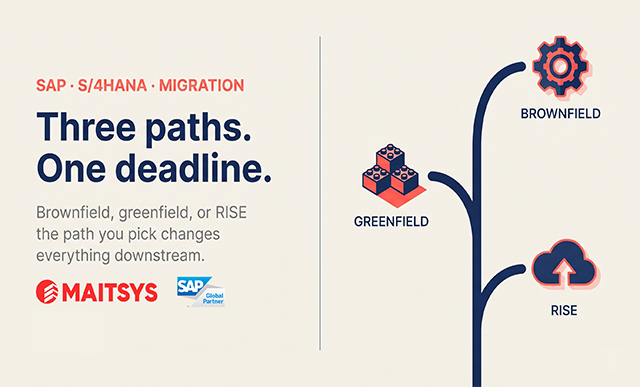
ECC to S/4HANA: Brownfield, Greenfield, or Selective Data Transition?To effectively transition from SAP ECC to S/4HANA, organizations must separately decide on their system transformation approach—whether through system conversion, new implementation, or selective data transition—and their operational model, with RISE with SAP primarily addressing the latter.
Shelf-Awareness: Stabilizing and Unlocking ERP Transformation in Grocery RetailIn the white-paper-shelf-awareness-stabilizing-and-unlocking-erp-transformation-in-grocery-retail, Boston Consulting Group outlines a three-phase framework of Stabilize, Simplify, and Scale with AI to help grocery retailers recover from ERP implementation disruptions and unlock long-term business value. The paper demonstrates how disciplined improvements in processes, data governance, architecture, and operating models can create the foundation for AI-driven inventory management, pricing optimization, and operational excellence
1 minute read

BI Solutions Inc. Courts SAP Customers Burned by Failed Utilities and Telecom ImplementationsBI Solutions Inc., a Plano, Texas-based SAP consulting firm, challenges industry 'armchair experts' by positioning itself as an alternative for Utilities and Telecom organizations wary of failed SAP projects. The company emphasizes its minority-owned certification and tenured consultants.
2 minute read

When the Customer Story Becomes Real: Inside Deloitte’s Playbook for AI-Ready SAP TransformationsAt SAP Sapphire 2026, Deloitte led with two customer outcomes: Ferrara Candy Company doubled OTIF and is retiring 55 legacy applications on a clean core, while Stellar Energy Global Infrastructure took SAP S/4HANA Cloud Public Edition live in eight weeks.
4 minute read