Featured Content
Topics

Explore critical topics shaping today’s SAP landscape—from digital transformation and cloud migration to cybersecurity and business intelligence. Each topic is curated to provide in-depth insights, best practices, and the latest trends that help SAP professionals lead with confidence.

Regions

Discover how SAP strategies and implementations vary across global markets. Our regional content brings localized insights, regulations, and case studies to help you navigate the unique demands of your geography.

Industries

Get industry-specific insights into how SAP is transforming sectors like manufacturing, retail, energy, and healthcare. From supply chain optimization to real-time analytics, discover what’s working in your vertical.

Hot Topics

Dive into the most talked-about themes shaping the SAP ecosystem right now. From cross-industry innovations to region-spanning initiatives, explore curated collections that spotlight what’s trending and driving transformation across the SAP community.

Featured Content
Topics

Explore critical topics shaping today’s SAP landscape—from digital transformation and cloud migration to cybersecurity and business intelligence. Each topic is curated to provide in-depth insights, best practices, and the latest trends that help SAP professionals lead with confidence.

Regions

Discover how SAP strategies and implementations vary across global markets. Our regional content brings localized insights, regulations, and case studies to help you navigate the unique demands of your geography.

Hot Topics

Dive into the most talked-about themes shaping the SAP ecosystem right now. From cross-industry innovations to region-spanning initiatives, explore curated collections that spotlight what’s trending and driving transformation across the SAP community.

SAP Analytics

Upcoming Events

SAPinsider Las Vegas 2026
Mar 16-19, 2026Las Vegas, Nevada, NV

Related Vendors

Analytics pertains to leveraging data generated and captured across the organization to generate insights that can help transform the way organizations run. Analytics can also  help build capabilities that can automate many aspects of day-to-day decision making that is currently performed manually. There are three main categories of analytics leveraged in organizations today:

Business Intelligence (BI)

Analytics pertains to leveraging data generated and captured across the organization to generate insights that can help transform the way organizations run. Analytics can also  help build capabilities that can automate many aspects of day-to-day decision making that is currently performed manually. There are three main categories of analytics leveraged in organizations today:

Business Intelligence (BI)

The end-to-end process of BI involves analyzing the data generated by businesses, transforming the data into insights, and leveraging those insights to make optimal decisions. BI tools primarily leverage “descriptive analytics,” because these tools traditionally focus on analyzing current and historical performance based on data generated by the enterprise.

Machine Learning

Machine learning (ML) is a subset of artificial intelligence (AI) algorithms. The differentiating aspect of these algorithms is that they can learn from the input data and modify the model based on changes in that data. It is this “learning” aspect that makes these algorithms powerful.

Artificial Intelligence

In simple terms, Artificial Intelligence (AI) refers to systems or solutions that can replicate human decision-making capabilities. These solutions often leverage a combination of software and hardware to mimic human capabilities like problem -solving and decision making

Key Considerations for SAPinsiders

SAP applications leverage AI and ML algorithms extensively to either embed innovative capabilities within their solutions, help end-users perform advanced analytics with minimal technical proficiency, or allow data scientists and ML engineers to build advanced ML models and solutions. SAP HANA has been designed to be easily leveraged as a scalable ML platform. A powerful tool built into SAP HANA is the Predictive Analytics Library (PAL).

SAP Data Intelligence has a rich ML content library. Like most best-of-breed analytics tools, SAP Analytics Cloud provides users the ability to leverage advanced Machine Learning (ML) algorithms.  While ML algorithms have many applications, predictive analytics remains a key one.

On the business processes side, SAP AI offerings promise to infuse transformative intelligence to all key business processes areas like lead to cash, design to operate, source to pay and recruit to retire. AI algorithms help include innovative features across all these processes.

121 results
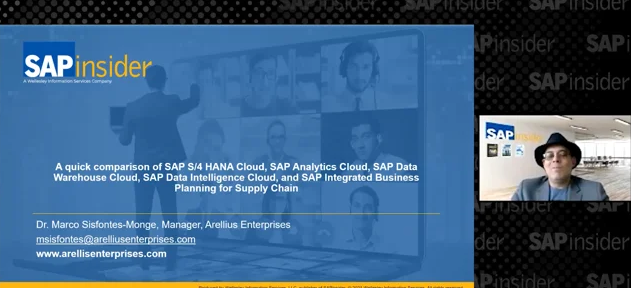
A quick comparison of SAP S/4HANA Cloud, SAP Analytics Cloud, and SAP Data IntelligenceMay 12, 2021  —  The goal of the presentation is to explore the latest updates related to SAP cloud technologies (SAP Analytics Cloud, SAP Data Intelligence, and SAP S/4HANA Cloud), and as a useful guide to companies to choose when each of these technologies is applicable to them depending on their key processes they want to involve in the cloud. It is oriented to towards decision makers and business managers interested to use SAP Cloud technologies, but I am not sure which one is appropriate for their process and their organization. The result of this presentation is to guide business users and technical managers to know exactly what capabilities can be found in each of these technologies, and how they align with other business processes. Key takeaways: -How to choose the right technology for you Key functionality differences -Explore the limitations of each of them Why SAP Cloud technologies are important to consider including them in your ecosystem -A quick review of a practical application of SAP Cloud technologies
1 minute read
The Role of Analytics in Business Process Intelligence
The Role of Analytics in Business Process Intelligence: A RISE with SAP PerspectiveMay 10, 2021  —  Increasingly, businesses are shifting their focus to accommodate the new digital reality. Technology is a key enabler in this aim, but businesses also need to consider what needs to change within their enterprises, including their processes and organizational design. Business transformation has become the front-and-center strategic priority that helps organizations adapt to the digital world and ultimately deliver value to customers. The business process intelligence (BPI) component of RISE with SAP enables businesses to become intelligent enterprises by providing best-in-class processes, process management, and process intelligence capabilities. When linked with analytics capabilities, BPI serves as a foundational component for driving business transformation because it extensively leverages all three key ingredients involved in the journey: people, process, and technology. In this article, Kumar Singh, Research Director, Data & Analytics, Supply Chain Management, SAPinsider, explains how analytics-powered BPI establishes process foundations that drive and undergird the success of a business transformation journey. Read this article and learn: • The role of analytics in supporting four critical BPI sub-components: Monitor and Analyze, Design, Simulate and Improve, Model and Manage, and Benchmarking. • The value of an effective and robust data collection and data management infrastructure to eliminate data latency, quality, and integrity. • About the importance of good data to drive process improvements, process re-design, and process optimization in business transformation initiatives. • How strategic and thoughtful KPIs help improve processes continuously while serving as a benchmark against the best in your class. • Why investing in people – an analytics talent pool dedicated to BPI and BPM – is essential to enhance analytics capabilities and drive business transformation success.
6 minute read
SAP AI Strategy featured image
Enterprise Artificial Intelligence – Embedded AIMay 4, 2021  —  If your company has not begun building an artificial intelligence (AI) strategy, it may risk falling behind competitors. That could mean lagging in areas of innovation that AI can enable, including improved or new products, reduced risks, and a better bottom line. There is good news for SAP customers: SAP has already begun embedding AI into its offerings, intending to make them ready to use. Additionally, SAP provides development platforms with AI capabilities that will enable customers and partners to enhance SAP systems with AI innovations. How can SAP customers incorporate SAP’s AI work into their own strategy? In an exclusive piece for SAPinsider, Dr. Feiyu Xu, Senior Vice President, Global Head of Artificial Intelligence at SAP teams up with Maximilian Herrmann, Project Consultant and Storyteller at SAP, to detail SAP’s plan for AI both within and complementary to its products, as well as what the vendor and its customers have already achieved in the AI space. Read this column and discover: - The growing market and demand for AI across many industries and the common roadblocks to adoption that companies are facing; - How SAP embeds AI into processes and applications, and how it develops ready-to-use AI functionalities with its internal “AI Factory” approach; - The AI-powered products and services that SAP currently offers and how customers can use them; and - An embedded AI use case for increasing efficiency around supplier invoice processing already in use by more than 100 small business and medium enterprise (SME) SAP customers.
9 minute read
Build an Agile Data Platform with SAP Data Warehouse Cloud
The journey from Strategy to an Analytics Algorithm : A Marketing Analytics exampleFeb 6, 2021  —  Every Analytics algorithm that you use in your teams should tie to your Corporate strategy goals. However, very few resources currently clearly highlight how. Closing this link, in my mind, is one of the ingredients to the secret sauce to developing analytical products that will work, in a sustainable way (not a blip that goes […]
1 minute read
Maximize Your Investment in SAP and Azure Synapse to Create a Cost-Effective Data Analytics StrategyFeb 1, 2021  —  Businesses across the globe are struggling as they attempt to wrangle multiple data sources into a cohesive data analytics strategy. Bringing together SAP and non-SAP data is complex and requires significant technical resources. In this session, learn from experts about how you can leverage IBM to help you bring this data together in a data fabric that maximizes your investment in SAP combined with Azure Synapse creating a cost-effective data analytics strategy and […]
1 minute read
Impact on Analytics and VisibilityJan 15, 2021  —  SAP S/4HANA, for many organizations, is the single sources of truth for finance and business functions. As organizations conduct their SAP S/4HANA transition projects, they are consolidating data from multiple systems across the enterprise. This has an impact on the business capabilities of making critical decisions, conducting analysis, and understanding the direction of the business as well as building tools that can help make better decisions. This track will focus on how you can utilize your SAP HANA database, discuss the analytics capabilities of SAP S/4HANA, and how customers can move forward with analytics both inside and outside SAP S/4HANA.
3 minute read
Advanced Analytics in SAP and Hybrid EnvironmentsJan 15, 2021  —  As Business Intelligence and reporting capabilities mature and get commoditized, organizations are increasingly looking to leverage more advanced analytics approaches. Both SAP as well as third party vendors offer a plethora of advanced analytics capabilities that leverage AI and Machine Learning algorithms. These sessions will help you understand how to leverage advanced analytics tools and technologies in a cloud environment. You will also explore how to use advanced analytics going beyond what you using do in these three areas: descriptive, prescriptive and predictive analytics – as well as using machine learning and AI in your analytics strategy.
2 minute read
SAP S/4HANA and Embedded AnalyticsJan 15, 2021  —  Embedded Analytics is increasingly becoming a significant feature in applications and is a core value proposition in SAP HANA offering. Available offerings in this space extend beyond the SAP ecosystem into third party vendors as well. As users start interfacing more and more with applications with embedded analytics capabilities, they need to have a good grasp of aspects that can help them exploit this feature optimally. This track will explore embedded analytics, various ways in which SAP HANA makes embedded analytics accessible, and how to get the most out of embedded analytics applications.
3 minute read
Pairing Analytics and AutomationNov 11, 2020  —  By Pierce Owen, VP of Research, SAPinsider Translating Data into Insights As part of their “digital transformation,” 75% of respondents in a recent SAPinsider survey say their organizations use or plan to use self-service analytics for operational performance. Self-service analytics help democratize analytics, allowing the average business user to visualize raw data, identify outliers or […]
3 minute read
Breakthru Beverage Group Reaches New Horizon on Journey to Become a Fully Integrated, Data-Driven BusinessNov 3, 2020  —  Modern consumers expect their unique needs to be met at the push of a button, and this expectation includes the food and beverage industry, as evidenced by the rapid increase in grocery pickup and delivery services, for example. Breakthru Beverage Group — which offers restaurants and retailers a portfolio of established and emerging beer, wine, and spirits, along with guidance on marketing the right products — recognized the need to embrace innovation to deliver the information its customers depend on to grow and improve their business performance and relevance. To meet this need, Breakthru set out to implement an enterprise data warehouse strategy and platform that would quickly deliver meaningful and individualized insights for its customers. In this article, you will learn how the organization: • Created a centralized source of governed truth by consolidating and simplifying its technology platform using SAP ERP, and by cleansing and conforming its data • Successfully moved to SAP HANA-based business intelligence for reporting and analytics using a program that helped users get acclimated to the new technology • Achieved a range of benefits from its improved and integrative reporting capabilities, such as consistent data, operational efficiency, and actionable insights
15 minute read