1 minute read
Meet the Experts
Meet the Authors
Key Takeaways
What you need to know
At SAP Sapphire 2026, SAP deployed more than 200 AI agents across its portfolio, with Joule positioned as the central orchestration layer, enabling cross-functional workflows that span finance, supply chain, HR, and industry-specific operations within the SAP Autonomous Enterprise framework.
SAP's industry AI strategy is moving beyond generic automation toward repeatable, domain-specific scenarios, reflecting a deliberate effort to demonstrate tangible ROI within vertical markets before scaling broadly.
Cloud migration remains the gateway to SAP's Autonomous Enterprise, with RISE with SAP now incorporating AI migration agents and tooling designed to reduce time, cost, and complexity for customers still operating SAP ECC or complex on-premises landscapes.
At SAP Sapphire Orlando 2026, SAP is framing its next phase around the “Autonomous Enterprise,” with AI agents, Joule, industry-specific workflows, and cloud migration tooling positioned as the connective tissue across its portfolio.
During the pre-event analyst summit, SAP’s Ada Agrait, Global CMO, and Eric van Rossum, CPO Industries, Globalization & CMO SAP Business Suite, described the company’s AI strategy as a response to a broader technology inflection point, arguing the next era of enterprise software will be defined by AI-driven decisions embedded directly inside business processes. The message is a shift from AI as assistant or productivity layer to AI as process participant. As they put it, decisions will increasingly be “made within the processes” and shaped, or eventually taken, by AI itself.
The strategy rests on three assets repeatedly highlighted in the briefing:
Explore related questions
Ask SAPi
- deep process and industry knowledge
- semantically rich enterprise data
- governance for mission-critical operations.
These themes are expected to run through Sapphire’s keynotes, show floor experiences, and customer demonstrations.
Joule Becomes the Front Door to SAP
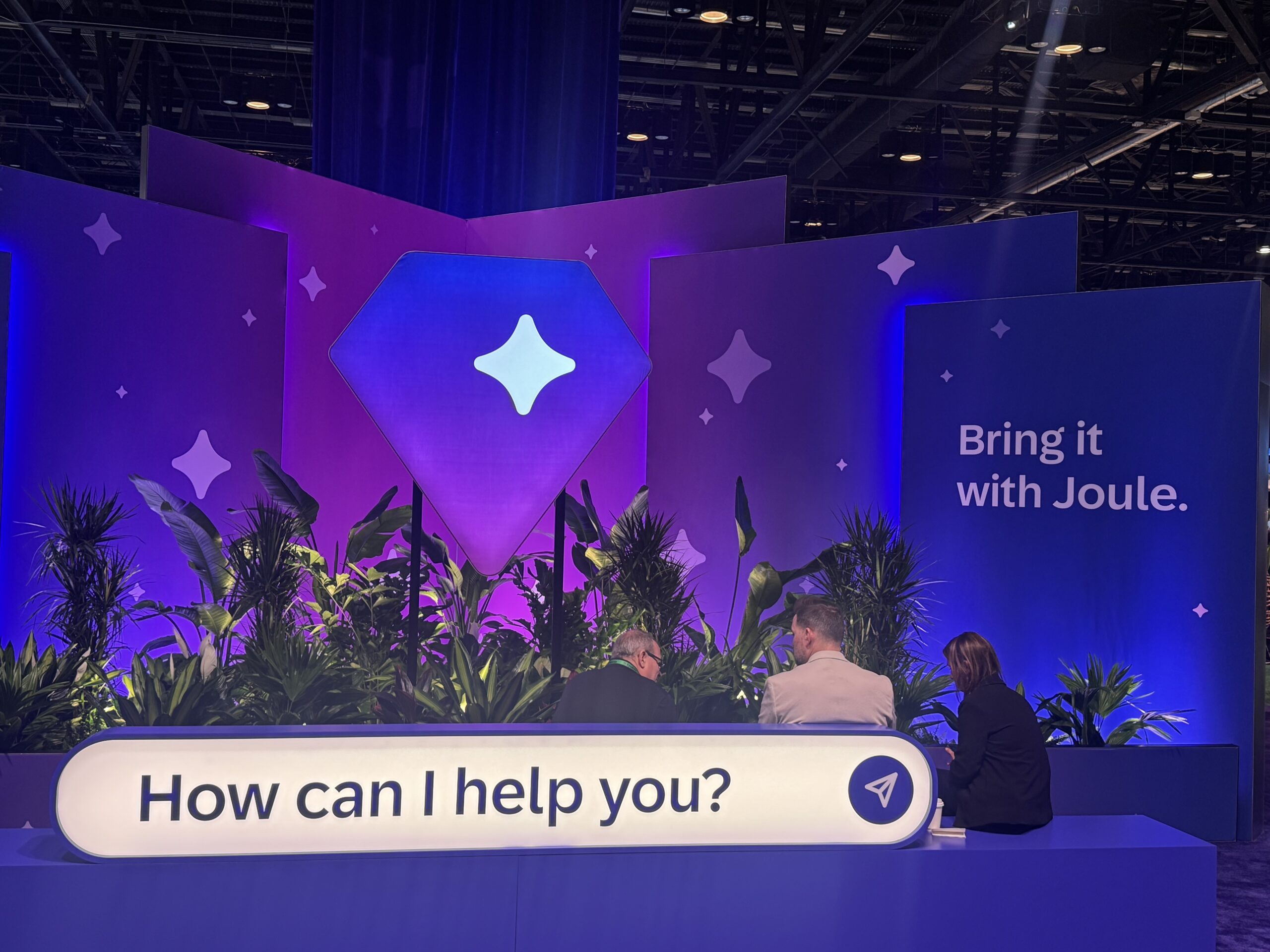
SAP is putting Joule at the center of the Sapphire experience, both as a product interface and as a signal of where the company wants enterprise software interaction to move. The event includes an agent lab, an autonomous suite area, a Business AI platform area, and services and support experiences built around the broader autonomous enterprise message.
Joule is becoming the “gateway to SAP,” with the autonomous suite underneath and the Business AI platform serving as the foundation for data, models, agent development, and agent orchestration. The speakers described Joule Work as a new engagement layer, with conversation spaces and a redesigned interface intended to let users interact with SAP systems through assistants and agents rather than conventional application navigation.
If Joule becomes the entry point into SAP processes, then the quality of the underlying process model, data context, permissions, and agent orchestration will determine whether AI improves execution or adds another layer of abstraction.
More Than 200 Agents, But Orchestration Is the Real Story
SAP plans to launch more than 200 agents across finance, procurement, supply chain, HCM, and customer experience. The number is attention-grabbing, but SAP’s more important claim is about orchestration.
The two executives emphasized the value of agents will not come from optimizing isolated tasks, but from coordinating workflows across lines of business and industry value chains. SAP is not simply adding AI functions to individual applications. It is trying to build agentic capabilities on top of the process maps and domain models that have long defined SAP’s application suite. The process structure still matters because it gives agents business context, not just technical access.
This is where SAP is attempting to differentiate from generic AI vendors. The argument is enterprise AI needs process knowledge, industry context, trusted data, and governance to operate safely in mission-critical workflows. The speakers pointed to the company’s 50-year history of process and industry knowledge, its access to consequential enterprise data, and its governance capabilities as reasons to believe it can compete in a more crowded AI market.
Industry AI Moves Toward Repeatable Scenarios
The speakers said seven industry scenarios will be discussed at this year’s event, developed through close customer engagement and designed around high-value agentic workflows. One example discussed in the briefing centered on revenue growth management in consumer products, connecting trade promotion, supply chain planning, and finance into a broader agentic scenario.
SAP also acknowledged these offerings are still evolving. In response to a question about whether the scenarios were product announcements, they said SAP is working with one or two customers on each scenario, with some running in productive or pre-productive states. The company expects a portion of each scenario to be repeatable at the platform level, with services filling the last-mile implementation gap.
Industry AI may be where the strongest business value sits, but it will likely require a blend of packaged capability, customer-specific process work, and services support before it becomes broadly repeatable.
Cloud Migration Gets AI-Led Transformation Layer
The speakers also tied the autonomous enterprise message to cloud migration, especially for customers still operating complex SAP ECC or on-premises landscapes. They described an AI-led transformation push inside RISE with SAP, including migration agents and tools intended to reduce time, cost, and effort in moving to the cloud.
The migration toolchain was positioned alongside existing assets such as Signavio and LeanIX, suggesting a broader model where process optimization, architecture visibility, and migration automation begin to converge. In the Q&A portion, SAP executives also discussed future potential around project health monitoring, real-time views into agent usage, AI unit consumption, and ROI calculations, although some of that remains directional.
SAP’s AI story still depends heavily on cloud adoption. Many customers remain in complex legacy environments, and SAP’s ability to deliver autonomous enterprise capabilities at scale will depend on how quickly those customers can modernize without creating more disruption.
Pricing and Platform Simplification Remain Open Questions
The briefing also surfaced customer-facing questions around platform packaging and AI commercialization. The speakers said SAP is simplifying its platform story by bringing capabilities such as Joule Studio, agent development, agent lifecycle management, data offerings, and SAP models under the broader Business AI platform framing.
However, the commercial model remains an area to watch. In response to a question about whether the Business AI platform is a true platform or still a set of individual SKUs, they explained there are no immediate licensing changes for existing customers. The value described under the autonomous enterprise will be consumed through SAP’s existing AI unit construct, and SAP is evaluating future flexibility while protecting existing customer commitments.
They also indicated that value-based commercial models are at a very early stage for industry AI scenarios. They described that work as a “10 step journey” where SAP is at “step point five,” with the goal of aligning high-value industry scenarios more closely to outcomes and value.
For SAP customers, that means the product direction is clearer than the commercial evolution. AI agents, migration agents, and industry scenarios may be moving quickly, but customers will still need transparency around usage, cost, value measurement, and adoption governance.
What This Means for SAPinsiders
SAP’s AI strategy is moving into process execution, but AI commercialization is still evolving. SAP is positioning AI agents inside finance, procurement, supply chain, HCM, and CX workflows, with orchestration across end-to-end processes as the value driver. It is also keeping existing AI unit constructs in place for now, while exploring more flexible and value-based approaches in select industry scenarios. SAP customers should evaluate agent adoption by process impact and push for clear usage visibility, ROI metrics, and governance models before scaling AI consumption across the enterprise.
Industry context will determine whether AI is useful or generic. SAP is leaning heavily on industry AI because cross-line-of-business scenarios are where agentic workflows can deliver measurable value. That also means customers should expect last-mile process work, services involvement, and industry-specific configuration before these capabilities become broadly repeatable.
Cloud migration remains the gateway to SAP’s autonomous enterprise. SAP’s migration agents and AI-led transformation tooling show that the company knows legacy complexity remains a barrier to its AI roadmap. Customers still on SAP ECC or heavily customized landscapes should assess whether migration planning, process optimization, and architecture management are coordinated tightly enough to support future agentic workflows.
More Resources
See All Related Content
SAPinsider Expert Exchange – Season 1 Building the Agentic-First EnterpriseExplore how SAP is helping shape the agentic-first enterprise, where AI agents, business context, and governed development work together to speed innovation without sacrificing reliability. Across these three episodes, experts from SAP discuss how organizations are rethinking build vs. buy, using intent-based development to start from business problems, and turning Joule Studio into a practical […]

How Data Archiving Changes SAP S/4HANA Migration EconomicsSAP customers often price migration services without calculating the cost of the historical data they will carry into SAP S/4HANA. Reducing the data footprint before migration can lower SAP HANA memory requirements, improve cutover performance, and strengthen an organization’s position during RISE with SAP contract negotiations.
4 minute read

Q&A – Two Roads to SAP Cloud ERP: A Conversation with SEIDOR’s Christopher HeschSEIDOR brought a 16-year ECC shop and a greenfield automotive group to the same Sapphire stage. CTO Christopher Hesch explains why brownfield and greenfield are two roads to the same destination, and what SAP teams should take from each.
6 minute read