3 minute read
Key Takeaways
What you need to know
SAP Sapphire 2026 shows SAP is expanding from ERP software into an Autonomous Enterprise platform, with more than 50 Joule AI agents and 200+ AI workflows across finance, HR, procurement, and supply chain. This matters because SAP customers now have a broader AI roadmap for process automation, and it impacts CIOs, ERP leaders, and business teams planning SAP modernization.
Palantir was named a strategic SAP partner, and its Foundry, AIP, and Apollo stack is being positioned as a validated, SAP-endorsed enterprise operating system for complex, multi-system transformation. This matters because it enables cross-system operational intelligence, AI agents, and governed actions across SAP and non-SAP data, impacting large enterprises, regulated industries, and organizations with fragmented data landscapes.
The biggest near-term use cases are SAP ECC to S/4HANA migration acceleration, real-time operational control towers, and multi-ERP unification without forced data centralization. This matters because organizations can reduce migration effort, improve AI-driven decision-making, and support air-gapped or on-prem deployments, impacting Fortune 500 companies, post-merger IT teams, and enterprises with strict data sovereignty requirements.
The Signal from SAP Sapphire 2026
In May 2026, SAP’s Sapphire conference in Orlando delivered a clear message: SAP is no longer simply an ERP company. CEO Christian Klein launched the Autonomous Enterprise vision more than 50 domain-specific Joule agents orchestrating over 200 AI workflows across finance, HR, procurement, and supply chain.
But the most strategically significant announcement wasn’t about Joule. SAP named Palantir as a strategic partner, alongside Anthropic, NVIDIA, AWS, and Google Cloud. The two companies announced a joint engineering effort positioning Palantir’s AIP as a validated, SAP-endorsed capability for complex enterprise transformation scenarios. For technology leaders carrying the dual burden of maximizing SAP investments while keeping pace with AI, this convergence demands serious attention.
Explore related questions
Ask SAPi
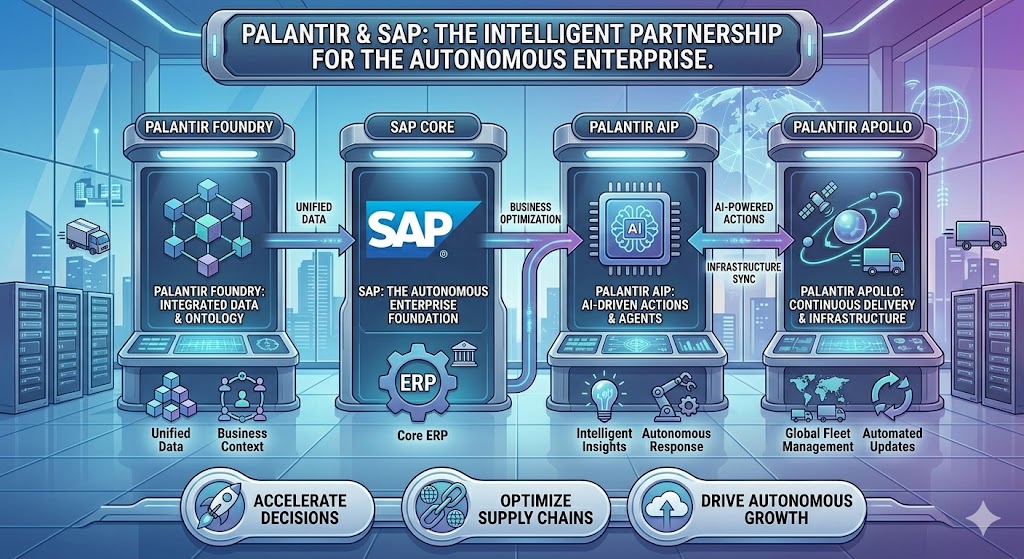
The Palantir Stack: Three Platforms, One Operating System
Palantir is not a reporting tool, an analytics layer, or a migration utility. It is an enterprise operating system connecting data, business logic, and real-world actions into a single operational fabric.
- Foundry is the data core. It ingests from SAP S/4HANA, ECC, CRM, IoT, and hundreds of other sources through 300+ connectors, then builds a living Ontology a dynamic digital twin of how the business operates. Not just a schema, but a model of every real-world entity (purchase orders, suppliers, assets, employees), the logic governing decisions around them, and the actions that can be triggered as a result. Within an SAP landscape, Foundry connects via an ABAP add-on installed directly on SAP ERP or BW. Three patterns are supported: direct connection to SAP ERP or BW, SLT-based real-time streaming, and a gateway path for older systems. ECC, S/4HANA on-premise, S/4HANA Cloud Private Edition, and Business Warehouse can all feed live transactional data into Foundry without rearchitecting the SAP core.
- AIP (Artificial Intelligence Platform) sits on top of Foundry and connects AI to operations, not just analysis. AIP Logic builds LLM-powered functions that reason through tasks checking invoices against contract terms, flagging anomalies, auto-approving within policy. AIP Agent Studio builds multi-step agents that investigate supply chain delays, query SAP inventory, read logistics feeds, and propose supplier alternatives in a single autonomous workflow. AIP Evals governs AI behavior with auditable, accountable outputs rather than black-box recommendations. Because AIP operates entirely within the Ontology, it understands business rules, data lineage, and permitted actions before generating any output or proposing any action.
- Apollo is the invisible engine Palantir’s continuous delivery platform that deploys and manages Foundry and AIP across any environment: multi-cloud, on-premise, private networks, and fully air-gapped systems. For enterprises with regulated SAP data that cannot move freely to public cloud, Apollo ensures Foundry and AIP run within existing security perimeters without compromising governance. It manages updates, monitors rollouts, and handles rollbacks across dozens of isolated environments without requiring a dedicated DevOps team on the client side.
Where Integration Creates Real Value
- ERP Migration Acceleration is the headline Sapphire 2026 use case. Rather than performing a direct ECC-to-S/4HANA table conversion, AIP extracts ECC data into Foundry, builds a semantic model, applies transformation logic through Foundry pipelines, and generates validated S/4-ready datasets for upload with no dual landscape requirement. Validation accuracy reaches 96% within hours and 99.8% within two weeks. SAP cited 35%+ reduction in migration effort using the joint toolchain. Palantir AIP for migration is now available as an SAP Endorsed App, with an SAP Solution Extension planned for Q3 2026.
- Cross-System Operational Intelligence is where Foundry earns its keep after go-live. A supply chain control tower on Foundry pulls real-time inventory from S/4HANA, correlates it with logistics feeds, demand forecasts, and supplier risk signals, and enables direct action triggering reorders, rerouting shipments all with write-back into SAP. For finance teams, AIP agents span account reconciliation, cash flow optimization, and compliance verification simultaneously on live SAP data, without extracting it from its governed environment.
- Multi-ERP Unification solves the post-merger problem. Instead of forcing a costly single-instance consolidation, organizations can connect multiple SAP systems ECC alongside S/4HANA, SAP alongside non-SAP ERPs into one Foundry Ontology. The Palantir Multimodal Data Plane processes data where it resides, without centralized movement that disrupts compliance or data sovereignty.
Palantir With SAP, Not Versus SAP
This is not a replacement decision. SAP is a system of record process execution, compliance enforcement, master data governance, transactional integrity. Palantir is a system of action operational intelligence across complex, multi-system environments where SAP’s native analytics cannot span the full context a decision requires.
| Decision Dimension |
SAP Native (Joule / Autonomous Suite) |
Palantir Foundry + AIP |
| Primary strength | Process execution within SAP ecosystem | Cross-system intelligence and AI action |
| Data model | SAP Knowledge Graph (SAP-centric) | Ontology (multi-system, any source) |
| Deployment model | Cloud-first, RISE with SAP prerequisite | Any environment: cloud, on-prem, air-gapped |
| AI access gate | Tied to RISE with SAP commercial commitment | Independent platform, separate commercial model |
| Best fit | Clean-core S/4HANA journeys | Multi-ERP, fragmented data, regulated industries |
| Maturity in SAP context | Decades of embedded process knowledge | Emerging first SAP-endorsed deployment in 2026 |
Choose SAP native first if your organization is committed to RISE with SAP and your AI ambition centers on automating processes within the SAP ecosystem. The 2026 Joule agent portfolio is shipping fast, with finance agents generally available now and HCM agents going GA in June 2026.
Add Palantir to the equation if your highest-value decisions span a complex multi-system landscape SAP alongside Salesforce, Oracle, legacy systems, or IoT where a unified operational picture across everything is the real requirement. If you are in a regulated industry where data sovereignty and air-gapped deployment are non-negotiable, Apollo’s flexibility is a differentiator SAP’s cloud-first architecture cannot currently match.
Five Things CIOs Should Act on Now
- Understand the commercial gate. SAP has tied Joule AI agent access to a RISE with SAP commitment. On-premises ECC customers not committed to a cloud journey are commercially excluded from SAP’s AI roadmap which makes Palantir’s cloud-agnostic platform considerably more relevant for that population.
- Treat Palantir as a complement, not a replacement. Its status as an SAP Endorsed App signals formal validation, not a mandate. Demand full transparency in proposals and hold both Palantir and your systems integrator jointly accountable for outcomes.
- Fix data quality before deploying AI. AIP cannot fix a flawed data model in SAP. Organizations with unresolved master data issues should address those before committing to AI-powered migration tooling.
- Acknowledge that the SI ecosystem is still maturing. Deloitte and Accenture have formalized Palantir alliances, and the joint Accenture–SAP–Palantir migration initiative brings serious delivery scale. But real-world delivery experience on large SAP transformations is still accumulating. First movers carry genuine execution risk.
- Right-size the decision. Palantir delivers maximum value at Fortune 500-scale complexity sprawling data landscapes, multi-geography decisions, compliance stakes measured in eight figures. For mid-market organizations with more focused AI ambitions, SAP’s native Joule capabilities will likely deliver more value with far less overhead.
The Bottom Line
SAP Sapphire 2026 formalized what the market had been signaling: Palantir and SAP are building toward an integrated future. SAP’s Autonomous Enterprise vision owns the process execution layer. Palantir’s Foundry, AIP, and Apollo stack owns the operational intelligence and AI action layer for environments where SAP alone cannot span the full decision context.
The most sophisticated enterprise buyers will not choose between these platforms they will design an architecture that uses both where each creates the most value. Getting that decision right, early, is now one of the most consequential items on the CIO’s agenda. The Autonomous Enterprise is not a single vendor’s product. It is an architecture. The organizations that design it deliberately will be the ones that actually achieve autonomous operations.
More Resources
See All Related Content
The Industry Context Behind Enterprise AIIndustry AI is defined by the sector knowledge it carries, from terminology and process rules to the systems where work takes place. Three kinds of industry context, meaning, rules, and place, offer a consistent way to evaluate what an Industry AI product actually includes.
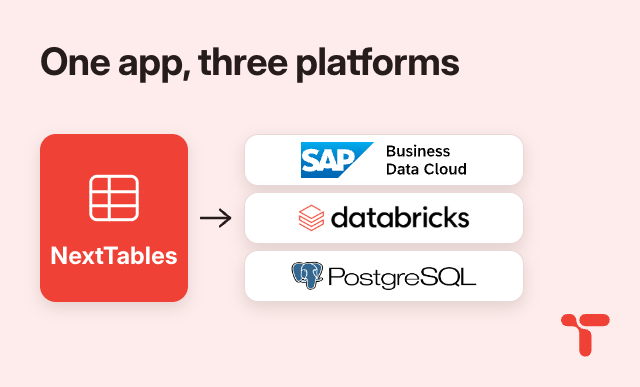
One data maintenance app, three enterprise data platformsBuild data maintenance apps, guided for business teams, trusted by IT. Business teams update their own data, with validation at entry, role-based authorization down to the row, and an audit log of every change stored inside your data platform.
1 minute read
SAP BW today or SAP Business Data Cloud tomorrow: the same gridOne runs inside your SAP Business Warehouse (BW) as an add-on, the other as a service on your enterprise data platform. The grid, validation at entry, import and embedding work the same way on both. Where it runs, who signs in, and how each platform keeps changes validated, authorized and auditable is what differs.
1 minute read