Jul 28, 2020
•7 minute read
SAP Analytics focuses on how organizations use enterprise data to generate insight, support better decisions, and automate parts of day-to-day decision-making across SAP environments. The topic spans business intelligence, machine learning, artificial intelligence, SAP HANA, the Predictive Analytics Library, SAP Data Intelligence, SAP Analytics Cloud, and SAP AI offerings embedded across business processes.
Analytics connects business users, data scientists, ML engineers, finance leaders, supply chain teams, and IT organizations around a shared goal: turning SAP data into operational insight, predictive capability, and business process intelligence.
SAP Analytics is the use of SAP data, analytics platforms, and embedded intelligence to understand business performance, identify patterns, predict outcomes, and guide decisions inside enterprise processes. It includes descriptive analytics through BI, advanced machine learning models that learn from changing data, and AI capabilities that support problem-solving and decision-making.
SAP Analytics focuses on how organizations use enterprise data to generate insight, support better decisions, and automate parts of day-to-day decision-making across SAP environments. The topic spans business intelligence, machine learning, artificial intelligence, SAP HANA, the Predictive Analytics Library, SAP Data Intelligence, SAP Analytics Cloud, and SAP AI offerings embedded across business processes.
Analytics connects business users, data scientists, ML engineers, finance leaders, supply chain teams, and IT organizations around a shared goal: turning SAP data into operational insight, predictive capability, and business process intelligence.
SAP Analytics is the use of SAP data, analytics platforms, and embedded intelligence to understand business performance, identify patterns, predict outcomes, and guide decisions inside enterprise processes. It includes descriptive analytics through BI, advanced machine learning models that learn from changing data, and AI capabilities that support problem-solving and decision-making.
The end-to-end process of BI involves analyzing the data generated by businesses, transforming the data into insights, and leveraging those insights to make optimal decisions. BI tools primarily leverage “descriptive analytics,” because these tools traditionally focus on analyzing current and historical performance based on data generated by the enterprise.
In practice, SAP Analytics helps organizations use tools such as SAP Analytics Cloud, SAP HANA, SAP Data Intelligence, and SAP AI capabilities to support reporting, planning, predictive analytics, automation, and business process improvement.
Teams use BI tools to analyze current and historical enterprise performance, transform business data into insights, and support decisions based on descriptive analytics.
Organizations use machine learning algorithms and SAP HANA’s Predictive Analytics Library to build models that learn from input data and support predictive use cases.
SAP Analytics Cloud supports business users with intuitive, AI-guided analytics capabilities, helping functional managers work with analytics without needing to be data scientists or technical managers.
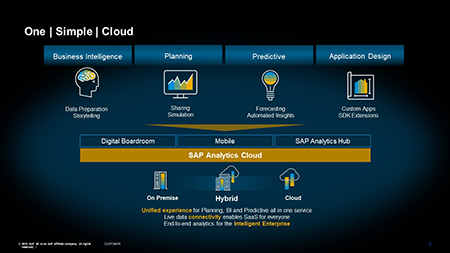
SAP Analytics Cloud combines planning, predictive analytics, reporting, and BI, allowing organizations to use it as a collaborative enterprise planning tool.
SAP AI offerings are positioned to infuse intelligence into lead to cash, design to operate, source to pay, and recruit to retire processes.
SAP applications support data scientists and ML engineers building advanced ML models and solutions, while also helping end users perform advanced analytics with minimal technical proficiency.
SAPinsider research shows that analytics maturity increasingly depends on cloud-based platforms, self-service access, and cross-functional data models. SAP Analytics Cloud reflects this shift by combining planning, predictive analytics, reporting, BI, and AI-guided analytics for business users.
The SAP Business Data Cloud benchmark shows that data foundations remain a major constraint. Only 3% of organizations have a unified governed data layer, while 38% remain siloed, limiting progress toward real-time analytics and AI-driven decision-making. Still, investment momentum is building. SAPinsider found analytics modernization was a top SAP BDC driver at 28%, followed by AI and agent-based use cases at 26%.
SAPinsider’s AI maturity research reinforces the importance of trusted analytics foundations. While 91% of respondents report some AI use, 79% cite access to high-quality, trusted data as a requirement for successful AI strategies.





Audio pioneer Dolby Laboratories, which has been delivering audiophiles a superior sound and sight experience since the 1970s, decided in 2016 that it wanted an equally stringent level of quality assurance for its business process testing. The business sought a risk-based automated testing solution to reduce or eliminate regression test coverage gaps and lengthy testing integration cycles. Discover how Dolby Labs implemented a solution by SAP partner Tricentis that provided risk-based prioritization and documentation of regression testing and end-to-end coverage for automating workstreams. Learn how the company automated regression testing for approximately 40% of mission-critical applications and saved roughly 75% savings in hours on regression testing.
Gone are the days when retailers could forecast inventory based on previous actuals and manufacturers could absorb unplanned production downtime by artificially inflating stock levels. In today's digital age, the abillity of companies to provide exemplary customer service in a digital environment is now tied to the performance and availability of their ERP systems. SAP customers are increasingly moving away from managing these systems in their own data centers and relying on cloud environments to run their mission critical applications and deliver high availability.
Learn why managed cloud provider CorpFlex opted for the Cisco HyperFlex hyperconverged infrastructure to run its customers’ SAP solutions and how this provider is offering improved technology and service options to these customers that minimize their system latency and reduce their storage footprint. See how CorpFlex can now deliver an approximate 40% performance improvement to its customers’ workloads, along with a capability to add a new node and create a new SAP environment for a customer in as little as two hours.
With millions of patients, pharmacies, and hospitals relying on its healthcare services and products, Cardinal Health employs an IT landscape consisting of thousands of SAP and non-SAP applications running countless business processes to conduct its business. To uphold stringent quality standards, improve operations, and provide necessary maintenance and business process testing, the company sought a test automation solution that could reduce costs, improve reliability, and promote continuous integration and development. Learn how it implemented Worksoft automation solutions to achieve these outcomes — as well as receive unexpected benefits from robotic process automation (RPA).
Preventing access risk and ensuring regulatory compliance are top priorities for any business, and cable and wire manufacturer Southwire Company, LLC, understands how analytics are required to successfully achieve these goals. Concerned that access-related risks were unacceptably high, Southwire embarked on a multi-phased project that aimed to remove, reduce, and mitigate these risks and to design more efficient user roles. Learn how Southwire Company, LLC, leveraged Security Weaver solutions to identify risks, remove or reduce segregation-of-duties (SoD) conflicts, optimize user role design, and improve overall business processes.
Offering personalized services can improve the customer experience for nearly any type of business. Companies leading in this digital age are establishing a competitive advantage by deploying technology that leverages data generated by customer behavior to improve their customers’ experience across different channels. Learn how lighting manufacturer Acuity Brands — which provides lighting, lighting controls, and building management solutions globally — has evolved its business to now offer connected building technology solutions that enable its customers to transform their buildings from cost centers to strategic assets. Learn how Acuity partnered with SAP to create a solution for joint customers that improve in-store operations for the store managers and associates, in-store engagement with customers, as well as conversions — and how this proof of concept is intended to extend well beyond the retail space to other industries.
Deforestation is devastating to Earth’s rainforests, and to the planet as a whole — it creates more of an impact on climate change than the emissions of planes, trains, cars, trucks, and ships combined, according to a study. With 90% of rainforest logging being done illegally, a massive opportunity opened up for Rainforest Connection, a non-profit organization focused on using technology to combat deforestation. Rainforest Connection teamed up with SAP to analyze data collected by recycled cell phones that monitored the sounds of the rainforest not only to identify illegal logging as it was happening, but even predict where a tree could be cut illegally ahead of time, allowing rangers to stop the activity and prevent future deforestation.
For the past 120 years, The Goodyear Tire & Rubber Company has been at the forefront of a continuously changing mobility industry. It has achieved this by leading with innovation in its products and services for customers, as well as in its internal systems and processes. Following this commitment, the company recently updated its system landscapes by expanding its SAP footprint. SAP system monitoring and change management processes have become progressively important to Goodyear – resulting in an increasing trend in working with SAP Solution Manager. With a goal of implementing better, easier, and faster software tools and processes – and answering SAP system users’ call for improved system performance and usability – the business decided to upgrade to SAP Solution Manager 7.2. Learn how the upgrade provided Goodyear benefits such as improved efficiency and resource allocation, enhanced visual representation, and a less restrictive content documentation structure.
Sanofi, a major multinational pharmaceutical company, has plans for expansion. To facilitate that growth, Sanofi decided it needed to automate its financial close, account reconciliation, and journal entry processes as many of them were manual and disparate across its business units. Discover how even partway through a global implementation of a record-to-report solution to transform its financial processes, Sanofi has already seen greater efficiency and time savings, allowing the staff to concentrate on value-added activities for its life-saving health care operations and medical research and development.
The disruptive nature of technology innovation is not limited to business: The public sector must also consider the impact of digital transformation. The State of Illinois recognized a need for improved technology and functionality across its growing responsibilities, and in 2016 began a digital transformation that aimed to replace 420 systems across 58 agencies in 30 months. The state selected SAP HANA Enterprise Cloud to deploy SAP ERP and SAP HANA technology across its organization. Learn how it leveraged SAP solutions to achieve better decision making on improved data analysis as well as better spend tracking and hiring processes — and how the gains are causing other agencies across the state to ask how they can benefit.
During the digitization of the medical world, the mental health field was virtually passed over. To fill this gap, HarrisLogic develops technology platforms for the behavioral healthcare field to help its users identify the workflow of mentally ill individuals moving through the system and ensure no one gets lost in the cracks. Through a combination of various engines that apply clinical evidence-based practices, fuse data streams together from various locations, and apply advanced and predictive analytics — paired with SAP technology — HarrisLogic was able to drastically improve the delivery of much needed mental health services, drive more connections to healthcare, and create a reliable model to gauge the risk in a variety of settings.
Three billion people across 230 countries currently consume lifestyle entertainment from Discovery, Inc. — a company that creates more than 8,000 hours of original programming in 50 languages each year and distributes television and digital content globally. After experiencing fast domestic and international growth, and with day-to-day accounting functions spread across offices in more than 20 countries, the company knew it could benefit from global standardization of controls and governance of its SAP landscape. In an effort to standardize and automate its financial close and journal entry process, Discovery, Inc. integrated its SAP ERP system with BlackLine solutions — Account Reconciliations, Journal Entry, and Task Management. Learn how the business now benefits from stronger financial controls, more efficient audit processes, and an improved journal entry workflow.
Due to its aggressive acquisition strategy, professional services company VINCI Energies – which has already grown to 77,500 employees spread throughout more than 1,000 global companies – needed an updated ERP program and IT strategy to integrate its new companies into the fold as quickly and easily as possible. To accomplish this, the business decided to consolidate on a single-instance environment with over 30,000 users running on SAP S/4HANA. Learn how VINCI Energies underwent a 10-month project that culminated in a migration over the weekend that imparted some valuable lessons. With 14 countries live so far and plans to deploy it universally, uncover the benefits the business is already reaping from the capabilities that SAP S/4HANA has introduced and innovating with SAP Cloud Platform, SAP C/4HANA, and more intelligent reporting and analytics.
On the heels of its migration to SAP S/4HANA, professional services company VINCI Energies wanted to extend the new functionality with a new application for employee timesheet entry that would replace former manual, paper-based processes. Learn how the business designed and developed the online app using SAP Cloud Platform, and how this application is creating more advanced capabilities for workers and managers who need to keep track of hours and other associated costs applied to individual projects from the field.
When Versum Materials was divested in 2016, it took the opportunity not only to make a fresh IT start with a greenfield SAP S/4HANA implementation, but also to do it with a big-bang approach. The newly independent business accomplished the massive change in 15 months with a painless go-live. Along the way, it discovered some major differences between its original SAP ERP system and SAP S/4HANA, including security and data models, and passes along several lessons learned.
Processing $2 billion through its billing system and $120 billion of global travel spend annually, travel technology company Sabre needed a sophisticated and failure-proof software system. The business turned to SAP HANA Enterprise Edition to handle its complex requirements. The Sabre team worked with SAP to implement this solution, and as a result, has since reduced invoice processing and review time from days to hours and runtime for reports to minutes, paving the way for more advanced analytics and decision making by the business.
McAfee was amidst sweeping change – shifting its accounting standards and financial reporting in SAP ERP, separating its IT systems from its parent company in a spinoff, and moving from a waterfall method to an agile methodology. In response, the business wanted to increase the velocity of its application delivery and testing. Learn how the organization turned to Worksoft Certify to automate its SAP testing and business processes, the many benefits that resulted, and how it used the solution in ways it didn’t originally anticipate.
After 140 years in business, global technology giant Ericsson knows a thing or two about staying at the forefront of a changing industry. Learn how the company has modernized its IT delivery approach, and increased customer satisfaction, by adopting a continuous delivery model for its digital business support systems portfolio, and how it used the ActiveControl solution by Basis Technologies to integrate SAP applications into this new model.
When Cooper Standard — systems and components provider for the automotive and industrial industries — saw the need to automate access management, the company undertook a project would affect over 11,000 desktop users, require defining common processes to meet compliance requirements, and improve control over its heterogenous SAP and non-SAP application landscape. Learn how the company came to the decision to select and implement a suite of access management applications by Security Weaver designed to tackle critical and complex challenges.


This fifth article in the Intelligent Enterprise series emphasizes the importance of the application of smart analytic technology to the vast amounts of data accumulated daily. Recognizing data as a key asset and deriving insights from it are the key to workplace transformation.

Deforestation is devastating to Earth’s rainforests, and to the planet as a whole — it creates more of an impact on climate change than the emissions of planes, trains, cars, trucks, and ships combined, according to a study. With 90% of rainforest logging being done illegally, a massive opportunity opened up for Rainforest Connection, a non-profit organization focused on using technology to combat deforestation. Rainforest Connection teamed up with SAP to analyze data collected by recycled cell phones that monitored the sounds of the rainforest not only to identify illegal logging as it was happening, but even predict where a tree could be cut illegally ahead of time, allowing rangers to stop the activity and prevent future deforestation.




Your request has been successfully sent