3 minute read
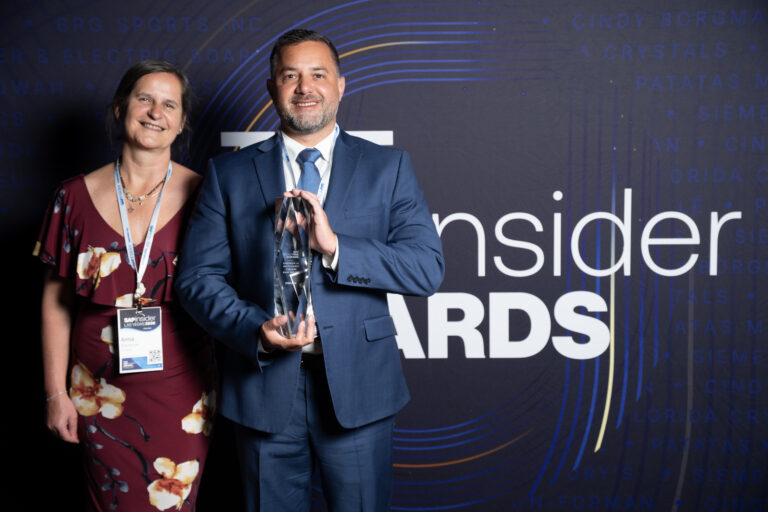
Meet the Authors
Key Takeaways
-
Fit Foods automated accounts payable using AI, OCR, and centralized workflows to improve speed and accuracy.
-
The company reduced manual processing by 70% and achieved an 85% invoice auto-match rate.
-
The transformation enabled finance operations to scale without adding headcount or increasing costs.
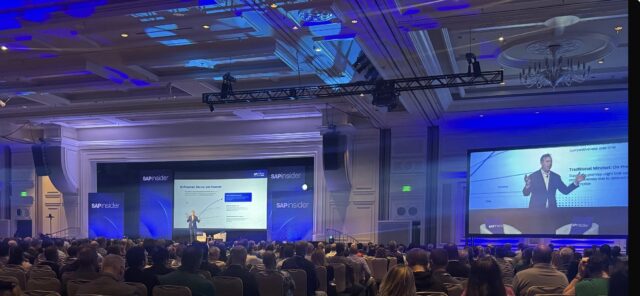
Sports nutrition and health supplements maker Fit Foods won the AI-Powered Innovation Project of the Year at SAPinsider Las Vegas 2026 for its Autonomous Invoice Processing initiative, which transformed accounts payable using AI and automation. In this Q&A, Marcus Noronha, Chief Digital Officer (CDO) at Fit Foods, explains the drivers behind the project, how the solution works, and what it means for scaling finance operations without adding headcount.
Q: To start, congratulations on the win. How are you and your team feeling right now?
Marcus Noronha: We’re proud, but more importantly, we’re validated. This wasn’t a technology project; it was a business decision to remove a scaling constraint across finance, Supply Chain, and the approval process. Seeing that recognized on SAPinsider, especially with this level of competition, reinforces that we’re on the right path.
Q: For those unfamiliar, what did you set out to achieve with this initiative?
MN: We set out to solve a scalability problem. As we grew, finance operations, especially accounts payable, were becoming a bottleneck. Our objective wasn’t just system consolidation; it was to create a standardized, automated finance backbone that could scale with the business without increasing cost or complexity.
Explore related questions
Q: What wasn’t working before this transformation?
MN: We were hitting the classic growth ceiling—volume was increasing, but our processes were still manual and fragmented. Each purchase order and invoice required human intervention, approvals were decentralized, and visibility was limited. At that point, the only apparent solution was adding headcount, but that’s a short-term fix with long-term cost implications. We have processed around 1,000 invoices, with a 15% CAGR over the past three years.
Q: What was the turning point that made you realize change was necessary?
MN: The turning point was when we realized growth was outpacing process maturity. We had two choices: scale people or scale the process. We chose to redesign the process using AI and automation, so the business could grow without proportionally increasing operating costs.
Q: How does the solution work today?
MN: Today, invoices are automatically captured via email using OCR and AI, validated against purchase orders, routed through a centralized approval workflow in iDocument, and once approved, flow to our SAP ERP. We’ve eliminated fragmentation; everything happens in one system, with full visibility and control. The key is not just automation, but orchestration across the entire AP lifecycle.
Q: Where has AI made the biggest difference in day-to-day operations?
MN: AI fundamentally changed the speed and accuracy of execution. We’ve reduced manual processing by roughly 70% and achieved an 85% PO auto-match rate. What used to take hours or even days is now happening almost in real time, with significantly fewer errors.
Q: What impact has this had on your team?
MN: The biggest shift is in how the team creates value. Instead of spending time on data entry and exception handling, they’re focused on analysis, vendor management, and financial control. We didn’t just improve efficiency; we elevated the role of finance.
Q: Fit Foods has scaled without adding headcount—how has this transformation enabled that?
MN: We’ve been able to absorb significant volume growth without increasing headcount. In practical terms, that means we’ve decoupled business growth from operational cost growth, which is a critical capability for any scaling organization.
Q: What’s next for Fit Foods in terms of AI and automation?
MN: AP was just the entry point. What we’re really building is a scalable operating model powered by AI and automation.
We’ve already expanded into procurement and sales order processing, and we’re now extending into accounts receivable and expense management. At the same time, we’re enabling teams with tools like Microsoft Copilot 365 to drive productivity across the organization.
The goal is simple: scale the business without scaling cost or complexity.
We’re executing this through a phased rollout over the next 6 to 12 months, starting with AR. Based on our AP results, we expect similar gains in efficiency, cycle time, and control.
Q: What advice would you give other SAP customers looking to adopt AI in finance?
MN: Start with a real business problem, not with technology. In our case, it was scalability and cost control. Once that’s clear, align IT and Finance tightly, and focus on measurable outcomes from day one. AI is powerful, but without governance and clear ROI, it becomes noise.
More Resources
See All Related Content
SAPinsider Las Vegas Opening Keynote: David Robinson Says SAP Customers Must Rethink IT Operating Models, Not Just Modernize ERPDavid Robinson, President of SAP North America, highlighted at SAPinsider Las Vegas that business transformation is no longer a linear process, as enterprises face an exponential convergence of AI, cloud, and automation.
4 minute read