9 minute read
Meet the Authors
Key Takeaways
What you need to know
SAP customers face a transformational shift from traditional upgrade cycles to an environment where AI, connectivity, automation, cloud, and data converge, requiring a complete rethinking of IT operating models.
The widening gap between IT and business leaders poses a significant challenge, emphasizing the need for organizations to refactor their IT operating models and close this gap to enable faster innovation and adaptability.
Excessive technical customization has become a strategic barrier for SAP customers, limiting their ability to leverage AI and new technologies; organizations must prioritize a clean, standardized core to drive ongoing innovation rather than just project completion.
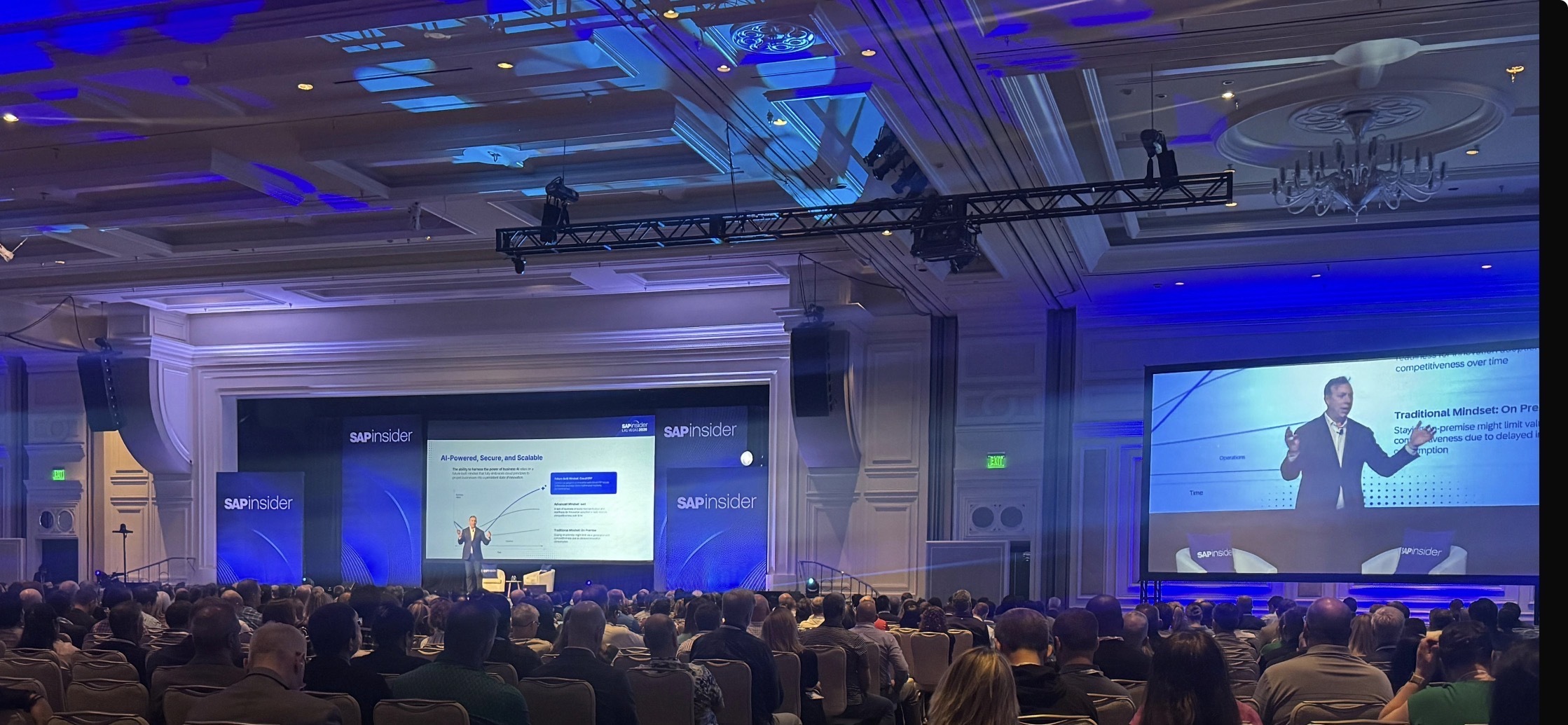
David Robinson, President of SAP North America and SAP Americas, opened SAPinsider Las Vegas with a blunt assessment of the pace of enterprise change: “The change is not linear. It truly is exponential,” he said.
The central message is that SAP customers are no longer navigating a familiar upgrade cycle driven by a new database, a new application stack, or a shift to cloud infrastructure alone. They are operating in a moment where “AI, connectivity, automation, cloud, and data” are all arriving at once, forcing IT organizations to rethink not just platforms, but how they work.
Robinson framed this as a break from previous SAP transitions. He traced the path from R/2 to R/3, then to ECC, HANA, and S/4HANA, arguing that each earlier shift centered on a major technology innovation that drove a predictable wave of adoption. This time, he said, is different. The challenge is not simply moving to the next SAP release, but redesigning the operating model around a faster, more complex, and more interconnected technology environment.
Explore related questions
Ask SAPi
From Migration to Operating Model Change
Robinson noted that too many SAP conversations still start in the wrong place. Instead of focusing first on how to move customers to cloud ERP, he said SAP and its customers need to focus on the deeper problem: the widening gap between IT and the business.
He described, for instance, organizations where business leaders see IT as slow and expensive, while IT teams see business demands as constant, underfunded, and detached from operational reality. That tension, he suggested, is the real transformation problem.
When Robinson described customer success, he did not define it primarily as reaching SAP S/4HANA Cloud. The more meaningful success stories are the ones where customers have “refactored their IT operating model,” changed how they allocate IT talent, and closed the “proximity gap between IT and the business.” In his view, the goal is to move from a reactive model to one that predicts business needs and enables faster innovation.
Why Technical Debt Is a Strategic Barrier
A theme of the keynote was the cost of customization. Robinson said many customers spent years differentiating through “custom Z programs, user exits, all those things that were elegant at the time.” Now, he argued, those same decisions are often preventing organizations from moving fast enough to consume new innovation.
His point was not simply that custom code is expensive. It is that excessive customization has made many environments harder to upgrade, harder to govern, and harder to modernize. He cited customers with tens of millions of lines of custom code and argued that large portions of those customizations are no longer even relevant. In that context, technical debt stops being a maintenance problem and becomes a strategic one.
That led to one of the clearest ideas in Robinson’s presentation: standardization and differentiation must be separated more deliberately. Core, mission-critical functions should become highly standardized and service-based. Innovation should happen outside that core, through extension architectures that let customers move faster without rebuilding the same upgrade problem they are trying to escape.
Architecture, Not Just Cloud, Is the Real Issue
Robinson made a clear distinction between running SAP in the cloud and consuming SAP as a cloud service. He said many customers have already moved workloads to hyperscalers, outsourced infrastructure management, and modernized technical operations. But he argued this alone does not unlock the real value of cloud.
The real shift happens when customers redesign the architecture around a clean, standardized core and a flexible extension model. He described that as the only sustainable way to incorporate AI, partner innovation, and new business capabilities without compounding technical debt. “It’s not what you employ, it’s how you deploy,” he said.
That architectural model is also central to his view of AI. Robinson did not present AI only as a future business feature. AI is already changing how customers can migrate, configure, test, and innovate, making transition work less costly, less risky, and less dependent on traditional labor-intensive approaches. That is why he repeatedly tied AI not just to productivity, but to economics.
A Different Economic Model for SAP Innovation
Robinson returned several times to the relationship between “total cost of ownership” and what he called “total cost of innovation.”
In his framing, enterprises have spent too much of their SAP budget sustaining non-differentiating work such as transport management, basis operations, infrastructure planning, and other commoditized tasks. The future model shifts investment away from maintaining those functions and toward delivering new capabilities faster.
“The economics will drive the transformation,” he ultimately concluded. That means go-live can no longer be treated as the endpoint. Robinson said the older mindset of finishing an implementation and then avoiding change is no longer viable. Instead, he argued that go-live should become the starting point for a persistent cycle of innovation, where each new business need can be addressed more quickly and with less disruption than the last.
What This Means for SAPinsiders
SAP’s message is shifting from product migration to operating model reinvention. Robinson’s keynote showed that SAP now sees the real transformation challenge as the distance between IT capacity and business demand, not simply whether a customer has moved to the latest platform.
Technical debt is no longer just a cleanup issue. In Robinson’s framing, excessive customization directly limits how quickly organizations can consume AI, partner innovation, and new business capabilities, making clean-core discipline an economic priority rather than a technical preference.
The long-term goal is persistent innovation, not project completion. Robinson’s emphasis on architecture, extension strategies, and total cost of innovation points to a model where SAP customers are expected to treat modernization as a continuous operating state rather than a one-time program.
More Resources
See All Related Content
ABAP Code Remediation vs Application Modernization: What to Do First on the Road to S/4HANAMoving from SAP ECC to SAP S/4HANA requires organizations to initially remediate legacy ABAP code for compatibility and business continuity, and subsequently modernize their customizations to align with clean core principles, balancing short-term needs with long-term agility.
BKW Group accelerates digital transformation with SAPBKW Group has evolved from a pure energy supplier to a diversified energy and infrastructure service provider by implementing a modern SAP landscape and outsourcing its SAP Basis operations to T-Systems, enabling enhanced efficiency, lower costs, and increased capacity for innovation.
4 minute read
Skip navigation Sign in Deploy SAP Edge Integration Cell in Minutes, Not WeeksAs the 2027 deadline looms for transitioning from SAP PI/PO to the SAP Integration Suite, teams face challenges with Kubernetes deployment for the Edge Integration Cell, but SUSE Rancher offers a simplified, SAP-validated solution to expedite this migration.
1 minute read