Topics

Explore critical topics shaping today’s SAP landscape—from digital transformation and cloud migration to cybersecurity and business intelligence. Each topic is curated to provide in-depth insights, best practices, and the latest trends that help SAP professionals lead with confidence.

Regions

Discover how SAP strategies and implementations vary across global markets. Our regional content brings localized insights, regulations, and case studies to help you navigate the unique demands of your geography.

Industries

Get industry-specific insights into how SAP is transforming sectors like manufacturing, retail, energy, and healthcare. From supply chain optimization to real-time analytics, discover what’s working in your vertical.

Hot Topics

Dive into the most talked-about themes shaping the SAP ecosystem right now. From cross-industry innovations to region-spanning initiatives, explore curated collections that spotlight what’s trending and driving transformation across the SAP community.

Topics

Explore critical topics shaping today’s SAP landscape—from digital transformation and cloud migration to cybersecurity and business intelligence. Each topic is curated to provide in-depth insights, best practices, and the latest trends that help SAP professionals lead with confidence.

Regions

Discover how SAP strategies and implementations vary across global markets. Our regional content brings localized insights, regulations, and case studies to help you navigate the unique demands of your geography.

Hot Topics

Dive into the most talked-about themes shaping the SAP ecosystem right now. From cross-industry innovations to region-spanning initiatives, explore curated collections that spotlight what’s trending and driving transformation across the SAP community.

SAPinsider Research

Access the definitive State of the Market guides, with your steps to success from benchmarking the performance of SAP professionals worldwide. See which strategies are yielding the best results, what sets Leaders apart from their peers. Discover actionable, data-driven insights to ensure the success of your initiatives.
SAP BPC
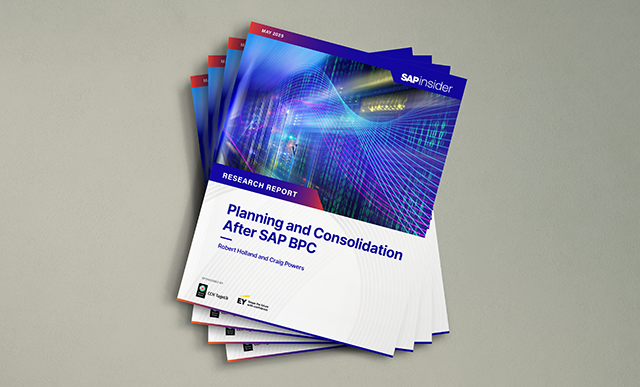
Planning and Consolidation After SAP BPCMay 9, 2025  —  Mainstream maintenance is ending for SAP Business Planning and Consolidation (BPC) in 2027 which is forcing customers of the product into a transitory period where they are compelled to search for new planning and consolidation tools and potentially adopt new processes associated with that replacement software. Replacing software is always going to have an impact, and SAP BPC customers will be looking for upgraded capabilities as they bring on a new financial planning and consolidation tool. Financial planning and consolidation solutions are the foundation of a modern enterprise performance management (EPM) framework, delivering critical capabilities that help organizations align financial operations with strategic goals. These tools enable more accurate forecasting, streamlined budgeting, and timely consolidation of financial data across business units, providing a single source of truth for performance tracking. SAP BPC, offering both planning and consolidation capabilities, has provided organizations the agility to respond to market shifts, ensure regulatory compliance, and drive accountability across the organization. With the upcoming end of maintenance, and with no direct replacement from SAP, organizations now need to determine how they will manage planning and consolidation moving forward. This research explores organizations preparedness for replacing their business planning and consolidation solutions, the factors most impacting the choice of a new planning and consolidation solution, and the concerns that organizations have about moving away from SAP BPC. The findings indicate that less than two thirds of respondents were aware of the upcoming end of mainstream maintenance resulting in many organizations not being prepared to transition to a new planning or consolidation solution. And with more than a third of respondents expecting a significant or major impact on day-to-day finance operations, it is clear that organizations need to do more to be prepared for the future. Download the benchmark report to read the full data analysis from 109 members of the SAPinsider community and receive recommendations for your own plans. - Understand the impact of the upcoming end of maintenance for SAP BPC. - Explore how SAPinsiders are approaching selecting a replacement planning and consolidation solution. - Learn about the factors impacting the choice of that replacement. - See what concerns SAPinsiders have about moving away from SAP BPC.
SAP BTP Data, Integration, and Application DevelopmentMar 31, 2025  —  Enterprise workloads continue to move to the cloud. As this progress continues, enterprise platforms are performing an increasingly important part of that process as they provide an integrated set of solutions and services that streamline the movement and protection of data across landscapes.With enterprise platforms offering additional capabilities such as application development, analytics and data intelligence, database and data management, and artificial intelligence (AI) and automation, choosing the right platform is now a critical component of a comprehensive data and integration strategy. Implementing enterprise platforms like SAP BTP enable organizations to digitize and automate routine tasks which frees up employees to focus on higher value activities. Workflow automation and intelligent process integration in these platforms helps ensure accurate, real-time data flow between modules — like from procurement to finance for example. This reduces the need for manual intervention, helps minimize errors, and eliminates duplication. This not only accelerates decision-making with up-to-date analytics and embedded insights but increases compliance through capabilities such as standardized processes and audit trails. Given the improved productivity and agility that these capabilities bring, it is no surprise that organizations are prioritizing investments in enterprise platforms to help achieve these goals. This year's research also explored the increased complexity of organizations today. Few are using predominately SAP solutions with most using a combination of SAP solutions at the core along with some best-of-breed solutions. But a growing number of organizations are taking an entirely agnostic approach to application selection. This makes addressing data and integration challenges more important than ever, something that enterprise platforms can make possible. To understand and explore the strategies for data, integration, application development and enterprise platforms, this SAPinsider report examines SAP BTP usage, the types of integration scenarios being supported by organizations, the makeup of the landscape, challenges that are being encountered, and the SAP BTP services that are being used. The findings indicate that integration is one of the most important challenges for organizations today, with eight in ten respondents reporting that that is the primary service they are using in SAP BTP. The mixture of systems from different providers with a combination of cloud and on-premise environments has made integration the primary focus for respondents, although application development and data and analytics services also see significant usage. In addition, while AI is not currently the primary use case in SAP BTP, two thirds (65%) of respondents report that it is important or very important to their organization that application development tools include AI capabilities. This demonstrates the value seen by respondents in the AI assistance that SAP is adding to tools like SAP Build. Download the benchmark report to read the full data analysis from 151 members of the SAPinsider community and receive recommendations for your own plans. - Understand how organizations are using SAP BTP. - Explore the factors influencing the adoption of enterprise platforms. - Learn about how other SAPinsiders are making plans for integration. - See what role application development will play in the future.
SAP S/4HANA
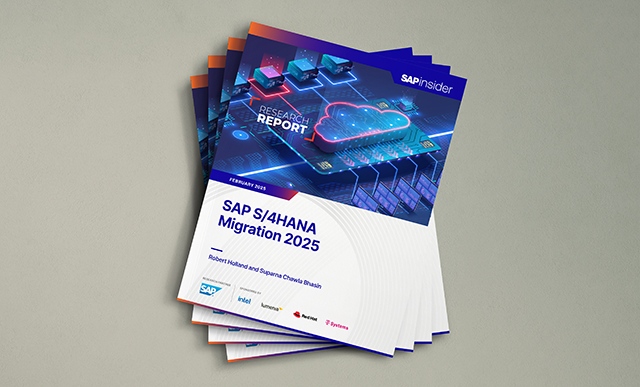
SAP S/4HANA Migration 2025Feb 28, 2025  —  With the 2027 SAP maintenance deadline approaching, SAP customers are under increasing pressure to move to SAP S/4HANA, especially within the context of RISE with SAP. However, recognizing the varying levels of preparedness in the SAP ERP customer base, SAP has introduced a phased maintenance approach beyond 2027. Starting in 2028, organizations can opt for extended maintenance—available until 2030 at a two percent premium—to ensure continued support while organizations complete the transition. Those who forgo this option or reach the end of their extended maintenance period will transition to customer-specific maintenance, which provides essential support but without full enhancements. This structured approach reinforces SAP’s commitment to facilitating SAP S/4HANA adoption while offering businesses the flexibility to transition at their own pace. However, a critical question remains: What is the true state of SAP S/4HANA migration across industries today? This year's research also explored whether organizations are planning on switching their existing SAP S/4HANA deployments to RISE with SAP as well as the overall impact of RISE with SAP on organizations that are moving to SAP S/4HANA. Deeper analysis of these topics is available in the executive summary for the report, and data from all the survey questions is available in the detailed findings. To understand and explore the SAP S/4HANA migration strategies, this SAPinsider report examines the adoption trends for SAP S/4HANA, the version of the solution that organizations are deploying, the challenges that they are encountering with the move, and the benefits that those that have already moved to SAP S/4HANA have received. The findings indicate a dynamic landscape where organizations are progressing at different paces based on their strategic priorities, business needs, and technical preparedness. Currently, 32% of respondents reported that their organization has already transitioned to SAP S/4HANA, a 10% jump compared to 2024 but more in line with data from 2022 (29%). Meanwhile, 27% of organizations are in the implementation stage, actively working to integrate SAP S/4HANA into their IT landscape, a number that has risen from 20% from last year. However, despite this momentum, 21% of organizations remain in the evaluation phase, a drop of 5% from 2024 and 9% from 2023, still assessing their business case for SAP S/4HANA migration, reflecting the complexities and challenges that come with such a transformational shift. Download the benchmark report to read the full data analysis from 170 members of the SAPinsider community and receive recommendations for your own plans. - Understand how organizations are moving to SAP S/4HANA. - Explore the factors influencing their ERP and SAP S/4HANA planning. - Learn about the impact of RISE with SAP on that move. - See where organizations are facing barriers to adopting SAP S/4HANA.
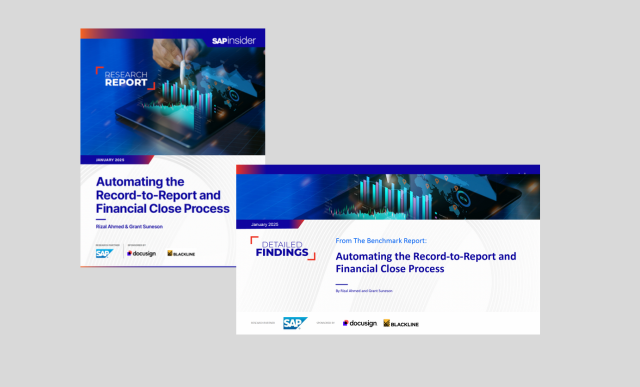
Automating the Record to Report and Financial Close ProcessJan 31, 2025  —  Read this report to learn how financial close and record-to-report processes are hindered by outdated manual methods, while highlighting the potential of AI and automation to enhance efficiency and reduce errors, as reflected in a survey of SAP finance professionals regarding current transformation strategies.
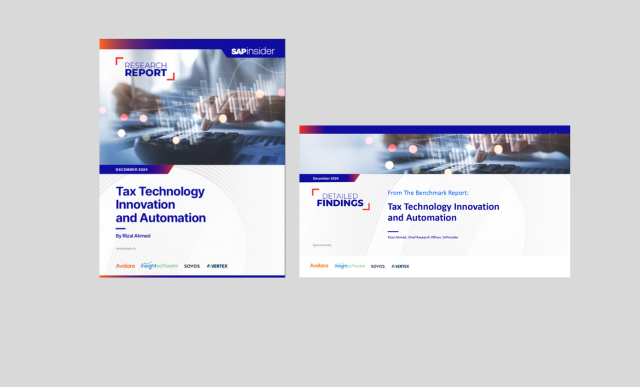
Tax Technology Innovation and Automation 2024 Benchmark ReportDec 30, 2024  —  As companies transition to SAP S/4HANA and undergo ERP transformations, they are not only redefining their technical infrastructures but also redesigning their business processes, necessitating the involvement of tax teams to improve compliance and operational efficiency in response to evolving regulatory and business demands.
RISE with SAP
RISE with SAP 2024Nov 30, 2024  —  SAP has continued to refine the messaging around RISE with SAP in 2024, positioning it as a platform for innovation, one that continues to play a key role in SAP’s cloud ERP transformation strategy for its customers. Additionally, SAP is now providing embedded AI scenarios that will allow organizations to accelerate processes and optimize their decision-making in RISE with SAP as SAP’s generative AI assistant Joule will be available in both SAP S/4HANA Cloud Public Edition and SAP S/4HANA Cloud Private Edition. SAP also seems to be looking towards a future where most customers are using public cloud for the cloud ERP deployments though this is still some way off. To understand and gather insights on RISE with SAP, how customers’ perspectives have evolved, and its role in the transformation strategies of the SAPinsider community, SAPinsider surveyed 125 members of its community between August and November 2024. Survey data reveals an unambiguous point: familiarity with RISE with SAP is growing. While the proportion of respondents “very familiar” with RISE with SAP was almost same in 2024 and 2023, a significant growth is seen in those reporting familiarity with the offering. This is supported by a corresponding decline in the number of respondents reporting they are “somewhat familiar” with RISE with SAP. There is also a difference in familiarity based on the size of a respondent's organization. For example, 86% of respondents from organizations with revenues over $2 billion report that they are at least familiar with RISE with SAP compared with just 54% of respondents from organizations with annual revenues below $2 billion. Last year, the single contract offered for RISE with SAP became the biggest benefit to respondent organizations which significantly increased this year. This growth in perceived value demonstrates that many organizations see the single contract with SAP as a major benefit when compared to negotiating for multiple contracts with multiple providers in more traditional ERP deployments. Notably, nearly twice as many respondents now view RISE with SAP as a platform for innovation—a significant potential benefit, and this aligns with SAP's marketing efforts over the past year. Additionally, while most potential benefits saw at least some growth no matter how small, it not true for cost which saw a slight decrease. In fact, when asking respondents about their biggest area of concern when it came to RISE with SAP, cost was at the top of that list. And the proportion of respondents indicating that was the case grew from 63% last year to 73% this year. Despite the significant benefits of RISE with SAP, concerns about the long-term costs associated with transitioning to RISE with SAP persist. Given the changes in packaging and contracts since the offering was announced, this concern is justified. This year's research also explored how familiar respondents were with the different components in RISE with SAP and the factors that they plan on using when choosing a cloud service provider for their RISE with SAP deployment. Deeper analysis of these topics is available in the executive summary for the report, and data from all the survey questions is available in the detailed findings. Download the benchmark report to read the full data analysis from 125 members of the SAPinsider community and receive recommendations for your own plans.
The CIO’s 2024 Transformation Report CardNov 27, 2024  —  CIOs have two main priorities: automation and standardization of business processes remain in the top spot. The second most popular response was unsurprisingly the move to SAP S/4HANA. The impending deadline is only getting closer as companies continue to assemble their business case and cobble together the resources and knowledge to get them there before 2027. This is according to SAPinsider’s CIO 2024 Transformation Report Card. In the fourth year of our study, SAPinsider surveyed 105 executives and decision makers from September to November 2024 to better understand their major transformation projects and what makes or breaks success for them. The results were compared with the previous year’s research on the same agenda. Respondents were asked to rate the progress or outcomes of their transformation projects on a scale of 1-10 (1 signifying not meeting expectations, and 10 representing exceeding expectations). The rating this year dropped to 6.61, compared to a mark of 6.91 from the previous year’s survey. Download the benchmark report to read the full data analysis and receive recommendations for your own transformation journeys.
cloud deployment
Enterprise Cloud Deployment 2024Sep 6, 2024  —  SAP customers are increasingly investing in cloud environments, particularly through hyperscalers, driven by factors such as security, cost, flexibility, and scalability, with RISE with SAP emerging as a top choice despite the persistence of older local systems. Download the benchmark report to read the full data analysis from 133 members of the SAPinsider community and receive recommendations for your own plans. Learn which why organizations are moving SAP workloads to the cloud. Explore the factors influencing cloud deployment decisions. Understand the criteria being used by respondents to measure the success of their cloud initiatives. See the infrastructure being used for SAP workloads and how learn how that is changing.
Process Productivity and Efficiency Through Process Automation and Intelligence 2024Aug 30, 2024  —  Recent research indicates a significant shift in the perception of process automation from a cost-reduction tool to a crucial strategic element for enhancing operational efficiency and employee productivity, with its importance rising from 40% to 54% among organizations in just one year.
AI — State of Adoption 2024Jul 31, 2024  —  AI is increasingly becoming a transformative force across various sectors, driving innovation, enhancing decision-making, and automating tasks. As AI adoption grows, its impact on business efficiency and competitiveness is expected to increase, marking a significant shift in technology. SAP is embedding AI into its cloud solutions to drive customer transition to the cloud and foster business growth, with plans to make 80% of SAP business transactions manageable through Joule, its AI copilot, by the end of 2024. Additionally, SAP is offering a range of AI capabilities, categorized as Base AI and Premium AI, to cater to diverse business needs. To provide insights and understanding related to SAP customers’ AI adoption practices and identify the key factors driving their organization’s AI strategies, SAPinsider surveyed 164 members of its community between April and July 2024, on strategies, challenges and priorities around AI adoption.​ The primary objective of the survey was to gather insights from professionals who play a pivotal role in taking decisions pertaining to the adoption and use of AI in their organizations, including understanding the technology prerequisites for AI and exploring the decision-making process behind choosing whether to build, buy, or combine both approaches for AI solutions.

Related Vendors