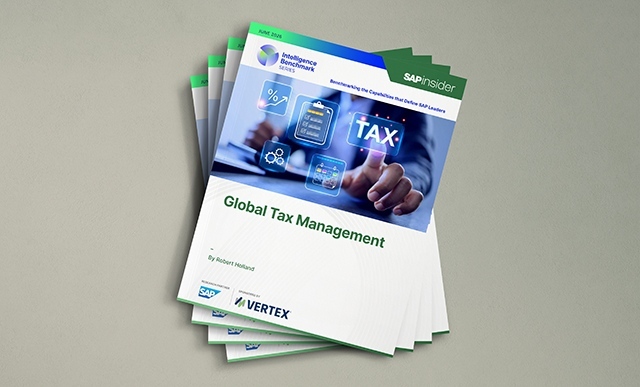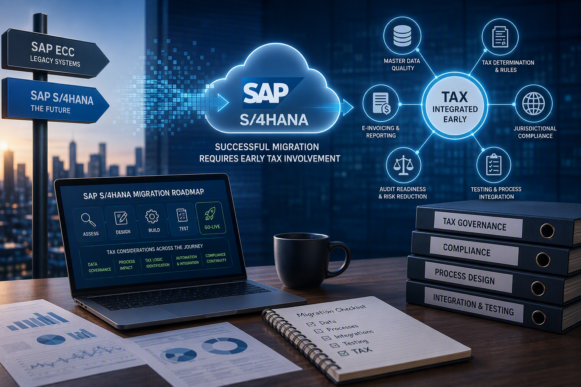
Tax laws and regulations are changing rapidly. Managing tax calculations, reporting, and overall compliance have become significant challenges for many organizations. Both business and IT professionals must work closely together to ensure their tax strategy incorporates a solid integration with the core business system landscape, including ERP. Technology has shifted dramatically over the last year and the need to adapt and remain agile will be critical to your organization.
More Resources
See All Related ContentDIY or Done-for-You? Rethinking Tax Compliance Strategy in SAPHow Tax Compliance Is Changing in SAP

Tax compliance in SAP is no longer just an IT decision. It’s a strategic risk decision.
As governments shift to real-time, transaction-level enforcement, SAP customers are being forced to rethink how tax compliance fits into their S/4HANA, Clean Core, and data governance strategies.
Many organizations are evaluating ERP-native approaches, while others are expanding their capabilities to account for authority-led, end-to-end compliance models designed to keep pace with continuous mandates. Each path comes with tradeoffs in cost, risk, scalability, and long-term agility.
In this session, Sovos tax and SAP experts explore how SAP customers should think about this decision, not from a product perspective, but from an enterprise architecture, risk, and operating model standpoint.
You’ll learn:
- Why tax compliance is shifting from an internal ERP function to an externally enforced, authority-led model
- What SAP customers should consider when using ERP-native tools for digital reporting and mandates, and what capabilities to enhance and complement those tools
- The hidden complexity behind e-invoicing, SAF-T, and continuous transaction controls
- How Clean Core principles intersect with tax data, controls, and audit exposure
- Key questions IT, Finance, and Tax leaders should be asking before choosing a compliance path
- How today’s compliance decisions can impact transformation risk for years to come
This session is designed for IT and ERP leaders, Finance and Tax executives, SAP CoE and Clean Core program owners, and enterprise architects responsible for compliance strategy, and is especially relevant for organizations preparing for the 2026–2027 regulatory expansion or actively navigating an S/4HANA
1 minute read
Brazil’s Tax Reform: Building a Resilient SAP-Centered Tax Compliance ArchitectureBrazil's tax reform is already underway—and it is not only redefining compliance, it is reshaping how companies operate at scale. As new mandates, electronic document types, and dual-system tax models take effect, organizations are rethinking the role of technology in managing tax determination, transaction reporting, and operational resilience.
In this on-demand session, Sovos experts Antonio Garcia and Helton Arsenio, hosted by SAPinsider's Sean Byers, examined how leading companies operating in Brazil are adapting their architectures to thrive in this new environment. Through three real-world customer cases, they explored how global enterprises are modernizing tax processes, externalizing tax logic from SAP, and building scalable platforms to absorb constant regulatory change.
The session detailed how organizations handling millions of transactions per month are preparing their SAP landscapes to support Brazil's new CBS and IBS tax framework—without compromising operational performance. Cases covered included a major Brazilian retailer operating across all 27 states requiring centralized, SAP-certified tax determination; a major airline managing millions of electronic tickets (BPE) with complex cancellation and rebooking workflows; and a global telecom company processing hundreds of documents per second across legacy systems inherited through acquisitions. Each case revealed how companies are turning regulatory pressure into an opportunity to modernize core systems and eliminate reliance on manual, spreadsheet-based processes.
Viewers will come away with:
- An understanding of Brazil's dual-system transition period (running through 2033), during which companies must manage legacy and new tax regimes simultaneously
- Why 2026 is the critical year for alignment and testing—and why 2027 marks the beginning of real government validation and enforcement
- How new electronic document formats (NFCom for telecom, BPE for airlines) and dramatically expanded XML invoice data requirements demand tighter master data governance
- How the government's move to transaction-by-transaction, item-by-item real-time control—including "assisted calculation"—makes dispute readiness essential
- Strategies for connecting SAP to certified tax engines without over-customizing existing systems
- How Sovos Intelligence applies AI and business intelligence tools to enable natural language querying of tax data and proactive planning
The organizations that will navigate Brazil's reform successfully are those treating tax technology not as a compliance cost, but as a foundation for scale, resilience, and competitive advantage. With 2026 already here and 2027 enforcement approaching, the window to build that foundation is narrow.
2 minute read
A Clean-Core Approach to Indirect Tax Compliance for SAP EnterprisesAvalara is positioning AvaTax on SAP BTP as a clean-core tax layer for SAP S/4HANA Public Cloud customers facing real-time reporting, e-invoicing, and jurisdictional complexity. The approach moves tax determination outside the ERP core, centralizes validation, and reduces the IT burden tied to compliance upgrades, outages, and market expansion.
3 minute read